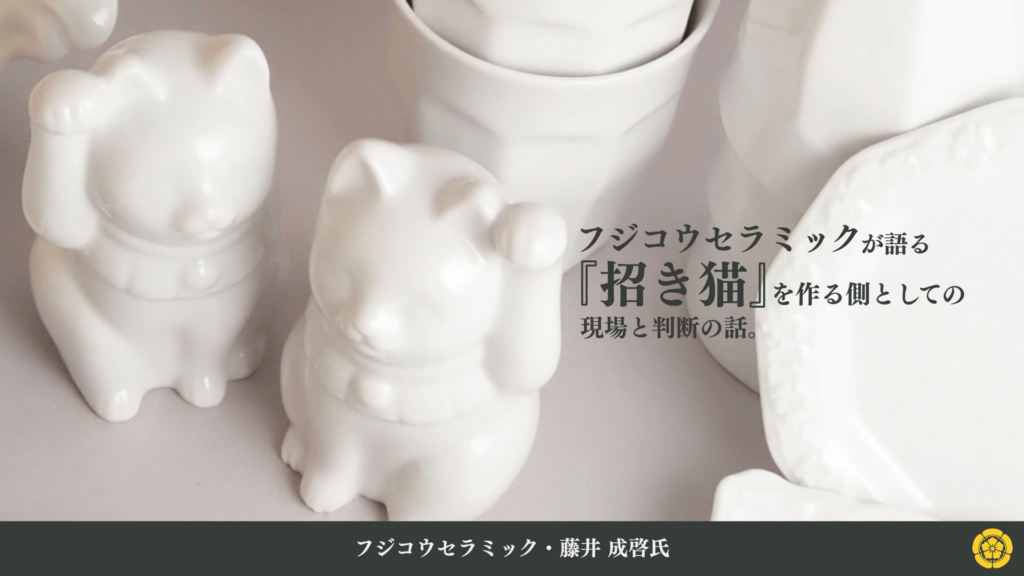
What are the people who “make” maneki neko thinking about today?
This interview was conducted in Japanese and translated by Maneki Neko Lab. Read the original Japanese interview.
A maneki neko (招き猫, beckoning cat) is not just an ornament raising its paw at a shop entrance.
Before it takes “shape,” there is clay and fire, human hands, deadlines and quality, and the judgment of the kiln.
Fujikou Ceramics, which has made pottery and porcelain in Seto (a historic ceramics town in Aichi Prefecture) for many years, is one such kiln that keeps making maneki neko in the middle of that everyday work.
A strict inspection system built up through making gaishi (碍子, ceramic electrical insulators). Careful scheduling to meet deadlines. Meetings with the craftspeople on the floor to work out “how we can make this work.”
None of this is talked about with fanfare, and that is exactly why it remains, quietly, as “trust built up over time.”
How much does that trust support the work on the floor?
The more we listened to Mr. Fujii (藤井成啓), who is in charge of on-site decisions and firing control at Fujikou Ceramics, the clearer the picture became.
This article is based on a firsthand interview with Mr. Fujii, who actually runs the kilns in Seto and makes the calls on firing and inspection.
Rather than judgments like “cute” or “selling well,”
it records how Fujikou Ceramics makes things and how it has kept going, through his own words and his sense of the work on the floor.
About Fujikou Ceramics as a Kiln
The first thing that came into view as we listened to Mr. Fujii was that Fujikou Ceramics holds a position that cannot be summed up in the phrase “a maneki neko kiln.”
It makes maneki neko. That is a fact.
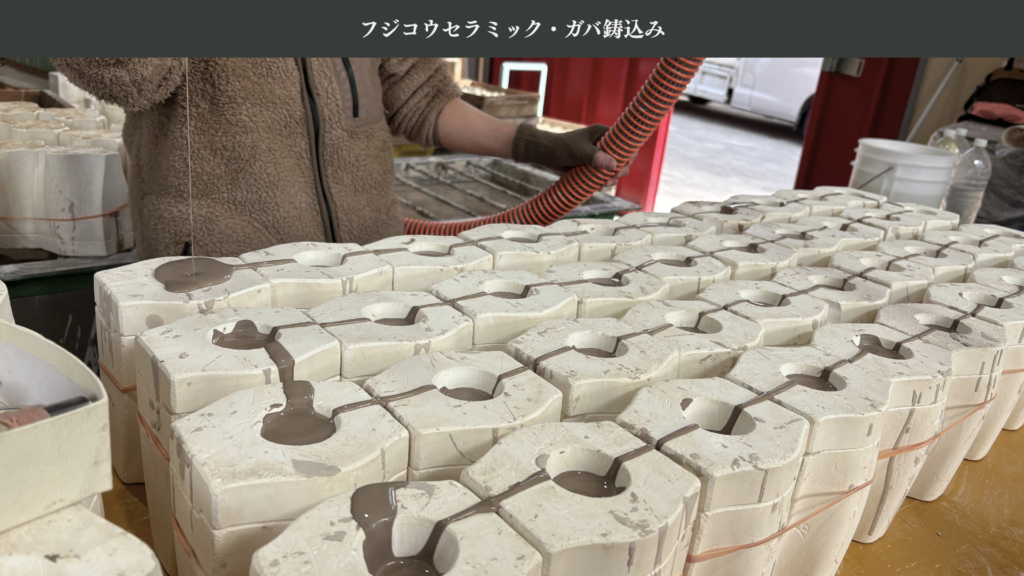
At the same time, it is a workshop that has taken on a wide range of production, including press molding, pressure casting, gaba-ikomi (ガバ鋳込み, a drain-casting method for hollow pieces), decal decoration, spray finishing and gold application, all centered on “reliably making” whatever job it is asked to do.
And what laid that foundation was the history of Seto as a production center, and the realities of manufacturing that have built up there.
How Fujikou Ceramics Began
Fujikou Ceramics has its roots in Hagitono-cho, Seto City.
In his grandfather’s generation, the founder worked at a manufacturing company before going independent, starting out as a kijiya (生地屋), a maker of unfired ware with no kiln of its own.
In his father’s generation a kiln was brought in, and the range of production gradually widened.
It was not a finished “kiln” from the start.
It was a very Seto way of growing: building up equipment and skills while passing work along within the production area.
What led to the move to the current site was a fire that broke out when Mr. Fujii was about 20 years old.
The home and factory burned down completely, but the kiln looked usable, so they moved it to a new location and made a fresh start as Hagitono Kiln.
You cannot fire a kiln just anywhere.
There are land conditions and local regulations, and the places where you can set one up are limited.
In the old days it was fine (it’s a local industry, so people didn’t worry about location as much as they do now), but now it’s tough. When I actually asked the gas company, “Are there more new kiln operators?” they told me, “If anything, there are fewer.”
Mr. Fujii
Just as he says, finding a place to fire was not easy.
Then, by chance, there was an offer to take over a site that a ceramic artist had been using, and that led to the current factory.
Mr. Fujii describes himself as “set to become the third generation,” though the company president jokes with him that things that shrink when fired don’t make money, so he should come up with something that puffs up when baked.
In Seto, kiln makers founded 200 years ago are not unusual.
Fujikou Ceramics, too, is a kiln that firmly exists within those layers of time.
The Relationship With Seto
On the strength of Seto as a production center, Mr. Fujii spoke less with “an insider’s pride” and more in terms of what he had heard from others.
I asked people around me, “What was so great about Seto, anyway?”
Mr. Fujii
What came back were stories from the days when trade was booming.
Back when Japanese ceramics were exported overseas in large volumes, Seto ware held the No. 1 share in modern trade from the Meiji era (1868–1912) onward, depending on the period, which is said to be why the word setomono (瀬戸物, “Seto things,” now a general Japanese word for ceramics) came into use rather than Seto-yaki (瀬戸焼, “Seto ware”).
Fired in Seto, given overglaze decoration on the Nagoya side, and shipped from the port.
The division of labor and flow of a production center were already in place.
Next door, meanwhile, is another large production center, Mino ware (Tajimi).
When there is more work, they cover for each other, and sometimes they compete.
Seto and Mino have been closely tied at the level of the workshop floor.
Another trait of the Seto and Mino areas he mentioned is how quickly they react to trends.
This happens in every industry: when something becomes a hit, everyone makes it at once, the market ends up saturated, and it turns into a price war.
Amid all this, some makers have grown steadily by planting their feet in areas such as tableware for restaurants, and companies that started as insulator makers and researched synthetic materials (fine ceramics) have grown large.
Seto is a place where paths split not only on whether you “can make it,” but on “where you plant your feet.”
This structure is similar to farming.
Fujikou Ceramics is a kiln that has built up trust by bringing in the sensibilities it developed through insulator manufacturing,
and by keeping to deadlines, quality and inspection “as a matter of course.”
What Is a “Maneki Neko” in the Eyes of Fujikou Ceramics?
For Fujikou Ceramics, the maneki neko is
not “a motif it chose because it wanted to make it from the start.”
Requests came in through the course of business, the molds were there, there were reasons to make them, and through various OEM jobs and the like, it is a product that lets the company try many things and grow.
As a result, it still makes maneki neko today.
That sense of distance is very down to earth, and at the same time sincere.
How He Sees the Maneki Neko as an Engimono (Good-Luck Charm)
“What is a maneki neko, really?”
Mr. Fujii did not answer the question right away.
Not because there is no answer.
As a maker, it was a choice not to load it with too much meaning.
Is it a product, or is it culture?
Is it something you buy for yourself, or something you give?
What came up several times in our conversation was the sense of it as “a gift.”
A story about giving one as a housewarming present.
A story about giving one to a classmate who got married, and his cat-loving wife being delighted.
A story about a maneki neko given to a part-time worker, after which she landed a job.
A story about someone who received one as a new-home gift, broke it, and wanted another one.
None of these are big stories.
But the feeling of “that was nice” clearly remains.
A maneki neko is not a tool that changes your life.
It is something quietly handed over at milestones and turning points.
For Fujikou Ceramics, the maneki neko is
something not to over-define, yet not to treat lightly.
What Sets Fujikou Ceramics’ Maneki Neko Apart
Fujikou Ceramics’ maneki neko was not designed from scratch.
It began with a request from a lifestyle goods brand, based on an existing mold.
Without trying to be quirky, it respects the basic form that people have loved for so long.
It is a shape that holds up to the traditional readings, such as the meaning of the right paw and left paw and the position of the ears.
The way it is made, however, has clear characteristics.
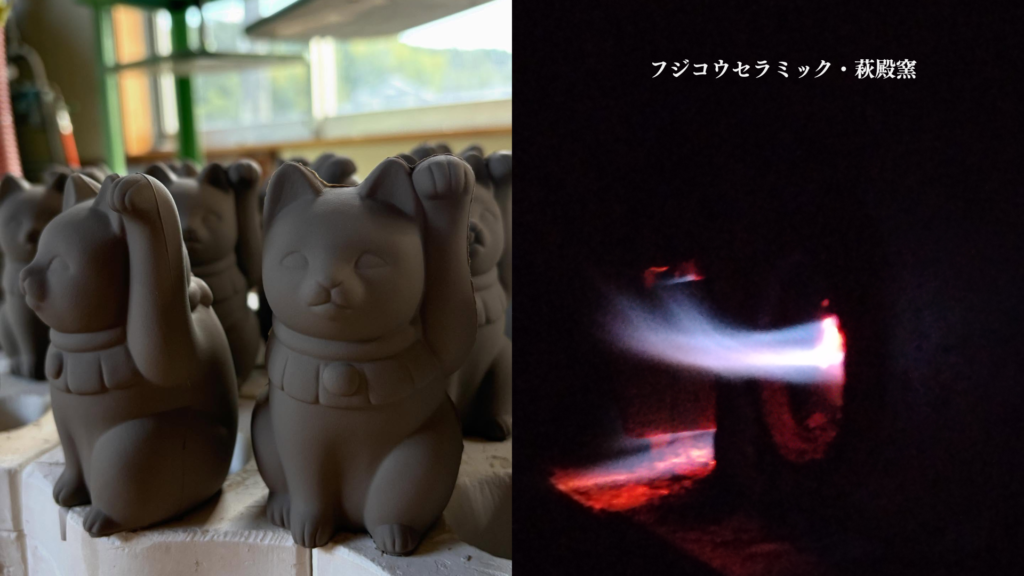
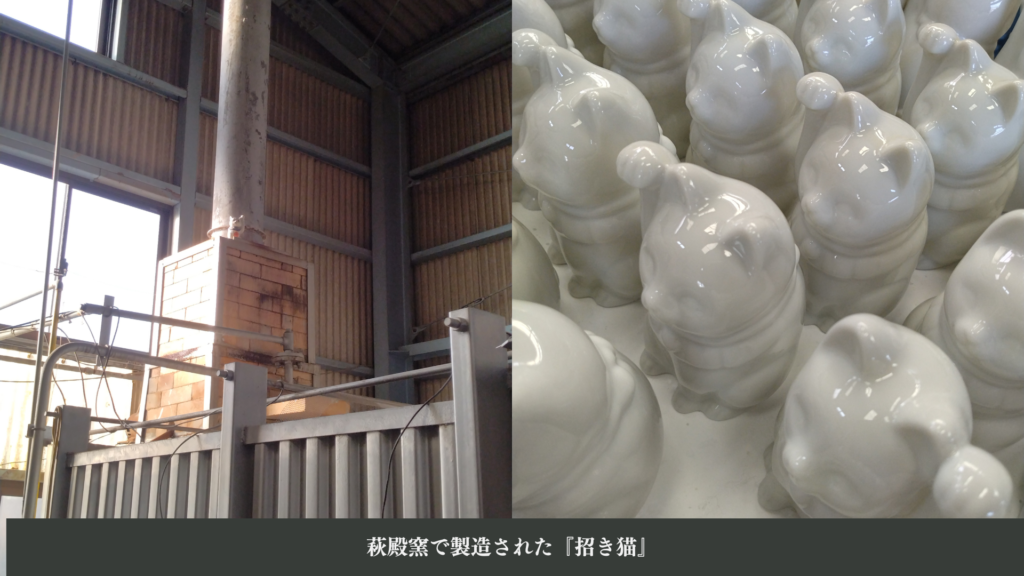
Firing is not fully automated. It is adjusted while a person watches the fire.
On top of that, the pieces are fired for 17 to 18 hours at a slightly higher temperature than elsewhere.
It costs more in gas, and some people call it wasteful.
Even so, the priority is that “firing at a higher temperature gives a clean, white finish.”
As a result, even from the same mold, each piece comes out with subtle individual differences.
They do not see this as unevenness.
They take it as proof that it passed through human hands.
It doesn’t try too hard to stand out.
But you can give it to someone with confidence.
That quiet accumulation is the essence of Fujikou Ceramics’ maneki neko.
What It Means to Keep Making Maneki Neko
Listening to Mr. Fujii, it comes across again and again
that the words “keep making”
can never rest on romance alone.
Behind them are
daily decisions, the atmosphere on the floor, human hands, failures, do-overs,
and the choice to “keep going anyway.”
What Mr. Fujii Upholds on the Floor
- Keep the workplace cheerful
- Use inspection standards on par with insulators, and let no cracks, chips or warping through
- Treat remaking an entire lot as a normal decision
- Use about 1,350°C as the benchmark and adjust how the temperature rises by eye
What Matters Most on the Production Floor
Above all, I keep the workplace cheerful.
Mr. Fujii
We expected to hear about quality or technique,
but surprisingly, that was the first thing he said.
Still, those words matched the atmosphere we felt as soon as we stepped into the workshop.
At the same time, he is extremely strict about quality.
・Inspection standards on par with insulators
・No cracks, chips or warping get through, ever
・Sometimes an entire lot is remade
In fact, he told us, “Everything we made last week failed as a lot, so we had to remake all of it.”
Because the work is done by hand, failures inevitably happen.
The question is whether you can, instead of brushing it off with “it can’t be helped,”
make the decision to redo everything as a matter of course.
That is where Fujikou Ceramics’ strength as a workshop lies.
Firing is the same.
In reduction firing, about 1,350°C is the benchmark, and adjustments are made while watching the state of the kiln.
How the temperature rises is adjusted by the human eye.
Above 1,400°C, the clay body cannot withstand the heat,
and it goes into “meltdown,” losing its shape.
But he says the temperature range just short of that is where pieces fire the most beautifully white.
The decision to push right up to that edge
rests not on a manual, but on Mr. Fujii’s experience and feel.
Torn Between Making in Volume and Protecting Quality
Fujikou Ceramics receives quite a few inquiries about OEM and mass production.
From the outside, it might look like “if you can make it, you should just take on everything.”
But rather than drawing a simple line between “turning down” and “taking on” work, Fujikou Ceramics puts weight on “in what form we can make things together.”
For example:
・The direction of the project is not yet settled
・Every process and decision is left entirely to the kiln
・Several middlemen are involved, and the originator’s intent does not come across well
・Imitations of products that are selling well for other companies
In cases like these, adjustments end up taking time,
and who is responsible for the final quality often becomes unclear.
The hardest thing is when, from the very beginning, everything is just left entirely to us.
Mr. Fujii
His words suggest not that he is being picky about work,
but that he wants to move forward through proper dialogue.
He also says that jobs he once turned down because the terms did not fit
sometimes come back later as new project inquiries.
At that point, they may take another look at investing in a mold or making a prototype.
What Fujikou Ceramics values
is not whether it can make something,
but whether it can make it by thinking together and fine-tuning along the way.
That principle runs through the work as a perfectly natural stance,
one that protects the quality of craftsmanship even on a mass-production floor.
The “Changes” Fujikou Ceramics Has Seen
Having stood on the floor for so long, Fujikou Ceramics
does not talk about “change” in grand terms.
It caught on, it faded, it sold, it stopped selling.
Before verdicts like these, what gets talked about
is what actually happened on the floor
and what decisions were made in response.
For example, tableware makers and industrial parts makers giving rise to offshoots, letting go of something and taking on something else.
He says he often hears things like “that maker has started doing such-and-such,” including talk of mergers and acquisitions.
Change is described not as a special event,
but as something that lay along the line of everyday production.
There is no exaggeration in it, and no excessive pessimism.
Shifting Demand at Home and Abroad
The most obvious change in recent years
has been the recovery of inbound tourism.
“We’re out, so we need them right away.”
“When will they come in?”
“How many can you do?”
“Customers won’t wait.”
As overseas tourists return,
inquiries from gift shops and souvenir stores have clearly increased.
At the same time, another strong trend is the rise of
transactions premised on not holding inventory.
Keep the sales floor light,
and buy only what you need, when you need it.
That is a trend shared across lifestyle goods as a whole.
But ceramics
is not work that can be “done by tomorrow.”
Shaping, drying, firing, cooling, inspecting.
Firing alone takes at least 4 to 5 days.
Skipping a step translates directly into quality.
That is why Fujikou Ceramics
does not break the following rules.
・Always keep to the order of orders
・No walk-in orders jumping the line
Even when demand rises,
they do not change how they make things or how they schedule the work.
This is not stubbornness.
It is a precondition for ceramics as a line of work to function at all.
In recent years, there have also been more inquiries
not only about “how to sell this maneki neko,”
but about “how to display it.”
Department store show windows,
displays in places where many overseas tourists gather.
The maneki neko,
while still something to sell,
is starting to be treated as a presence placed within a space.
That change, too,
is taken calmly as just one more part of how things flow on the floor.
How the Maneki Neko Is Seen Today
Another major change he pointed to
is social media.
One search,
and maneki neko from all over Japan appear instantly.
Materials, techniques and styles are all diverse,
and we now live in a time when information is extremely open.
Being able to see all kinds of maneki neko is fun to look at.
Mr. Fujii
He said it as a frank, honest feeling.
On the other hand, there are
difficulties that come precisely because information is so open.
Styles are easy to see,
and you can be influenced without realizing it.
Even when you think you came up with something on your own,
it can end up giving a similar impression.
Precisely because you can see so much, drawing the line isn’t easy.
Mr. Fujii
Faced with this situation,
Fujikou Ceramics neither criticizes anyone
nor strongly asserts its own position.
I think everyone is doing it according to their own sense of things.
Mr. Fujii
There is a stance of keeping some distance
and looking at the situation calmly.
In recent years, there have also been more maneki neko made from
materials other than ceramics, such as stone and glass.
On these, too, he offers no verdicts or criticism.
There are all kinds of materials, and they are fun to look at.
Nothing more, nothing less.
What Fujikou Ceramics values
is not materials or trends,
but the attitude with which you approach your work.
Rather than changing shape to follow trends,
keeping the core of its own work intact.
The “change” Fujikou Ceramics has seen
is not a series of outside events,
but a continuous chain of decisions made in order not to change.
What He Hopes to Leave Behind
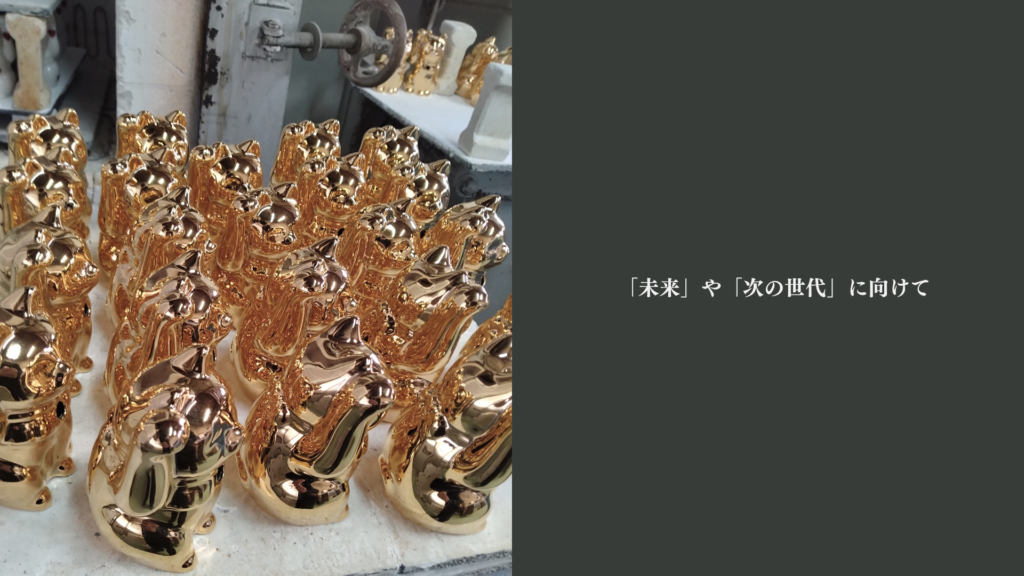
Toward the end of the interview,
when we brought up words like “the future” and “the next generation,”
Mr. Fujii began to speak a little more slowly.
He did not lay out a clear vision
or big goals.
Instead,
his real feelings as a maker showed through here and there in his words.
What Can Change and What Must Not in Making Maneki Neko
With ceramics, you know, once you buy it, it doesn’t fade.
Mr. Fujii
Even as time passes,
its shape and texture hardly change.
We can still see ancient pottery today.
Even after its maker has left this world,
it may go on quietly remaining somewhere.
That length of time
holds an important meaning for Mr. Fujii.
At the same time,
the times are certainly changing.
New manufacturing technologies such as AI, 3D printers, new materials and robots.
The options keep growing.
That is exactly why
protecting alone is not enough.
Not keeping something because it is old,
but asking what to add in order to keep it.
What today’s technology can do.
What only human hands can do.
What can be left to machines.
While sorting these out,
he layers “something extra” onto the parts worth protecting.
What must not change
is not the processes themselves,
but the attitude toward craftsmanship.
To the Next Generation and the Maneki Neko of the Future
A maneki neko is a maneki neko.
The meanings of the right paw and left paw,
and the places where they are put,
probably won’t change much.
But
the ways a maneki neko can exist should be much freer.
It’s fine to collect them.
It’s fine to display them.
It’s fine to be drawn to the form more than the meaning.
It’s fine to customize one to your own taste.
Even if you don’t like cats,
it can simply be something that makes you think,
“This maneki neko feels good to look at.”
He hopes the maneki neko will be
neither an object of worship
nor a tool of trade,
but something that naturally finds its place in everyday life.
It makes me happy when something I made stays in the world for a long, long time.
Mr. Fujii
Those words reveal a stance
that values continuing
more than growing bigger.
What Fujikou Ceramics is aiming for
is not a flashy future.
A future that remains, quietly and surely.
That is very much like the maneki neko itself.
You can learn more about Fujikou Ceramics, featured in this article,
including its manufacturing work, on its official website (in Japanese).
If you would like to know more about the background of its craftsmanship and the work it is doing now,
take a look at the official page here.