
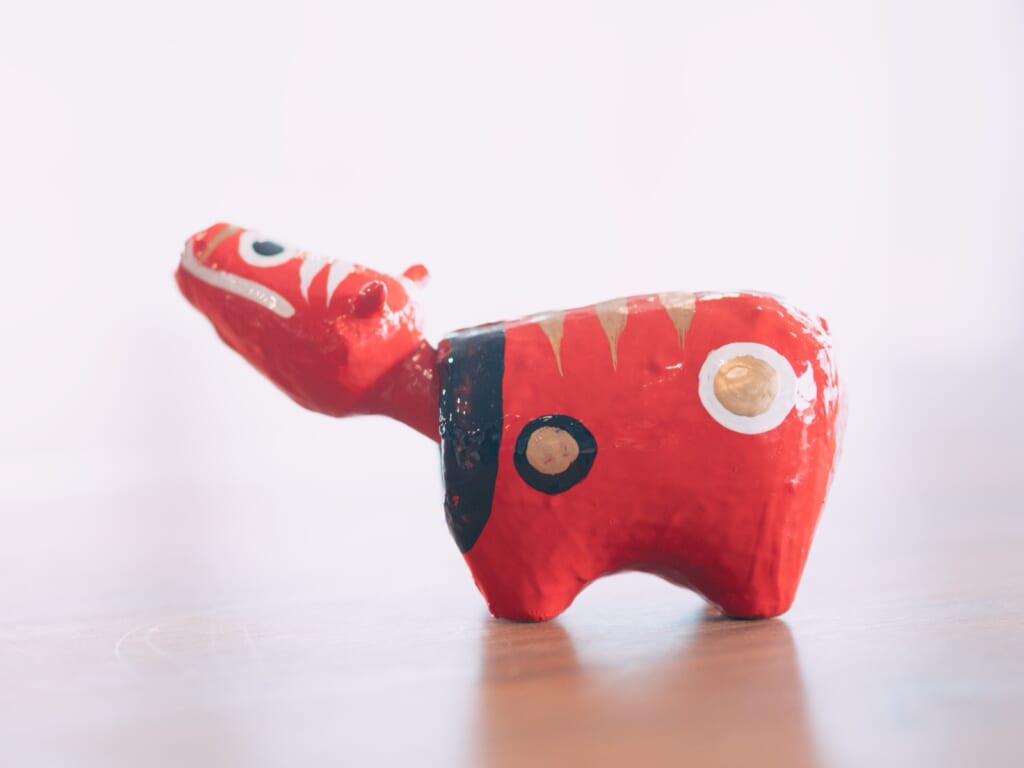
A red body and a head that gently bobs up and down. The akabeko (赤べこ, “red cow”), a folk toy from the Aizu region of Fukushima Prefecture, was designated a Traditional Craft of Fukushima Prefecture in 1997 (Heisei 9), and it is still loved today as a good-luck charm and a souvenir of Aizu.
This interview was conducted in Japanese and translated by Maneki Neko Lab. Read the original Japanese interview.
There is one story that is almost always told as its origin. When the Kokuzo-do hall (虚空藏堂) was being built at Enzoji Temple (圓藏寺) in the town of Yanaizu in Aizu, a red cow helped carry the timber. Tourist brochures and books introducing folk toys tell this story almost without exception.
However, this origin story was only linked to the akabeko around 1960, in the mid-Showa 30s.
The maneki neko, too, has several origin legends, such as the cat of Gotokuji Temple and the old woman of Imado. When, and from where, did people start telling the origin stories of good-luck charms? A way of looking that lets us check this should also be useful for understanding the maneki neko.
This time we spoke with Koji Meguro, a member of the Fukushima Historical Society (福島県史学会) who researches the local history of Niigata Prefecture and the Aizu region. In his paper “The Origin of the Folk Toy ‘Akabeko’ and the Nadeushi of Yanaizu” (Fukushima Shigaku Kenkyu, No. 103, 2025), Mr. Meguro traced the origin of the akabeko through historical sources.
What Mr. Meguro brought to light is the history of the akabeko and of another cow that existed in Yanaizu, the nadeushi (撫牛, “stroking cow”). In this article, we follow that history through his words in the interview, supplemented by the sources presented in his paper.
Chapter 1: Mountain Castles, Dams, the Tadami Line, and the Akabeko: Local History That Reexamines “Local Resources”
An “Ordinary Person” Outside the University
Mr. Meguro describes himself as “just an ordinary person.”
I myself don’t belong to any particular organization. I’m just an ordinary person. I’m not a researcher affiliated with a university, like the people who appear in Maneki Neko Lab’s interviews, so I’m not sure whether what I do can be called research.
Mr. Meguro
Even so, his work is wide-ranging: the remains of medieval mountain castles, dams and power plants, the Tadami Line, the Boshin War (the 1868–69 civil war), school songs. Focusing on Niigata Prefecture and the Aizu region, he has contributed many articles to specialist journals on castle studies and to local history journals, and he has also taken part in a community opera project.
It Started With a Ryokan in Yanaizu and the Tadami Line
What connects Mr. Meguro to Aizu is Hana Hotel Takinoya, a ryokan (traditional Japanese inn) in the town of Yanaizu. Mr. Meguro has been involved with this inn for more than ten years, and he says he has spoken many times at the “Hana Hotel Lectures” the inn holds.
The other is the JR Tadami Line. The Tadami Line was badly damaged by the heavy rains in Niigata and Fukushima in 2011, and for a time even its survival was in doubt.
For depopulating areas like the one we live in, a local railway line is a very important local resource. Mr. Shioda, the owner of Hana Hotel Takinoya, who has been very good to me, other people, and I myself all felt that we didn’t want it abolished because of a major disaster. We wanted to somehow keep it running. So I have also been involved in efforts to support the Tadami Line, such as holding pro wrestling events inside Tadami Line trains and making a Tadami Line brochure called “A Book for Enjoying the Tadami Line Ten Times More.”
Mr. Meguro
He took part in Tadami Line events and has also reexamined the many dams along the Tadami River as local resources. He says none of this is his job. Most of it is volunteer work.
The Akabeko Is Also a “Local Resource”
His turn to the akabeko is an extension of this. He did not come to it out of an interest in folk toys or good-luck charms.
I think it’s important to take the various things in a region as local resources and reexamine them in a different way from before. Railways, dams, I felt they all needed to be reexamined from the standpoint of local resources, and I was working on that. With the akabeko too, it wasn’t out of an interest in it as a folk toy or as a good-luck charm. I reexamined it as part of an effort to reexamine the things in the region.
Mr. Meguro
In the area where Mr. Meguro lives, the population is shrinking by 500 or 600 people every year. After noting that he would rather not use the phrase “regional revitalization,” Mr. Meguro says this.
How to keep the region going is a big problem. People often hold events and so on under the banner of “regional revitalization.” But before that, I think reexamining local resources is extremely important: reexamining the things in each region, what exactly they are, why they are in this region, and what meaning they have. Without a solid foundation based on evidence, rather than vague traditions, I think whatever you do, whether it’s an event or something else like product development, will end up lacking substance.
Mr. Meguro
Chapter 2: “Yanaizu” Appears in the Akabeko’s Origin Only From 1960
“The Cow That Built the Kokuzo-do,” Found in Every Book
Today, the town of Yanaizu in Kawanuma District, Fukushima Prefecture, is regarded as the birthplace of the akabeko.
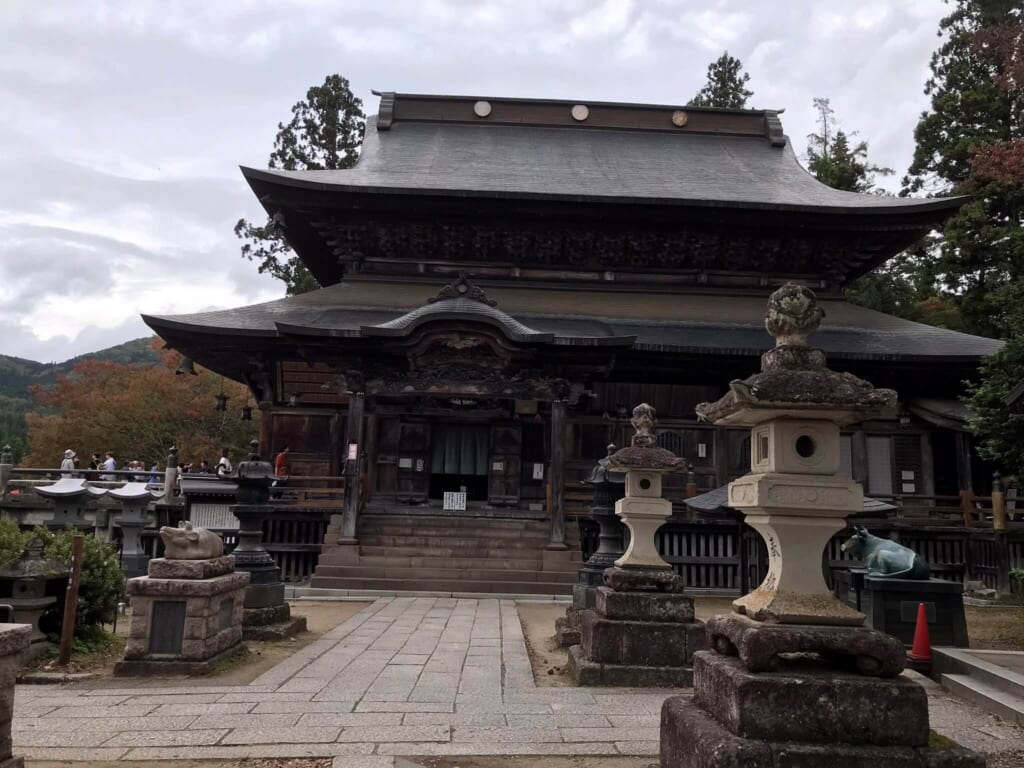
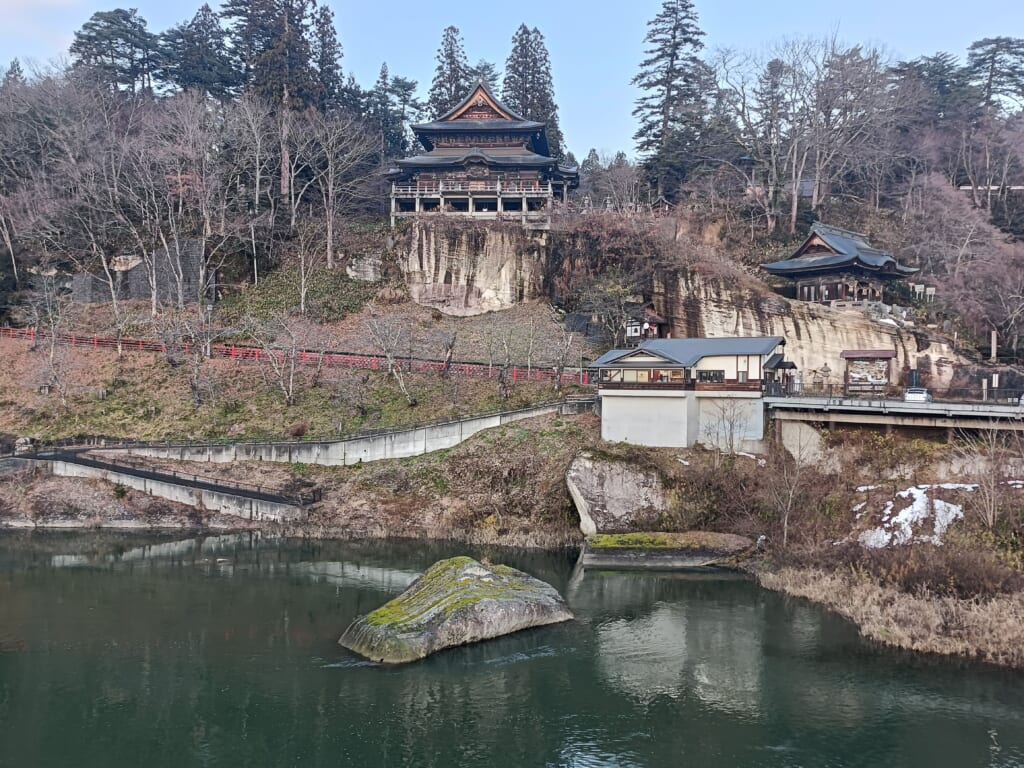
Yanaizu is home to Enzoji Temple, counted as one of the Three Great Kokuzo temples of Japan. Its Kokuzo-do hall (also called Kikko-do, 菊光堂) stands on a cliff overlooking the Tadami River.
The commonly known origin of the akabeko goes like this. When the Kokuzo-do was being built, the workers were struggling to carry the timber, and a herd of red cows appeared from somewhere and helped them. The akabeko is modeled on those red cows.
However, as far as Mr. Meguro could find, the oldest book that presents this story as the akabeko’s origin dates from 1960 (Showa 35). According to his paper, it is Kyodo no Gangu (Local Toys), compiled by the Fukushima Prefecture Products Hall.
Today, almost all tourist brochures and the various books that introduce folk toys say that the origin of the akabeko is the legend of the building of the Kokuzo-do at Enzoji Temple in Yanaizu. But I think that legend came to be regarded as the akabeko’s origin only from around 1960.
Mr. Meguro
In the 1954 (Showa 29) edition of the same Fukushima Prefecture Products Hall’s Kyodo no Gangu, just six years earlier, the akabeko was introduced as a decoration for Tanabata (the Star Festival). In only six years, the explanation of the akabeko’s origin had been swapped. We look at this Tanabata story in detail in Chapter 3.
In the Meiji Era, the Akabeko Was Called “Akaushi”
Then how long has the akabeko itself existed?
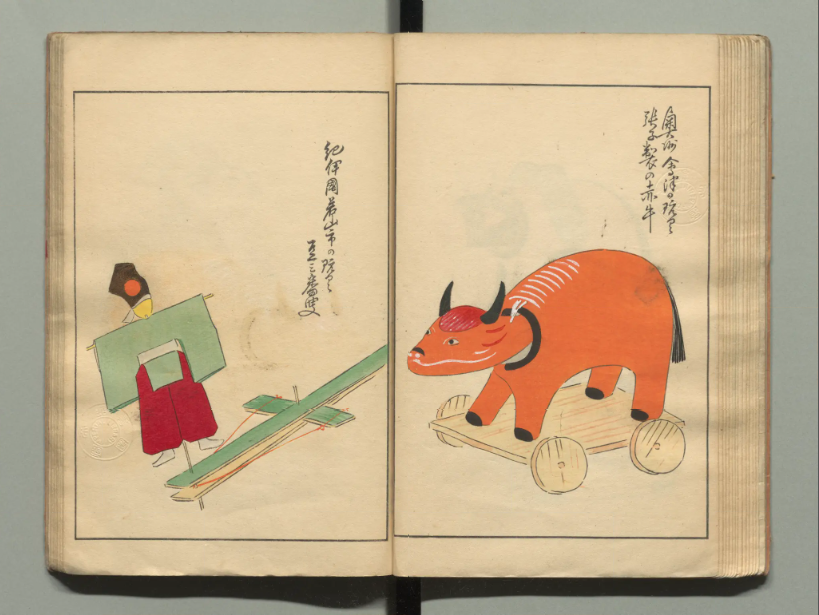
Mr. Meguro considers the Meiji era (1868–1912) to be certain. The clue lies in Unai no Tomo, a collection of toy paintings by Shimizu Seifu (清水晴風), known as a Meiji-era researcher and collector of folk toys.
Seifu collected folk toys from all over Japan, painted the toys he had gathered, and compiled the paintings into books. According to the paper, Volume 6 of Unai no Tomo, published in 1913 (Taisho 2), depicts a “papier-mâché red cow” (張子製の赤牛) as “a toy of Aizu in Oshu.”
In Shimizu Seifu’s Unai no Tomo, there is a painting labeled “a toy of Aizu in Oshu” and “papier-mâché red cow.” Volume 6 of Unai no Tomo was published in the early Taisho era, so I think Shimizu Seifu got the papier-mâché red cow in the Meiji era. It probably existed for certain in the Meiji era, but it seems the name was “akaushi” (red cow), not “akabeko”.
Mr. Meguro
The akabeko in Seifu’s painting stands on a four-wheeled cart, and its head can move. Today’s akabeko has black circles painted on the sides of its body, but Seifu’s “papier-mâché red cow” has no black circles. Judging from Seifu’s painting, Mr. Meguro thinks that something broadly similar, though slightly different in form from today’s, was being made in the Meiji era.
The cart was probably there so that children could pull it along as they played. It seems the Meiji akabeko was first of all a children’s toy, rather than a good-luck charm.
The “Head-Shaking Beko” of the Late Edo Period Cannot Be Verified
Whether this “papier-mâché red cow” can be traced back to the Edo period (1603–1868) is unknown.
There is one record that might be a clue. It is Omoto (萬年青), a record of childhood memories told in old age by Hinata Yuki, the daughter of an Aizu domain samurai, who died in 1944 (Showa 19) at the age of 94. It says that at the Juko-sai, the festival of Suwa Shrine (諏方神社) in the Wakamatsu castle town, boys bought things like a “kubifuri beko (head-shaking cow).” However, this is a story Hinata Yuki, who was a child at the end of the Edo period, told late in life while recalling her childhood.
Hinata Yuki’s recollections say that boys bought a “kubifuri beko,” but there’s the question of whether we can take at face value what someone around 90 years old said while recalling her childhood. It’s possible she was mixing it up with memories from after she grew up. So, at this point, it’s not really clear whether the akabeko existed in the Edo period or at the end of the Edo period. All we can say is that maybe there was something that became its prototype.
Mr. Meguro
What is more, the only words written are “kubifuri beko.” We do not know whether it was papier-mâché or whether it was painted red. The paper says it may have been the prototype of the akabeko, while leaving confirmation as a task for future research.
Chapter 3: Before the War, the Akabeko Was a Tanabata Decoration
The Cow the Cowherd Star Rides
From the Taisho era (1912–1926) into the early Showa era, there were several folk toy booms, and many books introducing folk toys were published.
How did those books explain the akabeko? When Mr. Meguro looked into it, a surprising answer came up.
In folk toy books from the early Showa era, it’s written that the akabeko is a Tanabata decoration.
Mr. Meguro
On the night of Tanabata, Orihime (the Weaver Star) and Hikoboshi (the Cowherd Star) meet across the Milky Way only once a year. Hikoboshi is Kengyu, in other words a cowherd. The cow that Hikoboshi rides when he goes to meet Orihime: that was the akabeko, according to the prewar explanation.
The folk toy books of the early Showa era say something like this: at Tanabata, the cow that the Cowherd rides when he goes to meet Orihime, that’s the akabeko. They say nothing at all about any connection with Yanaizu or the building of the Kokuzo-do.
Mr. Meguro
For example, Tohoku Dozoku Gangu Annai (A Guide to Tohoku Folk Toys), compiled by the Sendai Railway Bureau in 1928 (Showa 3) and cited in the paper, describes the Aizu akabeko as follows.
“It is displayed because of the legend that on the night of Tanabata, the sixth day of the seventh month of the old calendar, the Cowherd Star comes riding on this cow.”
On the sixth day of the seventh month of the lunar calendar, the night before Tanabata, Hikoboshi (the Cowherd Star) comes riding on a cow. The explanation is that the akabeko is displayed in honor of that legend. According to the paper, no mention of displaying akabeko has been found in records of Tanabata in the Aizu area from the Meiji to the Taisho eras. Even so, by the early Showa era, the akabeko seems to have been known to folk toy enthusiasts across Japan as something displayed at Tanabata.
In 1927 (Showa 2), the names “Aizu Akaushi” (會津赤牛) and “Aka-beko” (赤ベーコ) appeared on a ranking chart of folk toys. Among enthusiasts, it was already one of the toys representing Aizu.
The Akabeko Belonged to Wakamatsu, and Papier-Mâché Was a Product of Castle Towns
There is one more important point. The prewar akabeko was a folk toy of Aizu-Wakamatsu.
By the time of Shimizu Seifu’s painting, the akabeko was already papier-mâché. Aizu papier-mâché (Aizu hariko) includes many kinds of folk toys, such as Tenjin figures, and the most famous among them is the akabeko.
Mr. Meguro thinks about where papier-mâché was born in terms of how paper was used. The material for papier-mâché is not pure white paper. It is hogo-gami, waste paper that was written on for all sorts of things and then no longer needed.
Using pure white paper for papier-mâché from the start is something that, at least in the old days, people didn’t do. Papier-mâché is made from used paper, so you can’t make papier-mâché unless it’s a place where a lot of paper is consumed.
Mr. Meguro
A lot of used paper comes out of castle towns, where merchants keep account books and government offices produce documents. In Aizu, that means the castle town of Wakamatsu.
This isn’t just Aizu. In other regions too, it’s said that the places that made papier-mâché were often castle towns or their surroundings. It seems papier-mâché can’t take hold unless it’s somewhere with a lot of demand for and consumption of paper. In Aizu’s case, Wakamatsu became the center of papier-mâché production.
Mr. Meguro
This view may also apply to the maneki neko, which is made from the same material, papier-mâché.
Chapter 4: Yanaizu’s Other Cow, the Nadeushi
A Ceramic Cow That Fits in Your Palm
If the akabeko was a Tanabata decoration, then what was Yanaizu’s story of “the cow that built the Kokuzo-do” originally the origin of?
According to Mr. Meguro, Yanaizu had something entirely separate from the akabeko, called the nadeushi.
When they hear “nadeushi,” many people probably picture the stone or bronze statues of reclining cows found on the grounds of Tenmangu shrines and elsewhere. These are said to heal any part of your body that is ailing if you stroke the same spot on the cow. However, drawing on research by Naoto Chaen, who studied the nadeushi of the early modern period, Mr. Meguro says it was probably only after the war that outdoor cow statues came to be called nadeushi. His paper, also citing Chaen’s research, explains that calling the cow statues at Tenmangu shrines and similar places nadeushi is a postwar development, and that from the Edo period until the early Showa era, the word nadeushi referred to small good-luck charms.
The original nadeushi was something much smaller.
The nadeushi as a good-luck charm is something small, about the size that fits in the palm of your hand. It is modeled on a reclining cow, and in Yanaizu’s case it was made of ceramic. Not the stone or bronze statues on the grounds of Tenmangu shrines and such, the small good-luck charm is the original nadeushi.
Mr. Meguro
In large cities such as Edo and Osaka, and at major temples and shrines, these small cow figurines had been distributed as good-luck charms since the Edo period. These were what people called nadeushi. According to Mr. Meguro, what defined the nadeushi was that it was small enough to carry and was sold or given out at temples and shrines.
Before the War, the Nadeushi Was the Cow That Built the Kokuzo-do
Enzoji Temple in Yanaizu is said to have begun distributing nadeushi around the Taisho era. According to the paper, the 1913 (Taisho 2) guidebook Yanaizu Reikyo-shi lists the nadeushi as a souvenir of Yanaizu.
Yanaizu’s nadeushi were mainly made of clay and painted gold, and there were also carved wooden ones. They were made not in Yanaizu but in Hongo Town in Onuma District (now Aizumisato Town), a pottery-producing area. On the cow’s head was a figure of Daikokuten (a god of good fortune). From 1933 (Showa 8), they reportedly came in three sizes: large, medium, and small.
And prewar folk toy books said that it was Yanaizu’s nadeushi that was modeled on the cow used to build the Kokuzo-do.
If you look at prewar folk toy books, they explain the akabeko as a Tanabata decoration. On the other hand, the nadeushi, the souvenir and good-luck charm distributed in Yanaizu, is modeled on the cow used for building the Kokuzo-do. That’s how they explain it.
Mr. Meguro
In other words, before the war there were two separate cows: the akabeko of Wakamatsu and the nadeushi of Yanaizu.
| Akabeko | Nadeushi | |
|---|---|---|
| Where it was sold | Aizu-Wakamatsu | Yanaizu (Enzoji Temple) |
| Where it was made | Aizu-Wakamatsu | Hongo Town, Onuma District |
| Material | Papier-mâché | Ceramic (clay, painted gold). Wooden ones also existed |
| Prewar explanation | A Tanabata decoration (the cow the Cowherd Star rides) | The cow used to build the Kokuzo-do |
| Afterward | Still made today | Disappeared during the war, or by the late 1950s at the latest |
The Nadeushi Vanished, and Only Its Origin Story Moved to the Akabeko
However, Yanaizu’s nadeushi disappeared. The exact time is unknown. The paper notes that a 1958 (Showa 33) book says the author had heard it seemed to have been discontinued recently, and concludes that it was gone by the early Showa 30s (the late 1950s) at the latest.
During the Pacific War, Enzoji Temple was affected by the war too, for example by having to give up its bell for the war effort. In Hongo Town, where the nadeushi were made, production was also controlled during the war. Mr. Meguro thinks it is highly likely that Yanaizu’s nadeushi died out during the war or just after it.
Then, around 1960, starting with the 1960 Kyodo no Gangu compiled by the Fukushima Prefecture Products Hall as far as Mr. Meguro has confirmed, the explanation of the akabeko changed. It says the akabeko was made based on the legend that when the priest Tokuitsu built the Kokuzo-do, the red cow that carried the building materials turned to stone overnight on the evening the temple was completed.
Yanaizu’s nadeushi died out during the war or in the Showa 20s (1945–1954). Wakamatsu’s akabeko continued to be made, but around 1960 it ended up as if the legend, or rather the story and origin, of the defunct nadeushi had been attached to the akabeko.
Mr. Meguro
From then on, the akabeko came to be described as modeled on the cow that built the Kokuzo-do. Meanwhile, the explanation that “the akabeko is a Tanabata decoration” was heard less and less.
If the nadeushi had kept being made after the war, I think the explanation that the nadeushi is modeled on the cow for building the Kokuzo-do would have continued. If the nadeushi had still existed, I don’t think the akabeko’s origin would have become the building of the Kokuzo-do.
Mr. Meguro
The akabeko’s current origin story is not one that has been told about the akabeko since long ago. It was the origin story of a different good-luck charm that had disappeared, moved over to the akabeko and retold.
Why the “Cow” in Yanaizu?
Why did the cow become special in Yanaizu in the first place? Mr. Meguro points to its connection with Kokuzo Bosatsu (虚空藏菩薩, the bodhisattva Akasagarbha), the principal image of Enzoji Temple.
Kokuzo Bosatsu is regarded as the mamori-honzon, or guardian Buddha, of people born in the Year of the Ox and the Year of the Tiger.
Mamori-honzon assigns a buddha or bodhisattva to each of the twelve zodiac signs: Kannon for the Rat, Kokuzo for the Ox and Tiger, Monju for the Rabbit, Fugen for the Dragon and Snake, and so on. It seems to have originally assigned buddhas and bodhisattvas to the twelve directions of the compass, and from there, it is thought, grew the belief that Kokuzo Bosatsu is the buddha who protects people born in the Years of the Ox and Tiger.
I think that by the Meiji era at the latest, the belief that Kokuzo Bosatsu is the guardian Buddha of those born in the Years of the Ox and Tiger was established in Yanaizu. From there, it seems, the connection between Kokuzo Bosatsu and the cow developed.
Mr. Meguro
What about the Edo period? Shinpen Aizu Fudoki, the leading topography of Aizu, describes the origin of Enzoji’s Kokuzo-do in detail. Yet no cow story appears in it.
In the Meiji era, on the other hand, the link between Yanaizu’s Kokuzo Bosatsu and the cow becomes clearly visible. Inside the Kokuzo-do there are many votive plaques depicting cows and tigers, and one of them is an Ox-and-Tiger picture dedicated in 1894 (Meiji 27). Next to the purification fountain on the grounds there is also a stone statue of a reclining cow, thought to have been dedicated in the Meiji era. “Kokuzo-ko,” associations of people born in the Years of the Ox and Tiger, were also formed in various parts of Aizu in the Meiji era.
A cow that carried loads when a temple was built later turned to stone. Legends like this exist all over Japan, and there are reportedly about two in Aizu. Yanaizu’s nadeushi, too, was presented as a charm associated with exactly this kind of “cow that turned to stone” legend.
Chapter 5: Red Is the Color That Wards Off Smallpox: The Aizu Domain’s “Red Cows” and the 100 Years That Don’t Connect
The Aizu Domain Showed People Living Red Cows
When it comes to the akabeko, the red color is what stands out. As with the daruma dolls of Takasaki, red has been used in good-luck charms as a color that keeps illness away.
As Professor Okubo also mentioned in his interview with Maneki Neko Lab, red is said in folklore to carry meanings such as being a color that wards off illness, in particular having the power to ward off hoso (smallpox), or expressing strong vitality.
Mr. Meguro
On the combination of red and cows, Mr. Meguro introduced us to records from the Aizu domain in the Edo period.
The Aizu domain kept real red-haired cows in Wakamatsu and in Edo. And it showed those red cows to people who had not yet had smallpox, because it was believed that if you saw a red cow up close, your case of smallpox would be mild if you caught it.
According to research by Kozo Sakai, in Edo-period Aizu it seems people said that seeing a red cow would make smallpox mild, and the Aizu domain showed red cows to people and also presented them to the shogun in Edo. It seems red cows were believed to have the effect of making smallpox milder.
Mr. Meguro
There is also a folk belief that if a child crawls under the legs of a red cow, smallpox will be mild if the child catches it. Red cow dung was apparently sometimes used as an ingredient in smallpox remedies. Smallpox was highly contagious and often became severe, so people feared it. In the Edo period, there was certainly a belief in red cows as having the power to make smallpox milder.
Still, We Cannot Say for Sure That “Akabeko = Smallpox Charm”
So is the akabeko a papier-mâché version of the smallpox-warding red cow? Mr. Meguro’s answer is cautious.
As for whether the akabeko is a papier-mâché version of the red cow said to make smallpox milder, I can’t say anything that far. I don’t know. The akabeko is said to be one of the akamono (red objects) for warding off smallpox, and I think that possibility is worth considering too, but if you ask whether the Edo-period red cows can be directly connected to the akabeko, I don’t think that’s possible at this point. The reason is that there’s nothing linking the two.
Mr. Meguro
The Aizu domain records that mention showing red cows date from the late 18th century. From then until Shimizu Seifu’s painting in the early Taisho era, which confirms that the akabeko existed, there is a gap of roughly 100 years.
Moreover, during that gap, at the end of the Edo period, vaccination was spreading in Aizu too. It was a way to prevent smallpox based on Western medicine, using cowpox taken from cows. How people thought about red cows after a more reliable method than the folk belief of showing red cows had spread is also unknown.
If something turned up from those 100 years, in some reliable source or the like, about the existence of the papier-mâché akabeko, or about the relationship between red cows and smallpox, then I might be able to say something a little different. But for now there’s only about the “kubifuri beko” that appears in Hinata Yuki’s recollections, so I can’t say anything about the relationship between the Aizu domain’s red cows and the akabeko.
Mr. Meguro
According to the paper, books from the early Showa era also contain statements that the akabeko was used to ward off smallpox in children. However, the paper concludes that this came about because the akabeko was painted red and so came to be used as one of the akamono, and that it does not seem to have been painted red from the start for the purpose of warding off smallpox.
Even when something seems like “maybe it’s true,” he does not say it is, unless the sources connect it. Mr. Meguro was consistent in this stance throughout our conversation.
Chapter 6: Why Was the Origin Story Rewritten Around 1960?
The “Origin With History” That Tourists Wanted
So why did the akabeko’s origin story change around 1960? The paper suggests that a tourism boom in Aizu lay behind it.
In postwar Aizu-Wakamatsu, tourism built around Tsuruga Castle and the Byakkotai (the young samurai unit of the Boshin War) took off in earnest. From 1960 onward, riding the wave of Japan’s rapid economic growth, tourism in Aizu grew substantially.
It was also after the war that the akabeko became a souvenir for tourists. A craftsman who made akabeko for many years in Aizu-Wakamatsu looked back like this.
“Before the war, the akabeko wasn’t all that popular. It became popular after the war, once tourists started coming in greater numbers.”
To sell something as a souvenir, you want a story behind it. The paper’s view is that this may be why the origin story of the vanished nadeushi was retold as the origin of the akabeko.
The New Year Stamp That Spread “Yanaizu’s Akabeko”
A further tailwind was the New Year’s greeting stamp for 1961 (Showa 36), the Year of the Ox. When Fukushima’s akabeko was chosen for the design alongside Iwate’s kin-beko (golden cow), sales of akabeko reportedly rose.
Through newspapers, books, tourist brochures, and the people who bought akabeko, the explanation that “the akabeko is the cow that built Yanaizu’s Kokuzo-do” spread. By the late 1960s and early 1970s (the latter half of the Showa 40s), the Tanabata story was hardly written about anymore, and only the Kokuzo-do story remained as the akabeko’s origin.
The paper also touches on the idea of “tourism history” (kanko shigaku), formed in postwar Aizu with an eye on tourists as the “gaze of others,” in order to help the tourist city of Aizu-Wakamatsu draw visitors. The linking of the akabeko’s origin to the Kokuzo-do of Enzoji, an old and venerable temple in Aizu, may also have been done with tourists in mind.
The story “modeled on the cow put to work for building the Kokuzo-do” didn’t vanish along with the nadeushi when it died out. It was moved to the akabeko and retold, which suggests there was a demand for the story. I think the story itself was created in the early Showa era, but it means that even though the nadeushi disappeared, the story attached to it survived, and that makes you feel the power of stories.
Mr. Meguro
| Period | Akabeko | Yanaizu’s nadeushi |
|---|---|---|
| Late Edo period | A “kubifuri beko” was sold at a festival in Wakamatsu (possibly its prototype) | — |
| Meiji era to 1913 (Taisho 2) | A “papier-mâché red cow” from Aizu appears in Unai no Tomo | Appears as a souvenir in the 1913 Yanaizu Reikyo-shi |
| Early Showa era | Introduced as a cow displayed at Tanabata | A charm associated with the cow that built the Kokuzo-do (the cow that turned to stone) |
| Wartime to the late 1950s | A Tanabata decoration (even in a 1954 book) | Disappears |
| 1960 (Showa 35) | Described as associated with the cow that built the Kokuzo-do | — |
| 1961 (Showa 36) | Chosen for the Year of the Ox New Year stamp, and its popularity spreads | — |
Chapter 7: Recognizing “Invented Traditions”: What It Means to Trace an Origin Back
Hatsumode and Shinto Weddings Are New Traditions Too
Finally, when we asked about how legends are handed down, Mr. Meguro brought up the phrase “invented tradition.” It refers to something that was created in modern times but is thought of as a tradition dating from before the modern era.
Take hatsumode, the first shrine or temple visit of the New Year. The custom of making a special trip to a major temple or shrine spread in the Meiji era from campaigns that railway companies ran to increase ridership. Shinto wedding ceremonies did not exist in the Edo period either.
When it comes to things related to shrines and temples, things that feel old-fashioned, people sometimes have the sense that they’ve continued from long, long ago, from the Edo period or even earlier, but in fact they’re sometimes customs that started in the Meiji or Taisho era. Such things are sometimes called invented traditions, and the akabeko may have something similar about it.
Mr. Meguro
Checking “How Far Back It Can Be Traced”
The theory that the akabeko originated in Yanaizu has been told only since around 1960. Before that, the akabeko had nothing to do with Yanaizu.
Whether we can simply accept what’s said today exactly as it is, that’s something we should think about, isn’t it? Where it comes from, since when it’s been said, how far back it can be traced. When you trace the akabeko’s origin back, it was originally something different.
Mr. Meguro
And this is not just about the akabeko.
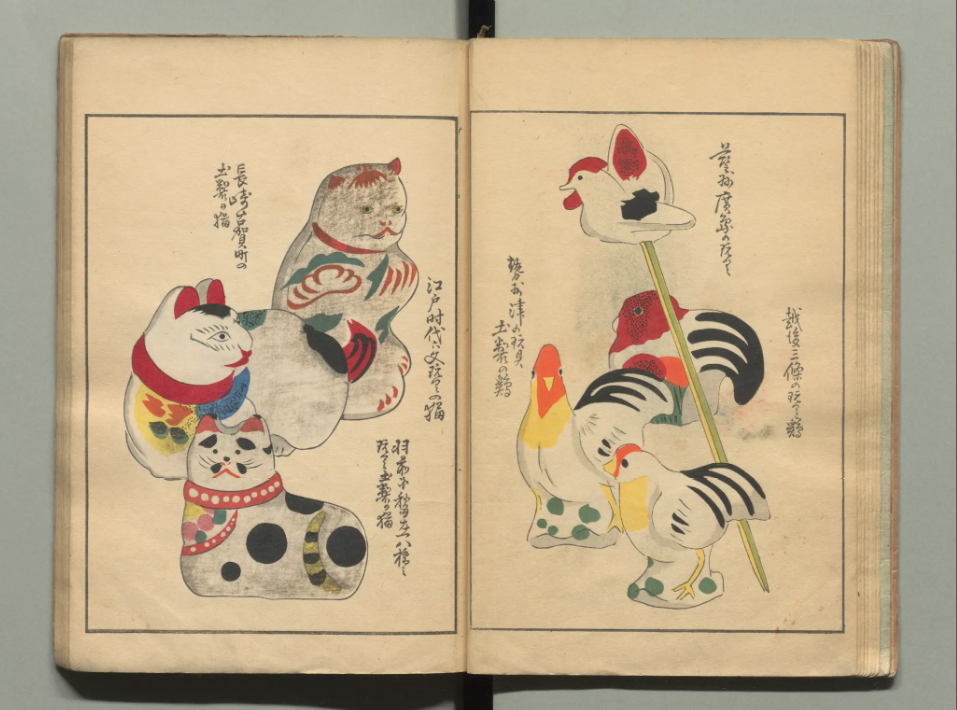
I think the same goes for the maneki neko and all sorts of other things. For example, there are several stories said to be the origin of the maneki neko, but how far back can they be traced, and where is the starting point? If you look into things like that, maybe you’d find that some stories that were originally said to be the origin of something else at some point came to be regarded as the origin of the maneki neko.
Mr. Meguro
Mr. Meguro also says there is no need to reject current origin stories altogether, since they too exist as the result of historical change. But things from the past are rarely handed down to the present unchanged, so it is better to think on the premise that change has happened. Knowing that, he says, is what matters.
What Was Written Later Was Written by Later People
Mr. Meguro’s standard for looking at historical sources is clear: every source tells us about the time in which it was created.
For example, in the Edo period many gunki-mono, war chronicles about the battles of Sengoku-period warlords and such, were published. War chronicles contain anecdotes about various battles and people, but they include a lot of invention by Edo-period writers, so you can’t take what’s written in them as events of the Sengoku period as they are. On the other hand, war chronicles were used by samurai to study military science and were widely read among ordinary people. That means they are an unparalleled source for learning how people in the Edo period viewed the Sengoku warlords.
Mr. Meguro
He says the same goes for tracing one’s own ancestors. Family trees tend to want to link ancestors to famous warlords, nobles, and the like.
A family tree, too, is strictly a source that shows how people understood things at the time it was made. Family trees are often made to create the pedigree of one’s family line and one’s own identity, so they often claim that the ancestors connect to famous samurai or distinguished noble families. Information close to the time the family tree was made is credible, but the further back you go, the more contrived it tends to become, and the less credible. Maybe they wrote it because there was some kind of basis, but you need to check what that basis is and whether that basis can be trusted.
Mr. Meguro
A Skill for Sorting Out Online Information, Too
This way of thinking does not stop at history.
Especially now, people talk a lot about things like fake news and internet literacy. With information on the internet too, we have to properly tell whether it’s reliable information and where it originally comes from. I think examining the origins of the maneki neko and the akabeko has something in common with the mindset of pausing to judge whether something can be trusted, rather than simply believing internet information or vague information as it is.
Mr. Meguro
Just because something is written somewhere, stop for a moment and think again before believing it as it is.
This applies to everything. Searching for your roots, internet information, the news too, and I think stories about folk toys are the same. I think it’s something that applies to all of them.
Mr. Meguro
Summary: Tracing Origins Makes Good-Luck Charms Even More Interesting
The story of “the red cow that built the Kokuzo-do,” told as the origin of the akabeko, was originally considered the origin of Yanaizu’s nadeushi. The prewar akabeko was a papier-mâché toy from Wakamatsu, explained as the cow the Cowherd Star rides at Tanabata. After the nadeushi disappeared, around 1960, as tourism in Aizu was taking off, that origin story was moved to the akabeko.
Mr. Meguro’s account does not deny the current origin story. Rather, it shows us that the akabeko has taken on different meanings in different eras, and that origin stories change within the flow of history. The era when it was a toy children pulled along as they played, the era when it was the Tanabata cow, the era when it spread as a tourist souvenir: all of them are part of the akabeko’s history.
The maneki neko, too, has various origin legends in different places, such as Gotokuji Temple, Imado Shrine, and Jishoin Temple. Since when, and where, did those stories begin to be told? If you trace the sources one by one, as Mr. Meguro does, the good-luck charm in your hands may start to look a little different than before.