Placing a maneki neko (招き猫, the beckoning lucky cat) in your home won’t scientifically raise your luck. Buying a kumade (熊手, a decorated bamboo rake sold as a good-luck charm) doesn’t guarantee that your business will thrive.
This interview was conducted in Japanese and translated by Maneki Neko Lab. Read the original Japanese interview.
And yet people still set up kamidana (神棚, household Shinto altars), carry omamori (お守り, amulets), and put their hands together in front of engimono (縁起物, good-luck objects). Why?
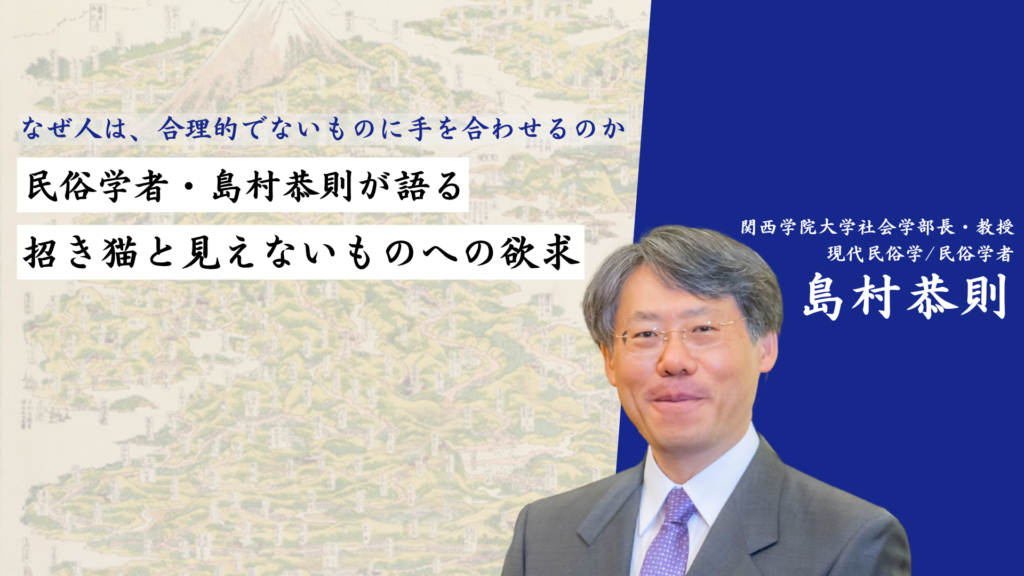
Folklorist Takanori Shimamura (hereafter Shimamura), Dean and Professor of the School of Sociology at Kwansei Gakuin University, has spent many years studying good-luck objects, urban legends, modern folk beliefs, and popular religion.
Through works such as the NHK textbook Kaiun! Shinpi no Chikara: Engimono (Good Fortune! The Mysterious Power of Good-Luck Objects) and Nemurenaku Naru Hodo Omoshiroi Zukai Minzokugaku (Illustrated Folklore Studies, So Fascinating You Won’t Be Able to Sleep), he has explained in scholarly terms how the “desire for the unseen” has crystallized into culture.
Chapter 1: What Is Folklore Studies, Anyway?
The way into folklore studies (minzokugaku, 民俗学) lies in two characters: “min no zoku” (民の俗), “the customs of the people.” “Min” means the people, and “zoku” covers not only the official culture written in textbooks and laws but also the unofficial side rooted in the everyday lives of ordinary people.
Put simply, once you fold things into this definition, good-luck objects, yokai (妖怪, supernatural creatures), festivals, and urban legends all fit neatly within the field as subjects of study.
Take a major festival such as the Gion Matsuri (祇園祭, Kyoto’s famous summer festival). It isn’t organized by the national government or by the City of Kyoto.
Even so, from the outside it looks like an “official event.” Most ordinary visitors enjoy the festival without being able to explain its “meaning” in any concrete way, such as what the yamaboko (山鉾, towering festival floats) and food stalls are for. And that’s fine.
Folklore studies, however, is the discipline that tackles this “unexplained margin” head-on as culture.
Good-luck objects are the same. People know that “there’s no scientific evidence that displaying a good-luck object will improve your finances,” yet they find themselves displaying one anyway. Where science can’t fully explain things, a deeply human culture takes up residence.
So was that culture really nothing more than irrational? Here, Shimamura offers a somewhat unexpected view.
Take yokai, for example. They’re classified into many different types. In the mountains you have tengu (天狗, long-nosed mountain spirits), and in the sea you have umibozu (海坊主, giant sea monsters), and so on.
If they were simply irrational, there’d be no need to go so far as naming and classifying them, right? It’s the result of people back then doing their best, in their own way (to find patterns).
Shimamura
In other words, yokai and good-luck objects were “attempts at science” by people of the past trying to make sense of the world. Forecasting mountain weather, too, was the “science of its day,” finding patterns through rules of thumb.
What could be proven with numbers was later split off as “science,” and what couldn’t remained as “folklore.” Good-luck objects belong, so to speak, to the lineage of “science that never got to become science.”
Why Folklore Studies Is Drawing So Much Attention Today
“Folklore studies is actually very close to stories and content,” Shimamura says.
Why do folklore studies and content sit so close together today?
Shimamura begins his explanation with “kōsatsu culture” (考察文化), the culture of analyzing and theorizing about works, as an example.
Games, horror, online ghost stories… everyone loves analyzing them, don’t they? Like checking the answers. And when you analyze something, you want material, information to work with.
Shimamura
It’s true that analysis needs material. Horror worldbuilding, anime settings, isekai (異世界, “another world”) reincarnation stories: when you try to analyze content that carefully builds “something different from this world,” people naturally start referring to “the real folklore that lies just behind it.”
One example Shimamura especially highlighted was “reincarnation” (tensei, 転生).
Reincarnation and the like have been around since long ago. People in the past didn’t see it as content. They all genuinely believed they would be reborn.
Shimamura
That Time I Got Reincarnated as a Slime and The Tale of Princess Kaguya (かぐや姫): the skeleton of stories like these is the very worldview of folk belief, in which people seriously pondered “what happens after we die.”
The “other worlds” enjoyed as content overlap in essence with the concepts of “the other world” and “this world” that folklore studies has long dealt with.
Shimamura also cited the concept of the “liminal space.” Picture a passageway in a big subway station that’s usually bustling, one you simply pass through on the way to the ticket gates. There are no shops, only ads, and no one ever stops there.
The fear that “I might never get out of this (empty, quiet, eerie) place” is something the game The Exit 8 brilliantly turned into play.
“Liminal” originally means “in-between” (ma, 間). A space in between, like a plain corridor that is neither the bustle of this world nor the entrance or exit you’re actually heading for, for some reason makes people terribly uneasy. It’s a game that really hits on this truth.
Shimamura
And this isn’t a feeling unique to the modern age. People in the past knew the same fear.
Long ago, in one area of the Tohoku region (northeastern Japan), people would load fish from the sea onto horses and cross the mountains at night to reach the market, traveling a pitch-dark mountain road in the middle of the night.
“It’s neither the seaside town where we usually live nor the market town on the far side of the mountains. Just a pitch-dark mountain road. What if this creepy road leads us off into another world?”
The fear of liminal spaces wasn’t invented by a video game. It’s a feeling humanity has always known in its bones.
What comes into view, then, is the fact that folklore studies isn’t merely “stories of the old days.”
The “world settings” (worldviews) that people in the past built for themselves have had a major influence.
History deals with events, such as “so-and-so did this.” Sociology takes on “the difficulties of modern life and social phenomena.” Folklore studies, by contrast, focuses squarely on the emotions that have arisen from people’s lives since ancient times.
The kinds of worldviews it uncovers are structurally close to the “carefully built worlds” of games and novels.
There’s a door in for people who love analyzing, and for people who just want to read something entertaining. That, Shimamura says, is where folklore studies stands today.
Chapter 2: From Funerals to Kumade Rakes to Entertainers: How Society Has Handled “Unseen Anxiety”
Why do people put their hands together before good-luck objects? Dig down to the root, and you ultimately arrive at one word: “anxiety.”
If “death” were handled purely as a matter of procedure, it would end with a direct trip to the crematorium. But people layer on rituals to cope with lingering attachment and to sort through their memories. The 49th-day memorial, Obon (お盆, the summer festival for ancestral spirits): this design of time is a culture for moving grief through stages within society, an idea close to grief care.
It makes “unseen emotions” visible and places them within a shared culture.
This hard-to-handle “anxiety” exists in the same way in the world of business and startups.
“For example, lots of people suddenly want a kamidana once they start a company,” Shimamura says.
Hozanji Temple (宝山寺) on Mount Ikoma, on the edge of Osaka, is a classic example. People who have gone independent and started a business climb the mountain, receive an ofuda (お札, a paper talisman), and set up a kamidana in their office. Then a monthly visit to the temple becomes a habit.
“In the nightlife business, too, after closing the shop late at night, the whole staff may pile into a van and head to the temple, sometimes forming a line.” The act of entrusting unseen anxiety to places, objects, and rituals is connected to funerals along one and the same line.
At Tokyo’s Tori no Ichi (酉の市, a November fair at shrines), people buy kumade rakes, while in the Kansai region (western Japan, around Osaka and Kyoto) they display fukuzasa (福笹, lucky bamboo branches). Where an amulet costing a few thousand yen would normally do, merchants pay 50,000 yen, even 100,000 yen, and buy a bigger one every year.
“You don’t have to go that far” is exactly what engi-katsugi (縁起担ぎ, doing things for good luck) is. Going back in time, Edo-period ukiyo-e prints also depict people delightedly buying bamboo branches and kumade rakes.
Even if you can’t explain it rationally, it puts your mind at ease.
Perhaps, as a fundamental human desire, that hasn’t changed from the Edo period (1603–1868) to today.
Why Does a Shed Snakeskin Mean “Better Luck with Money”? The Myth Surrounding Benzaiten
Behind good-luck objects like these, a complex chain of meanings is folded away.
The saying Shimamura offered as an example, “Keep a shed snakeskin and you’ll become rich,” looks at first glance like a mere superstition.
But untangle it with the eyes of folklore studies, and a story worth telling emerges.
First, the snake is a creature that lives near water. That’s why in Japan it has been worshiped as a water deity. Meanwhile, Hinduism in India depicted the water deity as a goddess, known in Japan as “Benzaiten” (弁才天, Sarasvati).
Water brings to mind a babbling stream, and a stream makes the sound of water. Since that’s sound, “Benzaiten” is the goddess of sound. The water deity is also the deity of sound, and the deity of sound is the deity of music. The deity of music means the deity of the performing arts. That’s why so many entertainers go to pray to Benzaiten.
Shimamura
Then, in the Edo period, people reread the character “sai” (才, talent) as “zai” (財, wealth), the “zai” in zaisan (財産, property). “Benzaiten (弁才天) became Benzaiten (弁財天), and the story became that she is the deity of water and sound and also the deity of wealth,” Shimamura says.
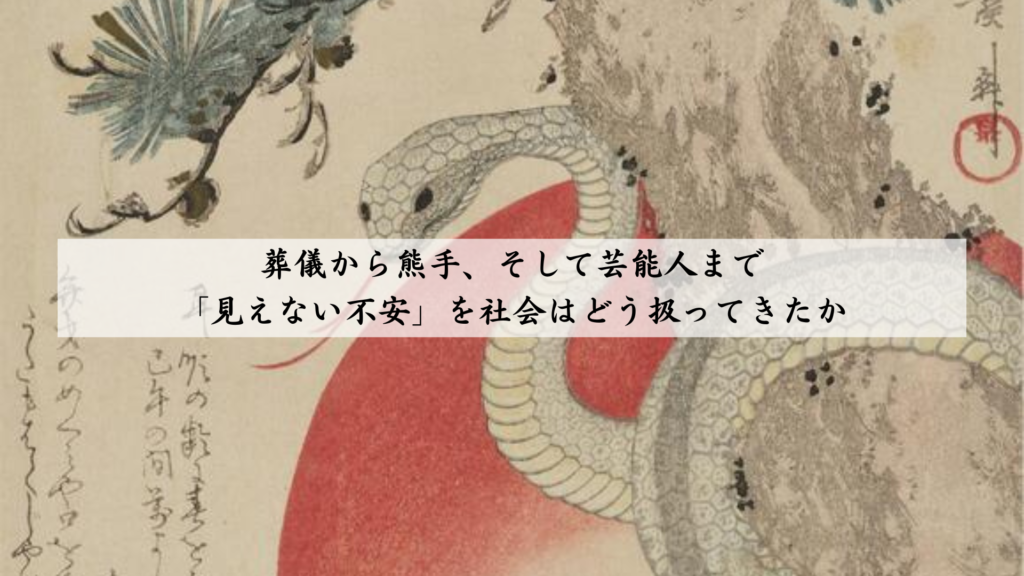
Benzaiten has a snake sitting on top of her head. The snake is a water deity. Through that water-deity connection, the snake became Benzaiten’s tsukawashime (使わしめ, divine messenger). On top of that, snakes shed their skin. Shedding is also a symbol of rebirth and long life. Auspicious.
“Wealth” plus “rebirth,” and so the shed snakeskin became an amulet with powerful energy. And of course, if you keep one, you’ll become rich. That’s how it goes.
Shimamura
The route to get here (snake, water, Ben“zai”ten of talent, the sound (of water), music, the performing arts, Ben“zai”ten of wealth, property, plus shedding and rebirth) would take a long time to explain as a historical sequence.
But in daily life, nobody spends all that time explaining it. It gets compressed into a single phrase, “Keep a shed snakeskin and you’ll become rich,” and handed on.
This “compression” is exactly why good-luck objects have lived on for so long among ordinary people, Shimamura says.
This is intuition, pure and simple. What’s amazing is that it’s become an intuitive package. Folklore studies is an academic discipline, so it works logically. That’s why we need to do the work of unzipping this package of intuition.
Shimamura
Entertainers who visit Benzaiten and people who keep a shed snakeskin in their wallets don’t know the chain of meanings behind it. But we can act on the feeling that “that’s just how it is.”
This package-like quality may be the very strength of good-luck objects.
Chapter 3: The Human Brain and How Good-Luck Objects Come About
To understand where this intuition and the structure of good-luck objects come from, Shimamura says, it helps to look at the structure of the brain.
The human brain is broadly divided into three layers. At the very center is the “brainstem,” the room of instinct. I’m hungry, I’m sleepy: primary reactions like these come from the brainstem.
Outside it is the “limbic system.” And the outermost layer is the “neocortex,” where humans differ most from chimpanzees.
The limbic system is the seat of “intuition,” what behavioral economics calls System 1 (fast thinking). The neocortex is the seat of “reason,” corresponding to System 2 (slow thinking). System 2 thinks slowly and builds up logic, while System 1 judges quickly and intuitively.
Say you sense that something is out there in the dark. If you thought it over slowly with System 2, (in the old days) a lion would eat you. Even at the risk of being wrong, you judge by intuition (sensing a presence) that you should run. That’s System 1.
Shimamura
To begin with, only the people who were wary to the point of being wrong, sensitive to the point of being oversensitive, survived and passed on their genes. “We’re their descendants.”
And this is where it ties into the core of folklore studies. Good-luck objects are, quite literally, a culture for System 1.
Put out a maneki neko and you’ll get rich, keep this shed snakeskin and your luck with money will improve. Nobody asks why. They work as a package of intuition: “that’s just how it is.”
Once you start asking why, you’re in for a long story, like the one about Benzaiten. Normally, nobody thinks about such things. You take it in intuitively, in an instant, and put your hands together.
Folklore studies as a discipline, on the other hand, is the work of unzipping that package with System 2. Intuition and the scholar’s logic look at the same object, through good-luck objects, from opposite directions.
Displaying good-luck objects is the act of mixing just a little intuition into your daily life. From a folklore standpoint, that’s a really healthy balance.
Shimamura
Chapter 4: The Origins of the Maneki Neko: A Doll Inhabited by a Spirit, Meanings That Change by Region, Its Spread Overseas, and Its Possibilities
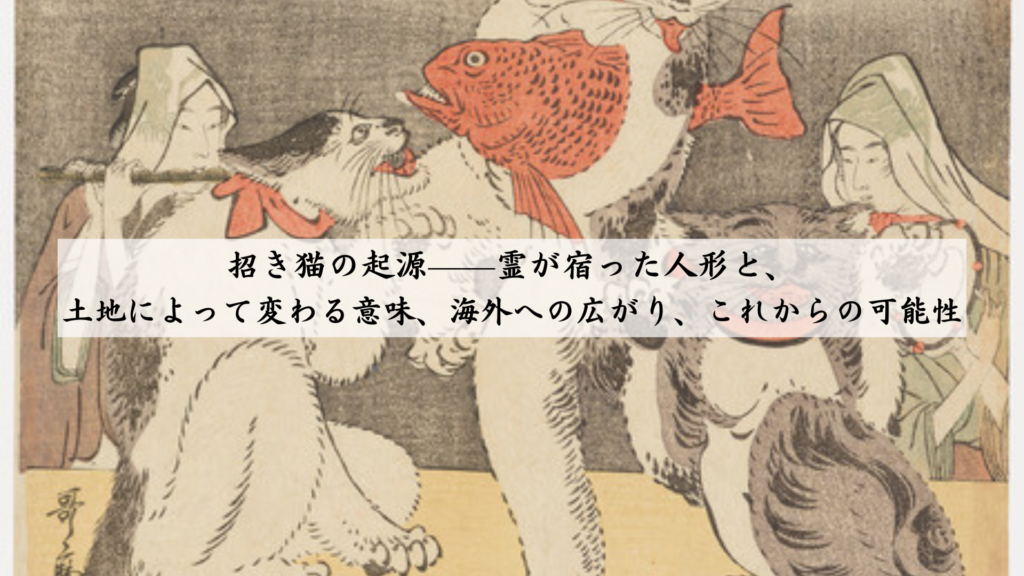
The origin of the maneki neko can’t be narrowed down to one. The Imado (今戸, an old pottery district in Tokyo’s Asakusa area) theory, the Gotokuji (豪徳寺, a temple in Tokyo’s Setagaya) theory, or yet another region: which came first can’t be settled. Shimamura says, “It’s enough to take the attitude that each place tells its own story of being the birthplace.”
As one example, he carefully recounted the following tale preserved in written sources about the Imado-yaki (今戸焼, Imado ware) maneki neko.
A cat cherished by a married couple who sold Imado ware in the grounds of Sensoji Temple (浅草寺) ate a pet bird belonging to an acquaintance’s household. The wife went to that house to apologize, but when she returned, the cat was gone, and the shock left her bedridden.
When fellow Imado craftsmen made a clay cat figure and gave it to her in place of the missing cat, the story goes that the cat appeared in the wife’s dream and revealed that it had in fact thrown itself into a well out of remorse.
Then, saying that from now on the cat figure would protect the wife in its place, it vanished. The next day, the wife was well again. That’s the plot.
The story was told as if a spirit had come to dwell in the cat figure, lending and borrowing the cat figure spread through the neighborhood, and when one wasn’t enough, people are said to have started making copies. So what is said in other regions?
Same Shape, Different Meaning: Regional Differences in the Maneki Neko
The maneki neko tends to be seen everywhere in Japan as a good-luck object for “thriving business.” But the context differs from place to place.
In Edo (old Tokyo), it grew up as a good-luck object born in a city of commerce, a symbol of prosperous business. In silk-farming areas such as Gunma and Fukushima, on the other hand, its role as a mouse repellent and a guardian deity of silkworms was stronger.
Even when the shapes look alike, the “meaning” tied to each area’s livelihood differs. One of the joys of folklore studies is revealing that the same shape has been used in completely different contexts depending on the place.
Tokoname (Aichi), Seto (Aichi), Imado (Tokyo), Gotokuji (Tokyo): there are several places associated with the maneki neko, each with its own style. The meanings of the colors, too, are interpreted differently by region and era.
Rather than asking which is the “correct” maneki neko, the folkloristic approach is to look at the culture of land and people in which each one grew up.
To China, to the West: The Maneki Neko Travels the World
You often see maneki neko in restaurants in China. They’ve spread across Asia, including the shiny gold ones with automatically waving paws. Many of these are produced locally rather than imported from Japan, and are distributed locally too.
It seems that in China there’s some awareness that “it’s apparently something Japanese,” but it has already blended into the local culture.
In Europe, the US, and South Korea, too, maneki neko are popular as souvenirs and interior decor. But what Shimamura finds especially noteworthy, though it isn’t about the maneki neko, is the way some people receive fox figurines beyond consuming them as souvenirs.
In Europe, people who visit Fushimi Inari (伏見稲荷, the fox shrine in Kyoto) buy a fox figurine, take it home, set up something like a torii gate at home, and post it on social media. Like, “I don’t know how I’m supposed to worship it, but I gave it a try anyway.”
Shimamura
It’s similar to how charms originally used in African and Middle Eastern folk beliefs, such as voodoo dolls and the evil eye (a blue eye-shaped amulet against evil), have been embraced in the West.
There are certainly a fair number of people beyond Japan who have the sense that Japanese objects “might somehow actually work.”
Shimamura also says the maneki neko could become a symbol of Japanese culture.
Synergy with Goshuin Collecting: The Future of the Good-Luck Object Market
Turning to Japan, there was an intriguing hypothesis: the spread of goshuin collecting (御朱印, gathering calligraphic temple and shrine seals) may be linked to the market for good-luck objects.
Ever since goshuin collecting caught on, people have gotten used to visiting shrines and temples, you might say. Access to things that aren’t necessary or urgent, but just might bring something good, may have become closer than it used to be.
Shimamura
People reach more readily for things sold at shrines and temples. That is nurturing a group who buy good-luck objects like the maneki neko as interior decor, or half in a spirit of fun.
It also runs parallel to the growth of the fortune-telling market. We live in an era when the desire to “do something about anxiety” is surfacing in many forms.
A doll inhabited by a cat’s spirit, a guardian deity of silkworms: it’s only when stories like these pile up that the maneki neko becomes something beyond a mere ornament. When it is introduced abroad as Japanese culture, that “depth of story” is what people find so fascinating.
Chapter 5: Conspiracy Theories and Good-Luck Objects Are Separated by a Thin Line: The Question a Folklorist Is Facing Now
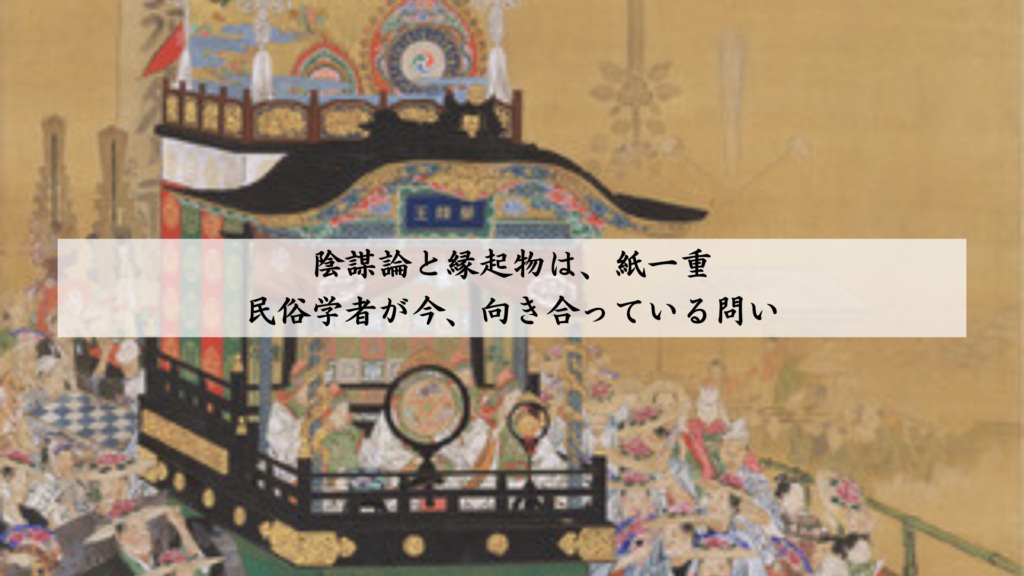
At the end of the interview, Shimamura named the study of conspiracy theories and spirituality as an issue folklore studies must face in the present day.
It may be surprising, but the difference between people who are fairly fond of good-luck objects and people who fall deep into conspiracy theories is less a break than merely a difference of degree.
Shimamura
In both cases, trying to believe in things that can’t be fully explained rationally is the work of what behavioral economics calls System 1. Believing in good-luck objects, buying a kumade rake, putting out a maneki neko: these are “just in case” acts that remain at the level of the “intuitive.”
Conspiracy theories, however, could be described as a state in which that “power to believe” has run out of control.
“So what society needs from here on is to step in among people who have fallen deep into conspiracy theories and explore the possibility of dialogue. Not to cut them off, but to stop the runaway through dialogue,” Shimamura said.
Folklore studies is neither a discipline that denies the irrational nor one that lets it run free. It faces the fact that humans live by balancing System 1 and System 2, and finds the shapes of culture within that. It is a discipline that unearths the wisdom that makes living more “comfortable.”
Finally, his message for young people came down to one phrase: “kōsatsu asobi” (考察遊び), the game of analysis.
Where did the maneki neko come from? Tokoname, Seto, Imado, or Gotokuji? Follow the traditions of cat worship, and you’ll come across the tanuki (狸, raccoon dog, also a good-luck figure) or run into Benzaiten.
“It’s not a topic where the spring will run dry anytime soon. Just use it as a starting point.” The entrance offered by the game of analysis and by good-luck objects, before you know it, leads into the broad field of folklore studies.