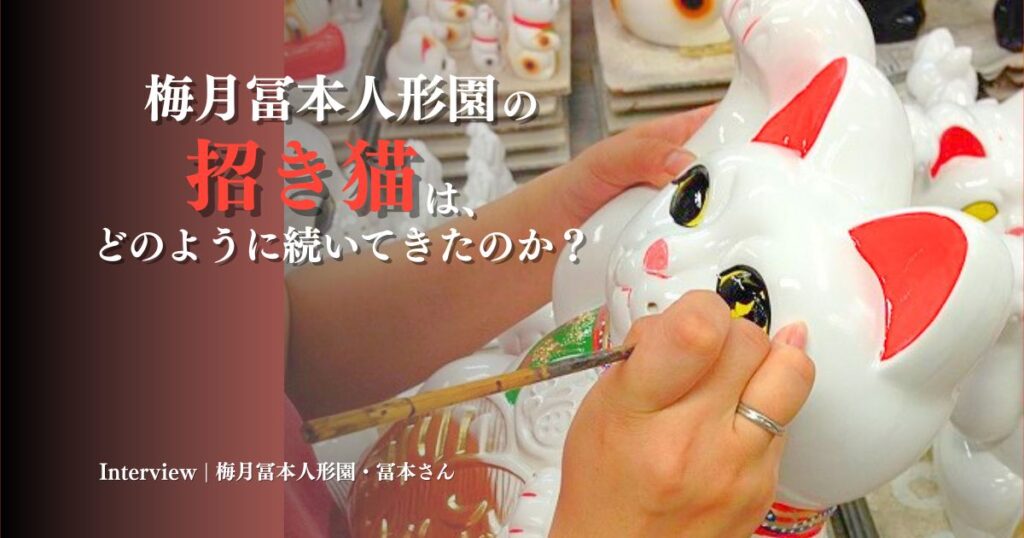
In Japan, the maneki neko (招き猫, “beckoning cat”) has long been cherished as an engimono (縁起物), a good-luck object.
You can find it all over the country, yet no two are quite the same.
A different place means a different way of making it, and a different span of time over which it has been handed down.
This interview was conducted in Japanese and translated by Maneki Neko Lab. Read the original Japanese interview.
Tokoname (常滑), Aichi Prefecture.
Here, a kiln that has made maneki neko for many years is Baigetsu Tomimoto Ningyoen (梅月冨本人形園).
Here, the maneki neko is neither “something that creates trends” nor “a product that keeps changing.”
It is something that, by keeping the form, keeping the process, and continuing to make it by human hands, has ended up remaining in people’s lives.
In this article, we quietly trace how Baigetsu Tomimoto Ningyoen began, what a Tokoname-yaki (常滑焼, Tokoname ware) maneki neko is, and what the kiln keeps unchanged and carries forward as it continues to make them, centering on the words of Ms. Kikue Tomimoto (冨本喜久恵) (hereafter, Ms. Tomimoto).
Without rushing to judgments or conclusions, we turn our eyes to “the fact that they have kept making them” and “the background behind it”, to consider why Tokoname maneki neko are still being picked up today.
Baigetsu Tomimoto Ningyoen and “Three Generations of Maneki Neko”
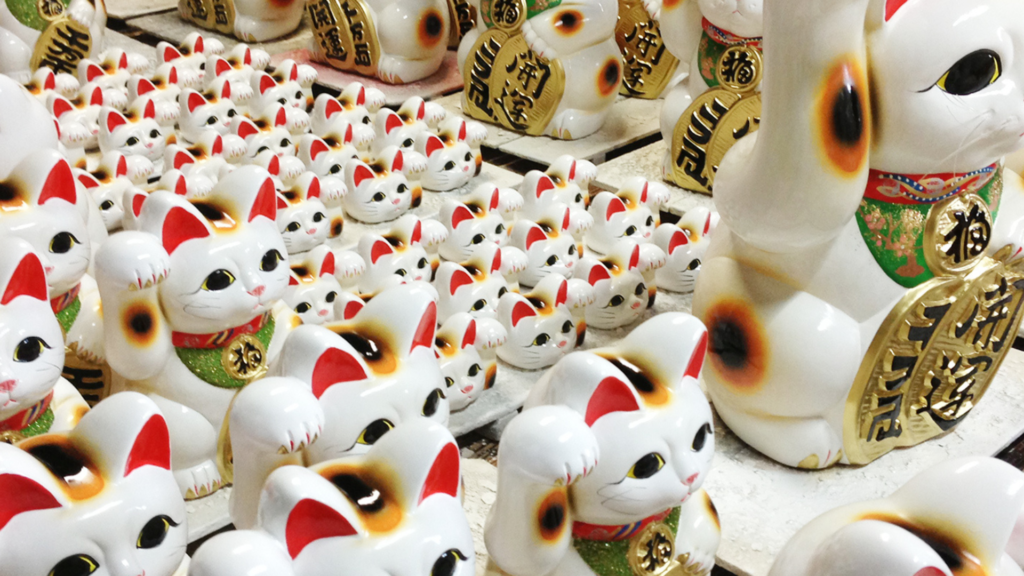
Ms. Tomimoto of Baigetsu Tomimoto Ningyoen is currently the fifth generation of the family business.
However, when it comes to making maneki neko alone, the history spans three generations.
Up to the generation before her father, Baigetsu Tomimoto Ningyoen is said to have made all kinds of pottery, including kyusu (急須, teapots) and large ceramic pieces.
The turning point came in the generation of Ms. Tomimoto’s grandfather.
The Choice to Focus on Maneki Neko, Starting with Her Grandfather
Maneki neko making began in earnest around 1945 (Showa 20).
In the years just after the war, Tokoname had a number of kilns, and there was demand for work that many people could take part in through a division of labor.
In that setting, what Ms. Tomimoto’s grandfather chose was the decision to put the maneki neko at the center.
It was not work completed by one person alone. With many people involved, it was possible to make large numbers efficiently.
Against that background, he is said to have seen potential in the form of the maneki neko and stepped up production in earnest.
By around 1950 (Showa 25), the basic shape that continues today, with large round eyes and a two-heads-tall (big head, small body) form, is said to have been established.
What the Land of Tokoname Has Supported
Tokoname at the time was a place blessed with good clay.
A pottery culture, beginning with teapots, had taken root, and it was precisely because the materials and skills were there that maneki neko making spread as well.
However, that “clay” is not limitless.
Today, she says, it has become difficult to keep using Tokoname clay as it is, and the raw materials are sourced from places such as elsewhere in Aichi Prefecture.
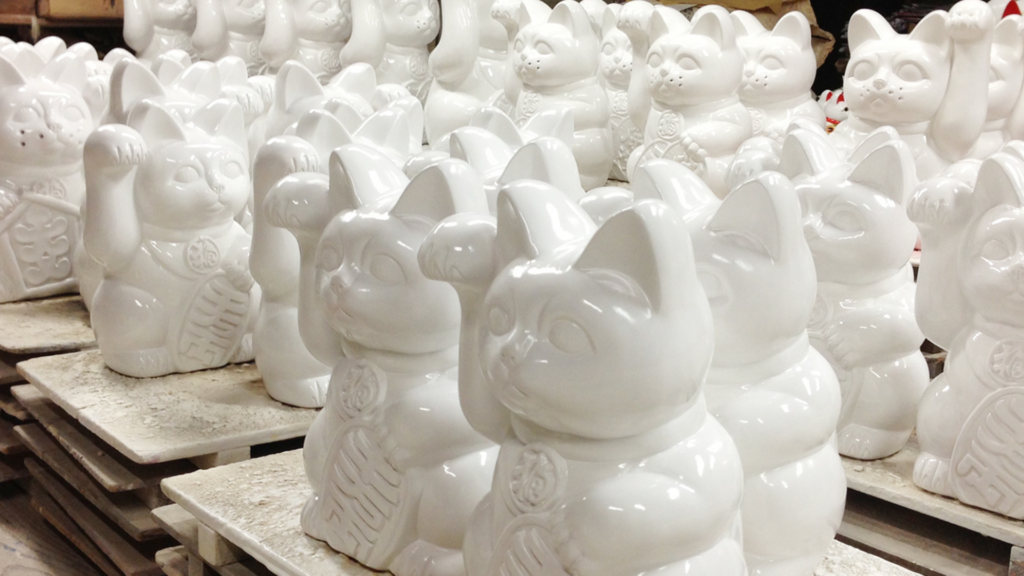
Clay, water, and additives are mixed to make deisho (泥漿, slip), a liquid clay, which is poured into plaster molds.
It hardens little by little from the outside, and the inside is drained to leave it hollow.
This process is still carried on unchanged today.
The Weight of “Three Generations” at Baigetsu Tomimoto Ningyoen
Maneki neko at Baigetsu Tomimoto Ningyoen have been made in an unbroken line from her grandfather, and Ms. Tomimoto is the current third generation.
Even without being put into special words, the very fact that it “has continued” speaks to the nature of this work.
It has followed trends, yet without greatly changing its form, it has quietly kept reaching the places where it is needed.
You can see that making maneki neko is not work that began suddenly, but a practice that has been chosen and preserved through the times.
What Is a Tokoname Maneki Neko?
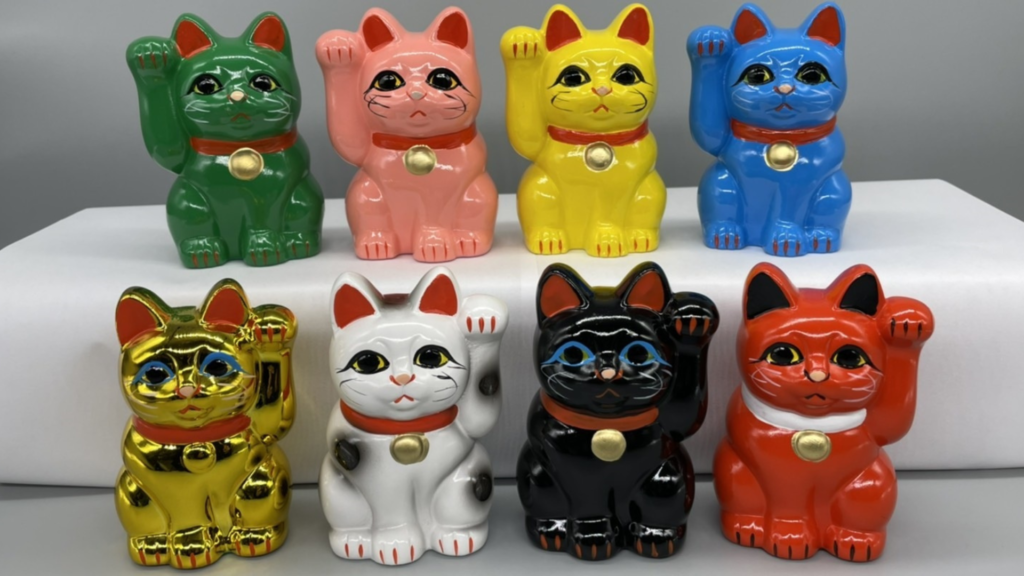
When people hear “Tokoname-yaki maneki neko,” many may picture the features of the production area or differences in technique.
For Ms. Tomimoto, however, a Tokoname maneki neko is less “something to be explained” and more something that has naturally remained there as the result of making it for a long time.
Less a Good-Luck Charm Than “Something That Brings Smiles”
When asked how she sees the maneki neko, Ms. Tomimoto’s answer was very simple.
It’s a good-luck object, I’d say. And rather than something that invites good fortune,
Ms. Tomimoto
the feeling closest to it is something that makes people smile when they see it.
What comes out before words like wealth or business prosperity is the feeling of “smiles” and “bringing joy.”
The distance Ms. Tomimoto, the maker herself, describes when she says it “makes you feel gentle” quietly tells why the Tokoname maneki neko has found its way so naturally into everyday life.
Why They Have Been Chosen for Celebrations and Milestones
Baigetsu Tomimoto Ningyoen’s maneki neko are not only for personal wishes. They are often chosen as gifts, she says.
For example:
・Housewarming gifts
・Anniversaries of a business
・Gifts for taking up a new post
At such “turning points,” the maneki neko has been handed over in place of words.
With a name added or a special meaning attached, it becomes “one of a kind in the world.”
Rather than just for display, the maneki neko has been used as something that stays beside someone at a milestone in their life.
The “Unchanging Form” Shared by Tokoname Maneki Neko
While new products and collaborations are born to match the times, there are also parts that must not change, she says.
That is the “form” of this maneki neko.
・A plump body
・A soft expression
・A presence that has hardly changed since the Showa era (1926–1989)
The words “we don’t do model changes” are less a refusal of change than a choice to carry it on as history.
New things are made as new things.
But the core form stays.
That stance is what makes the Tokoname maneki neko feel like “something still being made today” and, at the same time, “something we have always known.”
Why Each One Is “the Same, Yet Not the Same”
Maneki neko are made using molds.
So the basic shape is the same.
Yet no two maneki neko have exactly the same face.
Especially the “eyes” and “whiskers,” which set the expression.
A tiny difference in the brushstroke greatly changes the overall feel.
She sees those differences not as “inconsistency in handmade work” but as “the charm of handmade work.”
And because each expression is different, some people pick one up saying,
“It looks like the cat I used to have.”
That is one of the moments that makes Ms. Tomimoto happy.
Perhaps the reason a maneki neko is chosen is not logic but something closer to the intuition you feel the moment you see its face.
On Carrying It On, and Why They Have Continued
Baigetsu Tomimoto Ningyoen’s maneki neko are less “something that has been protected” than something that has remained as the result of continuing to be needed.
Continuing was never the goal in itself.
They were able to continue because there were people who picked them up.
Ms. Tomimoto sees this in very realistic terms.
“When It’s No Longer Needed, That’s the End”
When asked why she has kept making maneki neko, the answer she gave was surprisingly simple.
I think that once we’re no longer needed, we shouldn’t keep going.
Ms. Tomimoto
It is not an emotional sense of mission, nor grand words about protecting culture.
There are people who buy them.
There are people who are happy with them.
That is why they make them.
When that cycle stops, there is no reason to force it to continue.
This way of thinking is also, in the end, the reason it has lasted more than 80 years.
Supported by “the Shops” and “the People”
Ms. Tomimoto says she has not often had the chance to see firsthand where, and by whom, the maneki neko she makes are being picked up.
That is exactly why actually seeing the shop floors when she visited business partners in the Kanto region (the Tokyo area) this New Year left such a strong impression.
“They’re really popular.”
A business partner
“Everyone loves them.”
The moment she heard that, she felt it anew.
Their work was truly reaching “the other side.”
It is not complete with the makers alone.
It only works with the shops, the people, and time.
During COVID, She Once Saw the Possibility of Not Being Able to Continue
Even though it has continued, it has not always been smooth sailing.
During the COVID-19 pandemic, tourism stopped, and demand from shrines and temples dropped all at once.
Orders fell to about one-tenth, she says.
“We might go under.”
There were real moments when she thought so.
Even so, it never came to a decision to stop entirely.
Orders fell sharply, but they did not drop to zero.
“There are still places that need us.”
That fact was the reason to hold on.
Voices Arriving Not Only from Japan but from Abroad
Today, the maneki neko is supported not only within Japan.
Taiwan, South Korea, the United States, Europe.
More and more places understand the word “Maneki-neko” as it is.
Ms. Tomimoto herself has never set out “to sell overseas.”
Yet the people who need them have grown in number across borders.
As a result, that has become a reason to keep going.
“Carrying It On” Is Not an Intention but a Result
It was not carried on because they tried to carry it on.
Nor did it continue because they tried to continue.
It was needed, and the present exists as the result of continuing to respond.
What emerges from Ms. Tomimoto’s words and attitude is not a big subject like “protecting culture,” but this:
Making them properly today.
Delivering them properly.
And making them again tomorrow if they are wanted.
That accumulation is exactly what “carrying it on” means at Baigetsu Tomimoto Ningyoen.
What She Values in Her Work Now
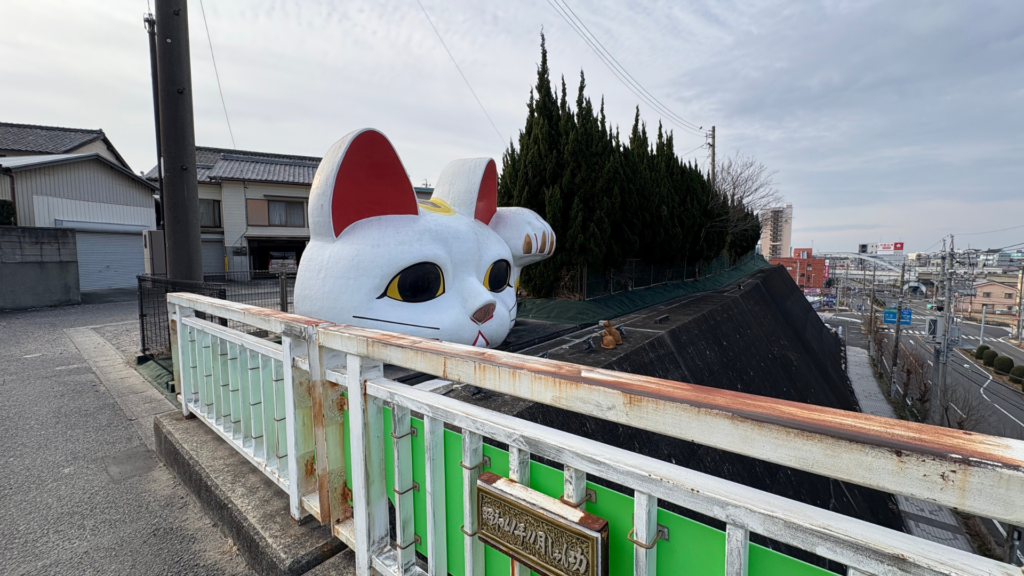
The work at the workshop may seem to have changed a great deal, but at its root, almost nothing has changed.
Still, the challenges they must face to keep going grow year by year.
“What do you value now?”
The answer came down to the way they make them and the way they train people.
What Ms. Tomimoto Values
- “120% handmade”: the extra 20% is “love”
- The step that takes the most care is painting the “eyes”
- Training people to handle painting the eyes and setting the expression
- No mechanization or overseas production, with quality control done by their own eyes
What “120% Handmade” Means
There is a phrase Ms. Tomimoto has used for many years.
Our maneki neko are 120% handmade.
Ms. Tomimoto
100% handmade is a given for a craftsperson.
The remaining 20%, she says, is “love.”
Putting feeling into each and every one.
Never getting careless.
Never letting routine take over.
Precisely because it is a good-luck object, the maker’s attitude shows directly in its expression.
It is not just about making a shape. It is complete only when it includes the feeling you bring to it.
That is what “handmade” means to Ms. Tomimoto.
The Eyes and Expression Decide Everything
Which step in making a maneki neko demands the most care?
Without hesitation, the answer was the “eyes.”
The size of the eyes.
How the outline is drawn.
The slight balance between left and right.
A single brushstroke can greatly change the impression of a maneki neko.
Once a line is painted, it cannot be redone.
That is why there is no room for hesitation at the moment the brush touches down.
Even with the same mold, what ultimately decides the “face” is the craftsperson’s own judgment.
Painting the eyes may be less a matter of technique than something close to resolve.
Training People Is Part of the Job
The workshop now has eight staff members.
Among them, people who share the most important steps with her have also grown.
・Painting the eyes
・Setting the expression
Getting to the point of entrusting someone with the most delicate parts took both time and resolve.
Technique can be taught, but a feel for it cannot easily be shared.
Even so, she cannot keep carrying it all alone.
Both so that she herself can go out into the world and so that the culture can be passed to the next generation, training people has become an essential part of the work.
The Difficulty of Balancing Higher Output with Quality
Sometimes people ask, “Can’t you make more?”
But they decided from the start not to take the options of mechanization or overseas production.
To make more, they must not break what is essential.
Even when expanding production through partnerships, the final finishing and quality control are always done where their own eyes can reach.
・Checking for flaws
・How pieces are touched
・How pieces are handled
If even one of these slips, the quality of the whole drops.
“Making them properly” over “making a lot of them.”
That order of priorities has not changed, even now.
How She Thinks About the Future
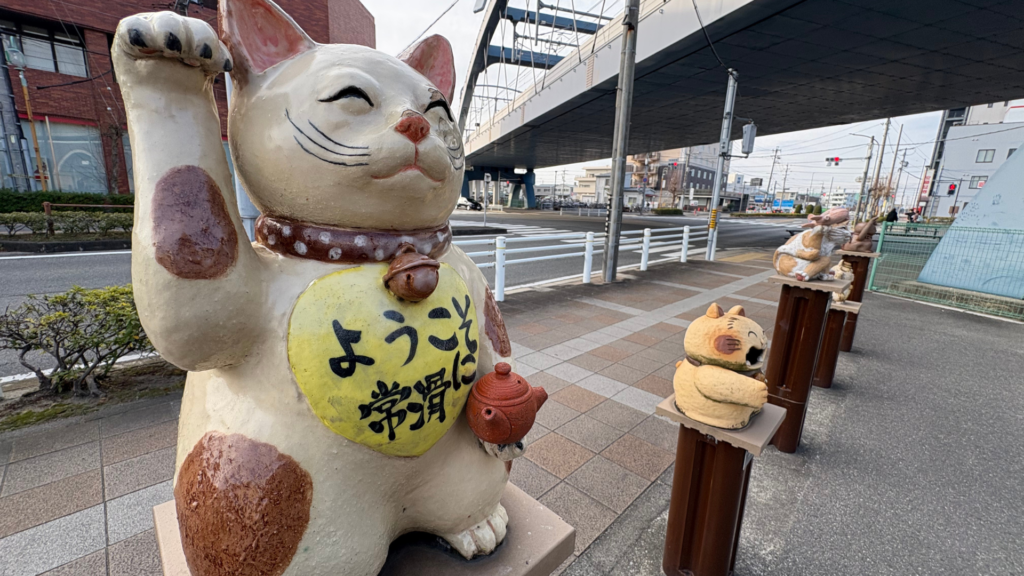
When we asked about the future, Ms. Tomimoto seemed to be choosing her words a little carefully.
Though she laughed and said, “That’s a hard one,” what she said was consistent.
I do want to try new things.
Ms. Tomimoto
I want to get out there, too.
I want more people around the world to know (about the maneki neko), too.
But before that, there is a “core” that must never be lost.
If keeping that core becomes impossible, then no matter how big the opportunity, it means nothing.
“Being Known” Before “Being Bought”
Surprisingly, what Ms. Tomimoto said was not the words “I want to sell.”
What matters is first having people know about it.
・What it is
・Where it is made
・What it means
If people pick one up after knowing that, she would be glad.
Before “having people buy,” comes “having people understand.”
Her stance of not wanting to get that order wrong is very clear.
The same goes for overseas.
Rather than selling large numbers, she believes it is far more important that people understand “this is a maneki neko made in Tokoname, Japan.”
Sharing “Tokoname” Through the Maneki Neko
Her feelings for Tokoname come through in everything she says.
“Where is Tokoname?”
She still gets asked that quite often.
・Near Nagoya
・The town with the airport
The reality is that not many people yet have any image of it beyond that.
That is why she wants the maneki neko to be the way people come to know Tokoname.
Not the maneki neko stepping forward alone, but the land and culture behind it being conveyed along with it.
For Ms. Tomimoto, the maneki neko is “the star” and, at the same time, a gateway to the place called Tokoname.
The Choice to Keep Protecting a Culture
When it comes to increasing output, certain options always come up.
Cutting costs.
Streamlining.
But she does not take that path.
Because it’s something we make as part of Japanese culture.
Ms. Tomimoto
She said this not as a strong assertion but as a perfectly natural feeling.
To keep going, some streamlining is necessary too.
But the moment you get its true form wrong, the culture breaks.
What she has been told since her grandfather’s generation and what she feels now point to the same place.
That is why, no matter how hard it gets, the premise of “continuing to protect the culture” does not move.
Telling What May Change from What Must Not
Times change.
What people want changes too.
・Exhibitions
・Collaborations
・Introductions overseas
Until now, there have not been many chances to go out into the world, but from here on she also wants to start moving, little by little.
That does not mean doing anything and everything, though.
The parts whose form may change, and the parts that must not.
If that line is drawn in the wrong place, the maneki neko itself becomes distorted.
Not going against trends, but not being swallowed by them.
Ms. Tomimoto believes that keeping that sense is what is needed to connect to the future.
“Keep Going for as Long as We Can”
The last thing she said was very quiet.
I’d like to keep going for as long as we can.
Ms. Tomimoto
Rather than holding up a grand ideal, it is about doing the same work properly tomorrow as today.
At the end of that accumulation, there is the next generation, and the culture remains.
Through the maneki neko, helping people know Tokoname.
That this cycle will keep quietly going on.
This is Ms. Tomimoto’s vision of the future.
In it was a realistic and sincere hope that only a kiln with such a long history could speak of.
In this article, we have introduced a part of how Baigetsu Tomimoto Ningyoen has made maneki neko and the thinking behind how it has kept going.
To see their maneki neko and how they are made, please also visit the official website of Baigetsu Tomimoto Ningyoen (in Japanese).