What You’ll Learn
- A nekomata is an old cat whose tail splits in two
- It lives in two forms, a mountain beast and a house cat
- Records run from a 1233 diary to Edo prints
- Fear of forked tails may have favored short-tailed cats
A nekomata (猫又) is a cat that, in Japanese belief, grows old until its tail splits in two and it gains supernatural powers. Old records also describe it as a man-eating beast that lives deep in the mountains.
The name joins neko (cat) with mata (fork), and Japanese dictionaries describe its tail as forked into two. It is the older of Japan’s two main cat yokai, or supernatural creatures, in written records.
This guide draws on Japanese dictionaries, folklore reports collected by the International Research Center for Japanese Studies and the Japan Tourism Agency’s multilingual database. It also uses Maneki Neko Lab’s interview with folklorist Yoshiyuki Iikura of Kokugakuin University.
What Is a Nekomata?
A nekomata is an aged cat with a forked tail and the power to harm people. Dictionaries list it under two spellings, 猫又 and 猫股, and record more than one kind.
Nekomata meaning in brief
- An old cat whose tail splits into two, then shape-shifts
- One kind lives in the mountains, another grows out of a house cat
- The bakeneko is its close relative, defined by disguise
The Dictionary Definition of Nekomata
The Nihon Kokugo Daijiten, Japan’s largest Japanese dictionary, defines a nekomata as a cat that grows old, splits its tail in two and harms people by shape-shifting. The Daijisen dictionary gives the same picture, with a tail forked in two.
Both spellings appear as headwords. The second character of 猫股 means a fork, a good match for the split tail that defines the creature.
The Heibonsha World Encyclopedia adds two more traits. Nekomata were said to have split tails, to transform and even to speak human words.
Source: Kotobank, “Nekomata”(猫股), Nihon Kokugo Daijiten, Daijisen and Heibonsha World Encyclopedia
Mountain Nekomata and House-Cat Nekomata
The Daijisen Plus dictionary notes that nekomata stories come in more than one form. Some describe a pet cat that turned into a monster with age, while others tell of a huge beast living in the mountains.
The two kinds of nekomata
| Kind | What it is | Typical setting |
|---|---|---|
| Mountain nekomata | A large beast that attacks and eats people | Deep mountains, roads near villages |
| House-cat nekomata | A pet cat that turns monstrous after many years | A home, a temple, a funeral |
Source: Kotobank, “Nekomata”(猫又), Daijisen Plus
The two kinds were never fully apart. Encyclopedia Nipponica summarizes the folktale “The Cat and the Hunter,” in which a house cat watches its owner count his bullets, then attacks him in the mountains as a monster.
The hunter survives because he kept one hidden bullet. In this tale, the mountain beast is the family cat in disguise, so the two kinds of nekomata meet in one story.
Nekomata vs Bakeneko
The short difference is that a nekomata is marked by its forked tail, while a bakeneko (化け猫, “changed cat”) is marked by its disguise. Village tales and Edo plays often blend the two, and our bakeneko guide compares them in a table.
Our overview of Japanese cat yokai places both alongside the kasha, a corpse-stealing spirit often said to be a cat.
The Earliest Records of the Nekomata
The nekomata appears in writing from 1233, more than 600 years before the maneki neko (招き猫, “beckoning cat”) is recorded by name. Early records place it in the wild, and later ones bring it indoors.
Nekomata records at a glance
- 1233: a beast in Nara kills seven or eight people in a night
- Around 1331: a famous essay jokes about a nekomata scare
- Edo period: essays tell of cats that speak and eat like people
Meigetsuki, 1233: A Beast in Nara
The first known example is an entry in Meigetsuki, the diary of the poet Fujiwara no Teika. It is dated the second day of the eighth month of 1233 (Tenpuku 1), as the Nihon Kokugo Daijiten quotes it.
The diary reports a “nekomata beast” near Nara, then the southern capital. In one night it ate seven or eight people, and many died.
Teika writes the name as 猫胯, with a character for the crotch, close in sense to 股. He adds that some people killed the beast, which had eyes like a cat and a body as long as a dog.
Encyclopedia Nipponica gives the same year and toll. So the oldest nekomata on record is a dangerous animal, not yet a transformed pet.
Source: Kotobank, “Neko”(ねこ), Encyclopedia Nipponica and Heibonsha World Encyclopedia
Tsurezuregusa, Around 1331: The Monk and His Dog
About a century later, Tsurezuregusa (Essays in Idleness) opens episode 89 with a rumor. It reports a nekomata in the deep mountains that eats people, as the Nihon Kokugo Daijiten quotes the line.
The same episode adds that even away from the mountains, a cat that grows old can become a nekomata. The dictionaries cite this line under the verb heagaru, “to grow old.”
Iikura told Maneki Neko Lab that the episode is a joke. A monk panics at what he takes for a nekomata attack, but the animal that leaps on him turns out to be his own dog.
So this essay holds both kinds of nekomata in one passage. It also shows that by the 14th century the creature was familiar enough to laugh at.
Source: Kotobank, “Heagaru”(経上る), Daijisen and Nihon Kokugo Daijiten
Edo Essays: Cats That Talk and Eat Like People
In the Edo period (1603–1868), essays brought the nekomata into temples and teahouses. The Yokai Folklore Database of the International Research Center for Japanese Studies summarizes several.
Shin Chomonju tells of a red cat kept at a subtemple of Zojoji in Edo during the Genroku era (1688–1704). Chasing a mouse, it fell from a beam and cried out a Buddhist prayer, and when people called it a nekomata, it vanished.
Baio Zuihitsu records a stranger case from the spring of 1796. Regular guests ate and drank at a teahouse, then the owner learned they had died seven years before.
Looking back, the owner recalled that they had eaten three flatfish, heads and bones and all. The essay concludes they must have been nekomata.
Source: Nichibunken Yokai Folklore Database, case 3490095 (Shin Chomonju)(怪異・妖怪伝承データベース), Nichibunken Yokai Folklore Database, case 3610007 (Baio Zuihitsu)(怪異・妖怪伝承データベース)
Nekomata in the records
| Record | Era | What it says |
|---|---|---|
| Meigetsuki (diary of Fujiwara no Teika) | 1233 | A nekomata beast near Nara kills seven or eight people in a night |
| Tsurezuregusa (episode 89) | Around 1331 | A man-eating nekomata in the mountains, and old cats that become one |
| Play titled Nekomata, Mandayu-za theater, Kyoto | 1696 | A monster cat reaches the stage |
| Shin Chomonju | Genroku era (1688–1704) | A temple cat cries a prayer and is taken for a nekomata |
| Gazu Hyakki Yagyo by Toriyama Sekien | 1776 | A picture book of yokai that includes a nekomata |
| Baio Zuihitsu | 1796 | Dead guests who ate fish whole are judged nekomata |
| Folklore report, Marugame, Kagawa | 1931 | An old house cat splits its tail and dances on its hind legs |
Source: Kotobank, “Nekomata”(ねこまた), kabuki and joruri titles
The Split Tail and Why Short Tails Were Favored
The forked tail is the sign that an ordinary cat has become a nekomata. Folklore reports explain when the split happens, and a library reference case links the fear to a preference for short tails.
The nekomata tail
- Reports say the tail splits once a cat grows old or large
- Red male cats were thought most likely to change
- Edo cat lovers may have favored short tails for this reason
When a Cat’s Tail Splits
Village reports agree that the split comes with age. A 1931 report from Marugame in Kagawa Prefecture says an old cat becomes a nekomata, its tail splits in two and it dances on its hind legs.
A report in the Miyazaki prefectural history (1992) ties the change to size. A cat that grows past one kan (about 3.75 kg) leaves home to train in the mountains and returns after one, two or seven years as a nekomata.
According to the same report, the tip of the tail splits in two, and red male cats change most easily. Families placed a newborn kitten in a masu, a square wooden measure, as a charm against growing too big.
These reports set no single age. Instead, they read a long life and a large body as warning signs, and the tail as the visible proof.
Source: Nichibunken Yokai Folklore Database, case 0640390 (Marugame, Kagawa)(怪異・妖怪伝承データベース), Nichibunken Yokai Folklore Database, case C4510104-000 (Miyazaki)(怪異・妖怪伝承データベース)
Short Tails and Fear of the Nekomata
One explanation holds that Edo cat lovers favored short tails partly out of fear of the nekomata. Okayama Prefectural Library summarizes it in a case on the National Diet Library’s reference database.
The book it cites, Neko Zukushi Nihonshi, notes that cats in pictures had long tails until the Muromachi period (1336–1573). Short-tailed cats first appear in the work of Kitagawa Utamaro (1753–1806).
The same book suggests that a long tail could look like a snake, and that a long-tailed cat might split its tail and become a nekomata in old age. People who thought so kept short-tailed cats and helped them spread.
A second book in the case, Neko no Kyokasho, says the nekomata legend reached ordinary Edo people and made long tails disliked. Both are explanations from books, and genetics also plays a part.
The gene behind short tails, and how the Japanese Bobtail breed grew from Japanese street cats, are covered in our bobtail guide.
In Nagasaki, by contrast, a kinked tail is read as lucky. Our Nagasaki guide explains the hook and lock meanings given to bent tails there.
Nekomata in Mountains, Funerals and Place Names
Beyond the records, local tales tie the nekomata to real mountains and to the care of the dead. These stories show where people expected the creature to appear.
Where nekomata appear in local tales
- Mt. Nekomadake in Fukushima is named the “evil cat peak”
- Hunters and swordsmen fight nekomata in the hills
- A cat stepping over a body was feared at funerals
Mt. Nekomadake, the Evil Cat Peak of Fukushima
Mt. Nekomadake (猫魔ヶ岳), a 1,404-meter peak west of Mt. Bandai in Fukushima Prefecture, takes its name from cat legends. The Japan Tourism Agency’s multilingual database translates the name as “evil cat peak.”
The most common story, it says, tells of a vicious cat that lived on the mountain. It disguised itself as a human to lure people and ate them.
The Buddhist monk Kukai (774–835) is said to have trapped the cat inside a great pile of boulders on a lower peak. The Fukushima prefectural history (1967) adds a cat stone near the mountain, where a nekomata once ate people and no plants grow.
Source: Japan Tourism Agency, “Mt. Nekomadake”(猫魔ヶ岳), Kotobank, “Nekomagatake”(猫魔ヶ岳), Encyclopedia Nipponica, Nichibunken Yokai Folklore Database, case C0730350-000 (Fukushima)(怪異・妖怪伝承データベース)
Iikura told Maneki Neko Lab that Nekomadake is also a cat mountain in folktales. Missing cats were said to go there and train to become nekomata, under a cat king of their own.
Hunters and Swordsmen in the Hills
Mountain tales often end in a fight with a nekomata that weapons cannot easily stop. In a 1969 report from Niigata Prefecture, bullets missed a man-eating nekomata, so a strong man wrestled it until both died.
A 1943 report from Mt. Haguro in Yamagata Prefecture tells of a man who killed a nekomata with an heirloom sword. The beast’s grudge then brought one misfortune after another to his house.
A 1984 report from Kagawa Prefecture notes that the mountains of Kuboya hold many nekomata. In these tales, the creature belongs to the wild land beyond the village, as in the 1233 diary.
Source: Nichibunken Yokai Folklore Database, case 0780296 (Niigata)(怪異・妖怪伝承データベース), Nichibunken Yokai Folklore Database, case 1231302 (Mt. Haguro, Yamagata)(怪異・妖怪伝承データベース)
Cats and the Dead
House-cat nekomata were feared most around a body awaiting burial. A 1933 report from Tsukui in Kanagawa Prefecture says that if a cat stepped over a corpse, the dead could rise and become a nekomata.
A 1943 report from Hida in Gifu Prefecture tells the same belief. So families kept watch to keep cats away from the dead, according to a 1976 report from Ehime Prefecture.
A 1968 report from Okayama goes further. Three nekomata plotted to snatch a body during a funeral, and a priest struck one with his prayer beads.
The Heibonsha World Encyclopedia notes that China kept a similar taboo against bringing cats near the dying or dead. The kasha, Japan’s corpse-stealing spirit, belongs to the same circle of beliefs, as our cat yokai overview explains.
Source: Nichibunken Yokai Folklore Database, case 1232370 (Tsukui, Kanagawa)(怪異・妖怪伝承データベース), Nichibunken Yokai Folklore Database, case 0310063 (Okayama)(怪異・妖怪伝承データベース)
Nekomata in Ukiyo-e and Picture Scrolls
Edo artists drew the nekomata with two tails, often dancing or playing music. Their pictures turned a feared beast into a familiar, even playful figure.
Nekomata in Edo art
- Toriyama Sekien included a nekomata in his 1776 yokai book
- Scrolls show nekomata in kimono, playing the shamisen
- Kuniyoshi drew a giant nekomata shadow in an old temple
Sekien and the Yokai Picture Scrolls
Toriyama Sekien (died 1788), an Edo painter and teacher of Utamaro, was known for his pictures of yokai. The National Diet Library dates the first, Gazu Hyakki Yagyo, to 1776.
A reference case on the National Diet Library’s database lists a picture titled “nekomata” in that book. The entry gives the creature a fixed place among Edo yokai.
Picture scrolls held by the International Research Center for Japanese Studies show other sides. In one by Hokusai Suechika, a cat monster with long hair plays the shamisen, its tail showing under the kimono.
The Shokoku Yokai Zukan scroll shows a nekomata in a blue kimono, again playing the shamisen. These images dress the nekomata as a woman of the town.
Source: Kotobank, “Toriyama Sekien”(鳥山石燕), Heibonsha World Encyclopedia, National Diet Library Image Bank, “Toriyama Sekien’s Yokai”(鳥山石燕の妖怪), Collaborative Reference Database (National Diet Library), case on nekomata pictures(レファレンス協同データベース), Nichibunken Yokai Image Database, Hokusai Suechika, “Nekomata”(化物尽絵巻)
Kuniyoshi and Yoshiiku: Looming and Dancing Cats
Two Utagawa school artists show the range of the nekomata in prints. Utagawa Kuniyoshi drew a late-Edo scene of a nekomata that has grown old and haunts an old temple.
In it, a huge nekomata shadow rises before the characters Inabanosuke and Teranishi Kanshin, with an old woman’s ghost beside it. The title itself says the cat caused the haunting after many years.
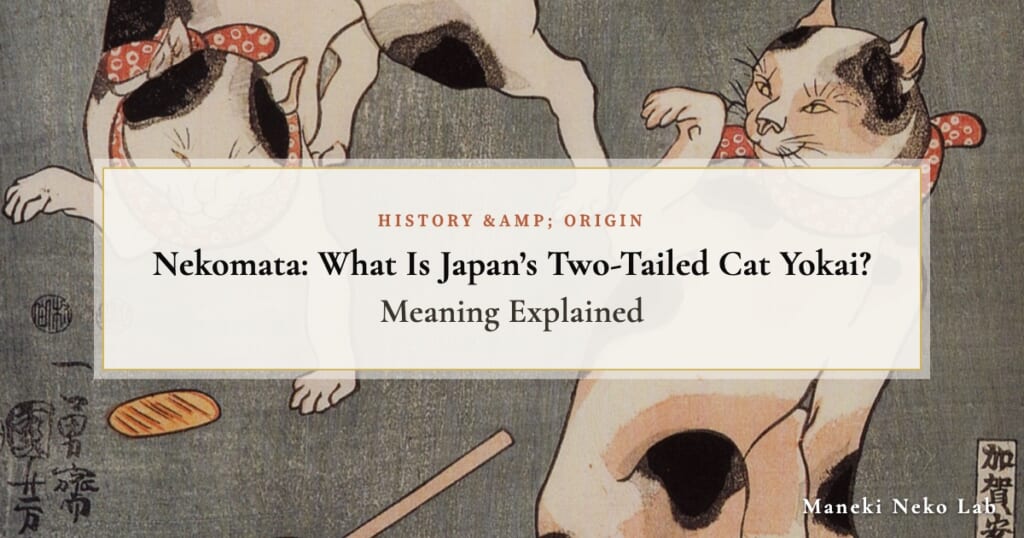
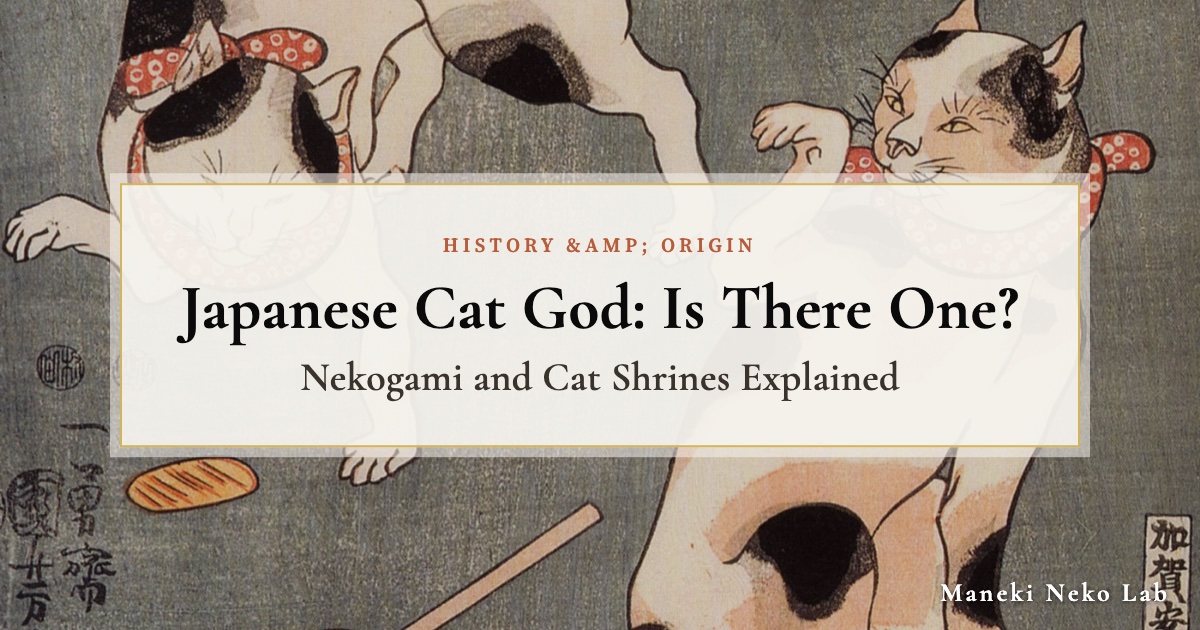
Utagawa Yoshiiku’s sheet of 27 monsters, dated 1853, is lighter. It shows two calico cats standing up to dance with towels on their heads, each with two tails.
Source: Nichibunken Yokai Image Database, Utagawa Kuniyoshi, “Nekomata”(昔ばなしの戯猫又年をへて古寺に怪をなす圖), Nichibunken Yokai Image Database, Utagawa Yoshiiku, “Shinban Bakemono Zukushi”(新板化物づくし)
Kuniyoshi also led the vogue for cat prints in Edo in 1841–42. Our ukiyo-e guide follows that vogue to the beckoning cats of the 1850s.
Why Did the Same Country Make the Lucky Maneki Neko?
In Maneki Neko Lab’s view, Japan made both because the power people feared in an old cat could also serve the household. Even nekomata tales sometimes end with the cat repaying the people who kept it.
From nekomata to maneki neko
- Some nekomata kill rats or bring a poor temple fortune
- A Niigata shrine called Nekomata Gongen became a god of prosperity
- The Lab reads the maneki neko as the same cat, put to work
Nekomata That Helped Their Keepers
Not every nekomata harmed its owner. A 1985 report from Kagawa Prefecture tells of a cat that a priest saved from a fisherman by the Yoshino River. It became a nekomata about three years later and killed a giant rat in the temple hall.
In an Edo essay, Shokoku Rijindan, a temple cat that ate other cats like a nekomata went home with a vegetable seller. A few days later the seller came to give thanks, because the cat had killed the wicked rat in his house.
A 1955 report from Yamagata Prefecture tells of a poor temple’s tabby that lifted a coffin into a black cloud at a funeral. When the poor priest was called to pray, the coffin came down, and the temple prospered from then on.
Encyclopedia Nipponica records the same pattern in the folktale “Neko Danka.” There, a poor temple’s cat uses its magic to win the temple new parishioners, repaying its keeper.
Source: Nichibunken Yokai Folklore Database, case 0470122 (Kagawa)(怪異・妖怪伝承データベース), Nichibunken Yokai Folklore Database, case 3880037 (Shokoku Rijindan)(怪異・妖怪伝承データベース), Nichibunken Yokai Folklore Database, case 2360105 (Yamagata)(怪異・妖怪伝承データベース)
From a Feared Name to a God of Prosperity
The nekomata name itself ended up on a god of good fortune. Nanbu Shrine in Nagaoka, Niigata Prefecture, enshrines a god of sericulture also called “Nekomata Gongen.”
According to Nagaoka’s tourism site, silk farmers once prayed there to keep rats from silkworms and cocoons. They also worshiped it as a god of thriving business, a maneki neko.
Source: Nagaoka Tourism Navi, “Nanbu Shrine”(南部神社)
In Maneki Neko Lab’s reading, the nekomata is the old cat’s power seen with fear. The maneki neko is the same watchful cat, turned toward welcoming people, and our guide to why cats are lucky in Japan traces that side.
The figure carries its wish in the paw. Maneki Neko Lab defines the raised right paw as inviting money and the left paw as inviting people. So the paw that a feared cat might once have used against people now beckons fortune in.
Other places where feared cats became gods, from Nagaoka to Tokushima, are gathered in our guide to Japanese cat gods.
After seeing the nekomata turn from a feared beast into a god of prosperity, you may want a cat that stays on the welcoming side. One answer is Hanaikada (花筏, white) from Luxen Maneki, a brand of Japan ManekiNeko Research Institute, Inc., the company that runs Maneki Neko Lab. Artisans at a traditional kiln in Seto hand-paint its gold.
Frequently Asked Questions
Q. How many tails does a nekomata have?
A. Two. Japanese dictionaries define the nekomata by a tail that splits into two forks as the cat grows old. Some village reports say only the tip divides. Edo prints such as Utagawa Yoshiiku’s show two full tails, and the forked tail is what separates a nekomata from an ordinary cat or from a bakeneko in most accounts.
Q. How did people get rid of a nekomata?
A. Folklore reports give several ways. A 1931 report from Kagawa says a family could feed the cat red bean rice with fish, put a red towel on its head and send it off. A Yamagata tale stood a sword on the roof ridge to stop a curse, and a hunter in another tale kept one hidden bullet.
Q. Did other countries have similar beliefs about old cats?
A. Yes. The Heibonsha World Encyclopedia notes that in Europe, old cats were believed to become devils or witches. In China, it says, aging cats were thought to grow uncanny, speak or sing, and transform by absorbing moonlight. These are separate traditions from the Japanese nekomata, though all link a cat’s long life with strange power.
Q. Is the cat in a nekomata story always evil?
A. No. Many tales show nekomata eating people or stealing bodies, but others show them killing giant rats or bringing a poor temple new followers. Japanese folklore rarely makes the cat purely good or bad. Whether a story fears or thanks the cat often depends on how its keepers treated it.
Luxen Maneki, Made by Maneki Neko Lab
The nekomata shows how much power Japanese folklore saw in a cat kept for many years. A maneki neko, too, is meant to stay with one household for a long time, so how it is made matters.
Luxen Maneki is a brand of Japan ManekiNeko Research Institute, Inc., the company that runs Maneki Neko Lab. Its white Hanaikada (花筏), gold Nishikigoi (錦鯉) and black Ukiyo (浮世) are made in Seto ware, one of Japan’s Six Ancient Kilns.
Unlike mass-produced figures, each piece is made to order over about four to six weeks, with gold hand-painted by artisans. It arrives in a paulownia wood box, and we ship worldwide.
Summary
A nekomata is an old cat whose tail splits in two as it gains supernatural powers, and older records also describe it as a man-eating mountain beast. The name appears from 1233 in Fujiwara no Teika’s diary and around 1331 in Tsurezuregusa.
Local tales place it on peaks such as Mt. Nekomadake and beside the dead at funerals. Fear of the forked tail may even have shaped which cats Edo people kept.
Yet some nekomata repaid their keepers, and a Niigata shrine turned the name into a god of prosperity. To see that welcoming side, start with how the maneki neko came to be.