Why is the ribbon on a maneki neko (招き猫, the Japanese beckoning “lucky cat”) red? Almost no one knows the answer. You may be surprised to hear that the story goes all the way back to The Tale of Genji.
This interview was conducted in Japanese and translated by Maneki Neko Lab. Read the original Japanese interview.
According to art historian Noriko Okubo (hereafter Okubo), however, it is no coincidence at all, but the product of a cultural “continuity” spanning more than a thousand years.
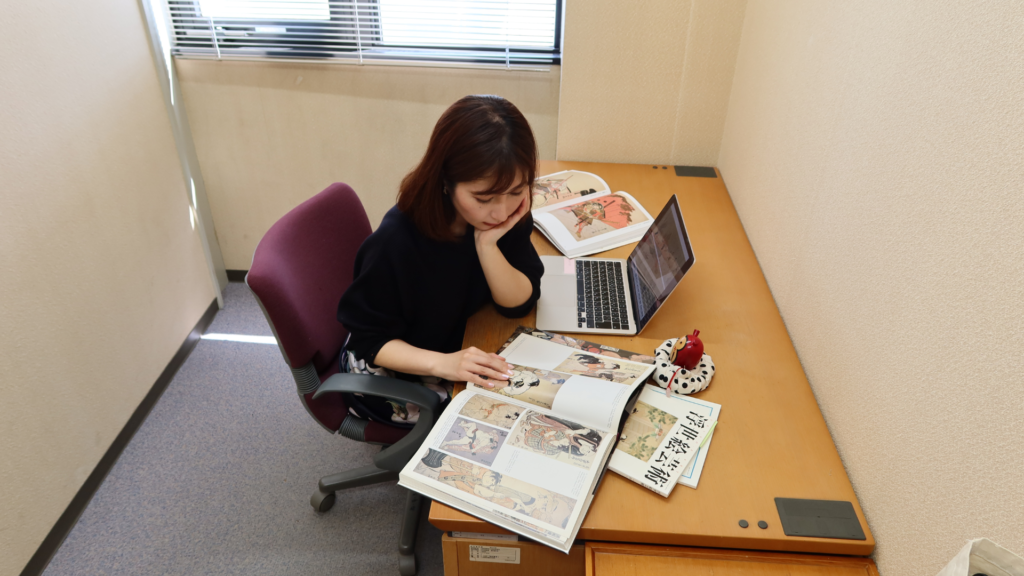
As an Associate Professor at the Graduate School of Humanities and Social Sciences, Okayama University, Okubo has specialized in ukiyo-e (浮世絵, Japanese woodblock prints) and Edo-period lucky charms, with a focus on sumo-e (相撲絵, prints of sumo wrestlers).
She says her research began when the lab she joined, drawn by a professor who “seemed to be having fun,” happened to specialize in Japanese art.
Then one day, while she was studying Japanese art, she went to the Kokugikan (国技館, Tokyo’s national sumo arena) to watch sumo. Noticing that the sumo prints she came across there were largely unexplored as a research subject, she decided to narrow her research to sumo-e.
As the title of her research project, “Popular Belief and Ukiyo-e: Focusing on the Representation of Sumo Wrestlers,” suggests, her interest goes beyond the artworks themselves, reaching deep into the beliefs and sensibilities of the ordinary people on the other side of the pictures.
Chapter 1: Ukiyo-e Was Mass Media — The “Explosion of Popular Culture” Born in Edo
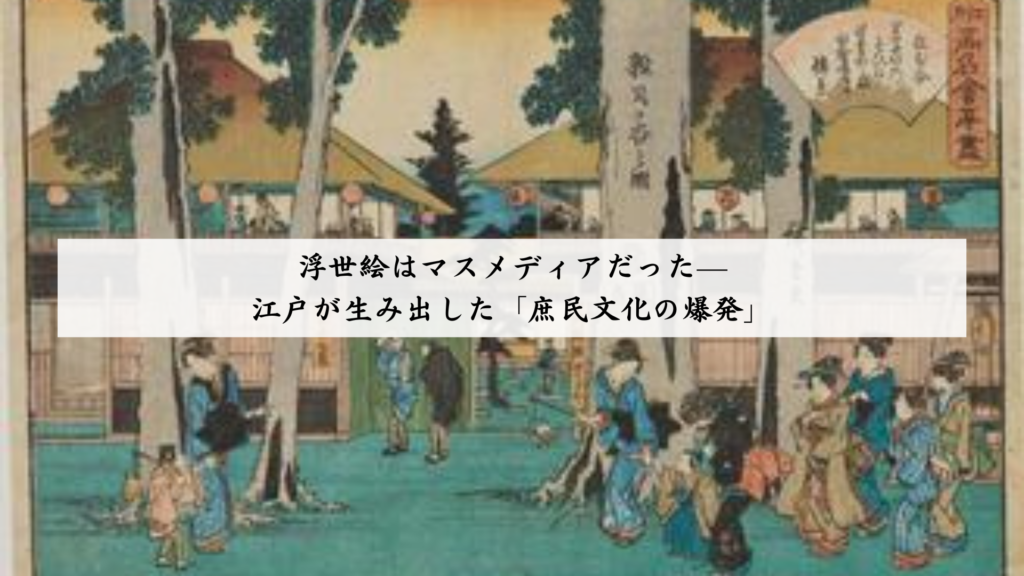
The sumo prints Okubo studies belong to the genre of ukiyo-e. Like prints of kabuki actors and of beautiful women, sumo-e were a kind of bromide, portraits of wrestlers drawn and sold to fans.
There were no photographs back then, and the demand to keep a picture of a famous, popular wrestler close at hand helped grow the ukiyo-e market.
But the significance of ukiyo-e goes beyond bromides. Okubo states it firmly.
Ukiyo-e were mass media (much like TV today). In the sense of a visual culture of mass production and mass consumption, that is exactly what ukiyo-e were in the Edo period.
Okubo
Until then, paintings were one-of-a-kind works that aristocrats and other privileged classes commissioned from painters. Only a very small upper class could own pictures.
Woodblock printing, however, made cheap mass production possible, and ordinary people who had never dreamed of “owning a picture” could now buy one at an affordable price.
What matters here is the background: why ordinary people in Edo came to have room in their lives to buy pictures.
Before the Edo period, ordinary people worked from morning to night just to get through each day. Then a long stretch without war, together with political stability, gave them leisure time, and economic breathing room as well.
Ordinary people gained access to education, literacy rose, and reading as a hobby spread all the way down to commoners. This was a strikingly early change even by world-historical standards, Okubo says.
In places like Britain, education hadn’t reached ordinary people. The privileged classes didn’t think they needed to actively educate the lower classes in order to rule them. Because people who don’t know are easier to rule.
Okubo
Japan had literate commoners from early on. Even so, reading and writing ability varied widely among people at the time.
Some could read fluently, while others could only read by checking one character at a time. For such people, pictures were an extremely important information medium (as an aid to the written explanation).
Illustrations are really important, aren’t they? You can understand what’s written through the pictures (even if your grasp of the text is shallow). So apparently illustrated books sold better.
Okubo
Once publishers realized that illustrated publications sold, they added more and more pictures. Books packed with pictures sold well.
Eventually a demand arose for “just the picture, as a single sheet.” That led to the development of ukiyo-e, Okubo explains.
Ordinary people became not only “receivers” of culture but its “creators.” This shift is the very essence of Edo.
Until then, culture was something the privileged classes made (to enjoy their leisure). Only in the Edo period did ordinary people become the protagonists, the ones creating culture. Even globally, that really is unusual.
Okubo
Chapter 2: “Food,” “Travel” and “Health Remedies” — The Everyday Life of Edo Recorded in Ukiyo-e
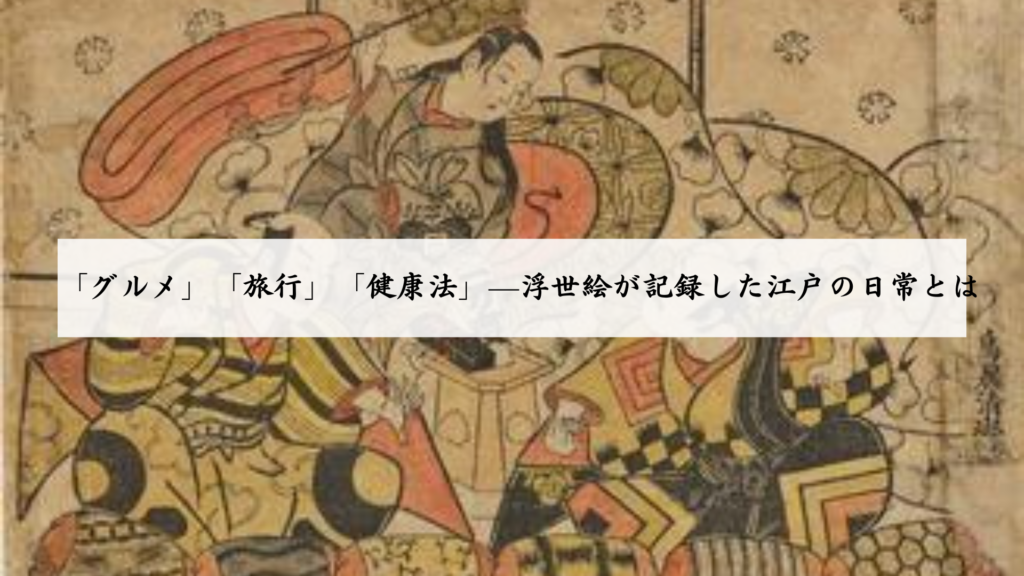
“Edo is amazing, you know. There’s still so much more to dig into.” Okubo said this with a laugh as she began to talk about the everyday culture of Edo.
Ukiyo-e depicted more than actors and wrestlers. Food, travel, entertainment, even health remedies: the daily lives of ordinary people are recorded visually. The roots of today’s food culture, in fact, also lie in Edo.
First, the development of the Five Routes (Gokaido, 五街道) and sea transport played a major role in the growth of food culture. As the shogunate built up the main roads and shipping routes (along the Sea of Japan and Pacific coasts), goods from all over Japan came to gather in Edo.
Specialties from every region arrived in one place. Sushi, tempura, soba, eel: much of the food culture we now call “Edomae” (江戸前, Edo style) was nurtured among ordinary people in this era. The sushi depicted in ukiyo-e was apparently much bigger than today’s, each piece with quite a presence.
Because Edo disliked anything suggesting seppuku (切腹, ritual belly-cutting), splitting eel down the back became the norm. Tofu was big too. Okubo’s words, “Everything was huge,” left a strong impression.
A travel boom also took place in the late Edo period. But travel at the time was a little different from travel today.
Each domain had its own checkpoints, and going to the neighboring domain required a legitimate reason. That is where the pretext of “Oise mairi” (お伊勢参り, the pilgrimage to Ise Grand Shrine) came in. Citing religious devotion got you through the checkpoints.
Each village set up a kind of group savings fund and took turns sending representatives on the Ise pilgrimage.
The person who went on behalf of the village would travel through the post towns eating the local food, visit Ise, buy souvenirs and return to the village. That’s how the cultures of different parts of Japan gradually became widely known.
Okubo

The development of regional specialties and local cuisines also owes much to the Five Routes and the Ise pilgrimage boom.
Customs that combine collector psychology with travel culture, like collecting goshuin (御朱印, temple and shrine seal stamps), can be seen as a variation on the Edo travel boom.
Health remedies were unique as well. How did the people of Edo deal with illness? The example Okubo gave was the story of Katsushika Hokusai.
Hokusai once suffered a chufu (中風, stroke). While many ukiyo-e artists were left paralyzed on one side, Hokusai recovered without lasting effects. Afterward he went on to create “The Great Wave off Kanagawa” (one print from his masterpiece series Thirty-six Views of Mount Fuji).
Hokusai himself credited his recovery to a medicine recipe of his own, and the recipe survives today. Yuzu citrus simmered with sake, medicinal Yomeishu (a herbal tonic liquor): a homemade prescription based on ideas akin to kampo (traditional herbal medicine).
There wasn’t science as such, so there was a way of thinking like kampo. Back then people had the idea that this food works for this or that.
Okubo
Even more interesting are “hashika-e” (はしか絵, measles prints). These ukiyo-e were made each time smallpox or measles broke out, and they spell out which foods you may and may not eat, charms to ward off the illness, and even the cycle of outbreaks (a rule of thumb: “It comes around about every 20 years, so be careful”).
Foods that seemed easy to digest were recommended, while fish (especially raw), high-fiber vegetables, oily foods and the like were avoided on the grounds that they “chill the body and are hard to digest.” There was no scientific basis, but a good deal of it makes sense even by today’s knowledge.
The foods you were allowed to eat were mostly things that seem fairly easy to digest. And it’s true, even today it’s kind of like that, isn’t it?
Okubo
Charms, lucky objects, the wisdom of kampo: every weapon the people of Edo had against the unseen was packed into the medium of ukiyo-e and spread among ordinary people.
Record, education and comfort all at once: ukiyo-e worked as that kind of multifunctional medium.
Chapter 3: Sumo, One of Edo’s Three Great Entertainments — The Only Popular Culture the Shogunate Never Banned
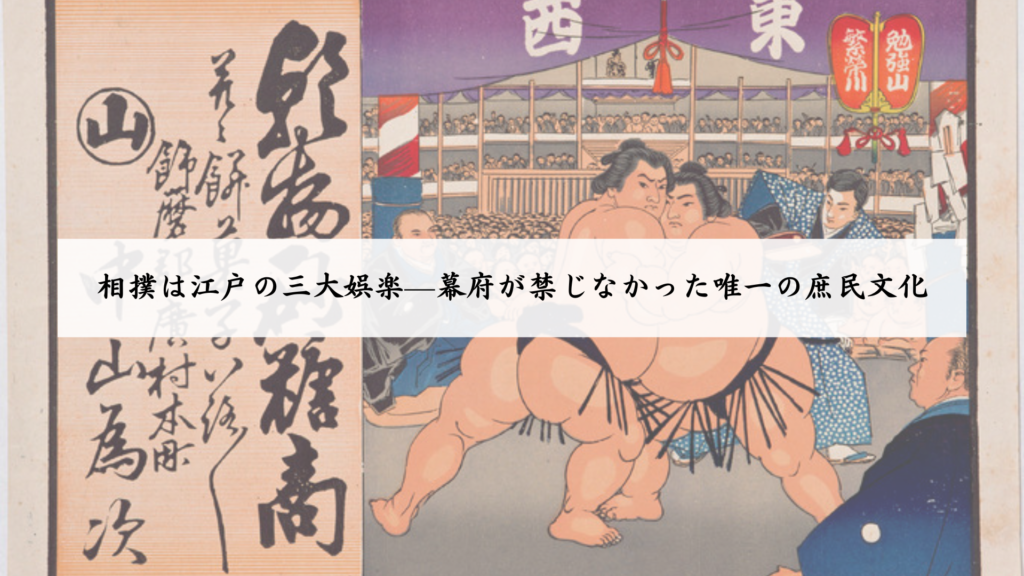
What did ordinary people in Edo do for entertainment? Okubo named three things: kabuki, pleasure quarters such as Yoshiwara, and sumo.
But the shogunate did not welcome all three equally.
Kabuki originated in popular theater performed by people called “kabukimono” (かぶき者/傾奇者), who were close to what we would now call hoodlums. Today kabuki is recognized as “high culture” that cultured people dress up in kimono to see, but back then it actually started out as something rather disreputable.
For that reason, the shogunate often suppressed kabuki and banned the publication of actor prints and prints of beautiful women as corrupting public morals. Yoshiwara, too, was hard to endorse openly.
Yet sumo alone was never suppressed.
The reason lies in the social status of wrestlers. Strong wrestlers were employed by the lords of the various domains and held the status of samurai. In Edo’s warrior society, the shogunate could hardly ban sumo performed by samurai.
In fact, the worse the economy, the more actor prints were banned, and the more sumo prints were produced in their place.
It was also a culture the state encouraged to a certain extent.
What fits really well with warrior society is sumo wrestlers, who train their bodies. On top of that, sumo wrestlers are samurai, so the strong wrestlers were retained by the lords of each domain. They were wrestlers in the lord’s service.
Okubo
Sumo has ancient origins. It appears in the Kojiki (古事記, Japan’s oldest chronicle), and originally wrestlers from the east and west competed as part of rituals held at the imperial court.
Later, in the age of the samurai, sumo came to be practiced as physical training, and eventually masterless samurai who could find no lord to serve organized their own sumo groups and put on shows.
That is the direct source of today’s sumo.
It needs no equipment. Anyone can do it anywhere.
“Mura-zumo” (村相撲, village sumo) was held at shrines and temples across the country, and sumo spread as a national sport.
As an entertainment sport in Edo, sumo was in a league of its own. After all, popular entertainment back then meant kabuki, Yoshiwara and sumo. Those were the unshakable big three, but sumo was the only one that people of every social class could easily say openly that they enjoyed.
Okubo
Sumo prints functioned as ukiyo-e resting on this cultural background. The same demand as today’s fans buying and collecting bromides of athletes, essentially unchanged, existed among the ordinary people of Edo.
Chapter 4: Why Did Sumo Wrestlers’ Handprints Become Lucky Charms? — The Deep Roots of Sumo and Popular Belief
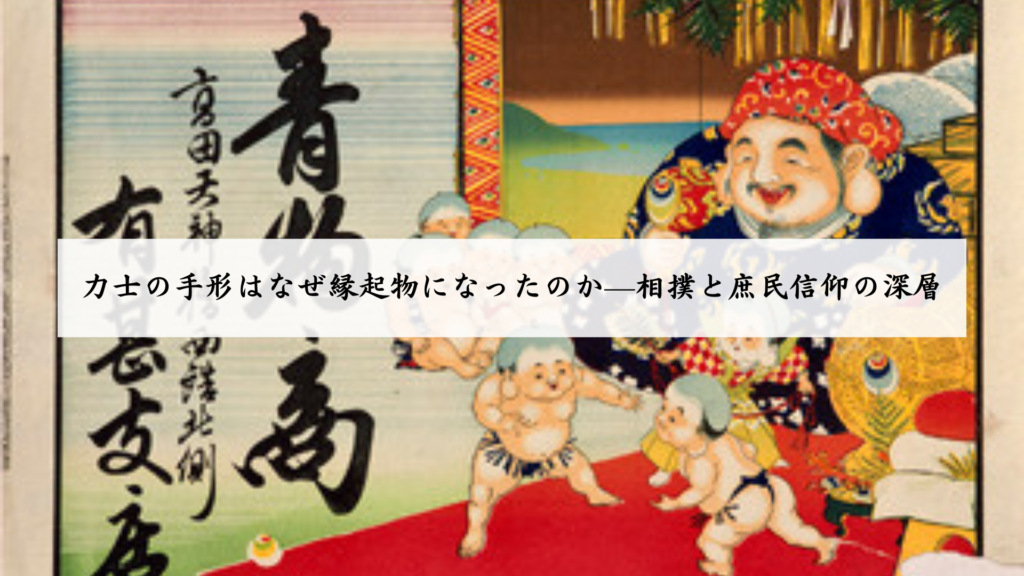
Many people have seen sumo wrestlers’ handprints displayed in restaurants. But few have wondered why it is a “handprint” (tegata, 手形). Okubo is pursuing exactly that mystery as an ongoing research theme.
Handprints basically still circulate today as talismans, charms, good-luck objects, for things like business prosperity or protection from epidemics, right?
Okubo
When and why did handprints become lucky charms? There is no definitive record. Handprints apparently came to circulate as lucky charms spontaneously: that, she says, is the course of events that emerges when you trace the sources.
It began with a naturalist’s curiosity about “giant wrestlers.”
The motive, “a person of extraordinary size must have a very large handprint, so let’s keep a record of it,” gave rise to the practice of pressing handprints onto paper.
At first, only the handprints of giant wrestlers were recorded. Over time, wrestlers who were both giant and extremely strong, at the level of yokozuna (横綱, sumo’s highest rank), also began to have their handprints taken.
Interestingly, “no handprints survive from wrestlers who were small but strong.” What mattered was being “big.”
Eventually, handprints of yokozuna and others appeared with added inscriptions such as “this handprint drives away evil” and “brings a good harvest.” From around this point, handprints began to function as lucky charms and protection against epidemics.
Why did people believe that spiritual power dwelt in an imprint of a wrestler’s living body? Here Okubo points to the “divinity” inherent in sumo culture as a whole.
Sumo wrestlers themselves apparently came to be seen in Edo culture as auspicious beings, as beings who connect the gods and humans.
Okubo
When a yokozuna spreads his legs wide and stamps during the dohyo-iri (土俵入り, ring-entering ceremony), it is an act to drive out evil spirits sleeping in the ground. A being charged with a special power to dispel evil: that is what a sumo wrestler is. Though human, he cannot be called entirely the same as the rest of us. He carries the power of the gods.
Wrestlers’ shikona (四股名, ring names) also reflect this worldview.
A lot of sumo wrestlers’ ring names come from a mountain or a river in their hometown, don’t they? That really is nature worship. There’s an idea that the god of a great mountain or river in the wrestler’s home region is giving the strength of that land through the wrestler.
Okubo
Something-yama (mountain), something-fuji: the ring names still used today are not mere custom but are deeply tied to Japan’s animistic nature worship. Gods dwell in big things.
Mount Fuji being an object of worship and sacred trees being held holy are extensions of the same idea. Wrestlers over 2 meters tall embodied that very “awe of big things,” and so overlapped with the logic of lucky charms.
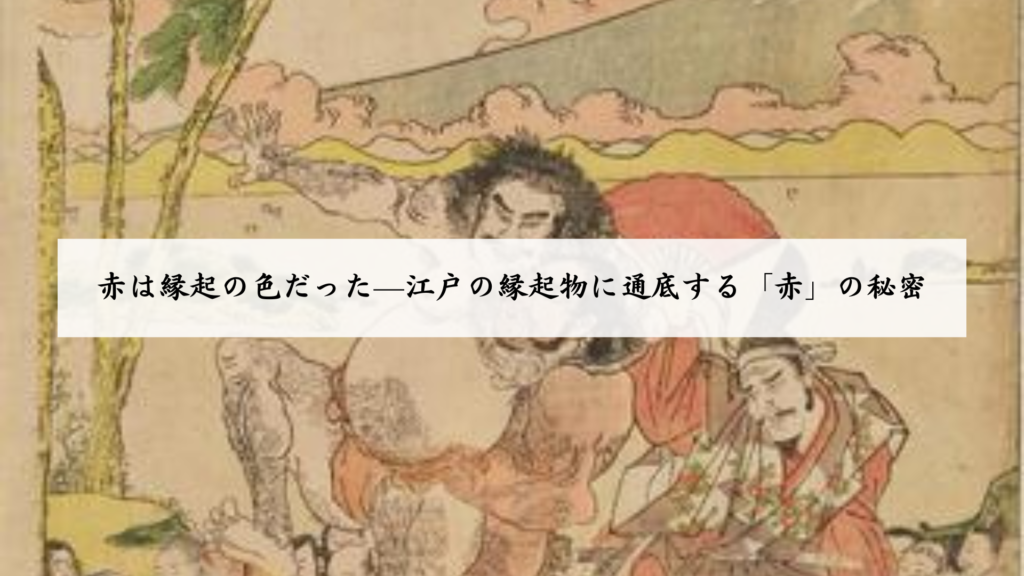
Chapter 5: Red Was the Color of Good Luck — The Secret of “Red” Running Through Edo Lucky Charms
Before we get to the maneki neko, one more piece of context is worth grasping.
It is the question of why red was considered a lucky color.
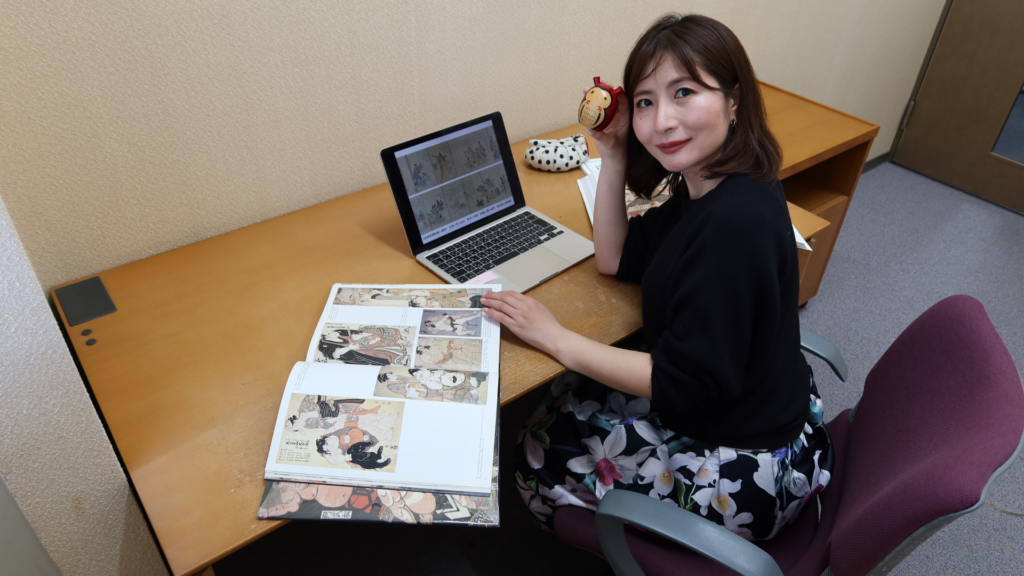
Okubo keeps a long-eared red horned owl (mimizuku, ミミズク) figure with her every day. Edo-period ukiyo-e also depict red horned owls of almost the same shape as lucky charms. It is, she says, a charm for “protection against smallpox.”
Smallpox (hoso, 疱瘡) was a terrifying disease that broke out again and again in the Edo period. In the folk belief of the time, there was a tradition that the “smallpox god” (hosogami) who spread the disease disliked the color red.
That is why so many toys and lucky charms for children are red. Daruma dolls are red too.
So many small items and children’s toys handed down from the Edo period are red. And in ukiyo-e there are also “aka-e” (red prints), some of which are printed entirely in red.
Okubo
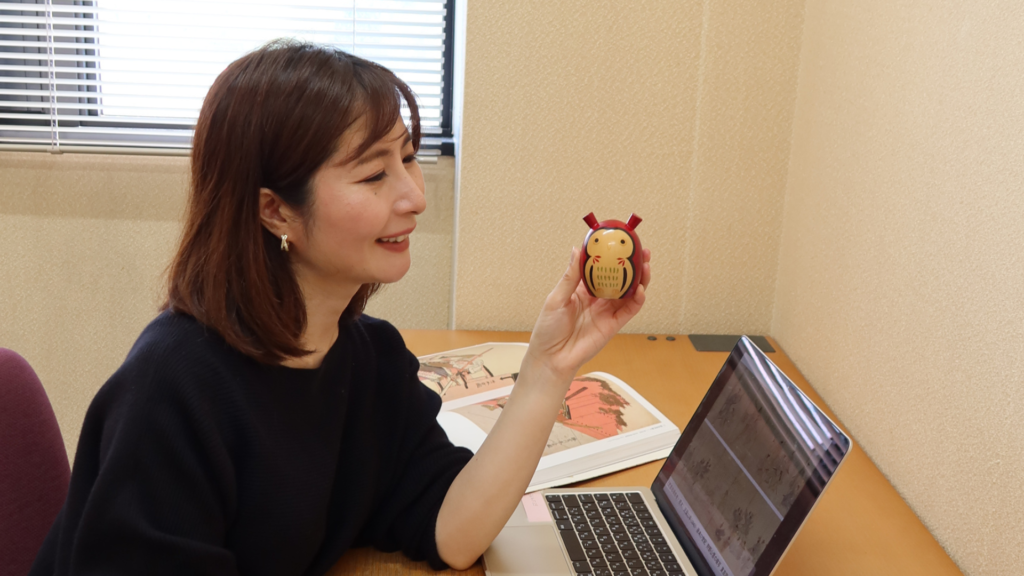
People believed that “this picture absorbs the evil” in measles prints, and once the illness had passed, the prints that had been put up were disposed of by burning them or floating them away on water. Because they were used as consumables, many were printed on poor-quality paper to begin with, she says.
Okubo also told us about another layer of meaning in the red horned owl.
Because smallpox often left people hard of hearing, the design emphasizes the ears, carrying the wish “may you keep hearing well.”
Horned owls are also known for seeing well in the dark, so they were popular as “charms for seeing what lies ahead.” Rabbit figures are also common among Edo lucky charms, and their red eyes and long ears likewise made them work as smallpox charms.
It’s red and the ears are emphasized. That’s exactly it, isn’t it? In that sense too, red is a pretty important color for lucky charms.
Okubo
Before we talk about the maneki neko’s red ribbon, knowing that Edo had this sense that “red is the color of good luck” will make the next part resonate all the more.
Chapter 6: Why the Maneki Neko’s Ribbon Is Red — A Cultural Continuity Reaching Back to The Tale of Genji
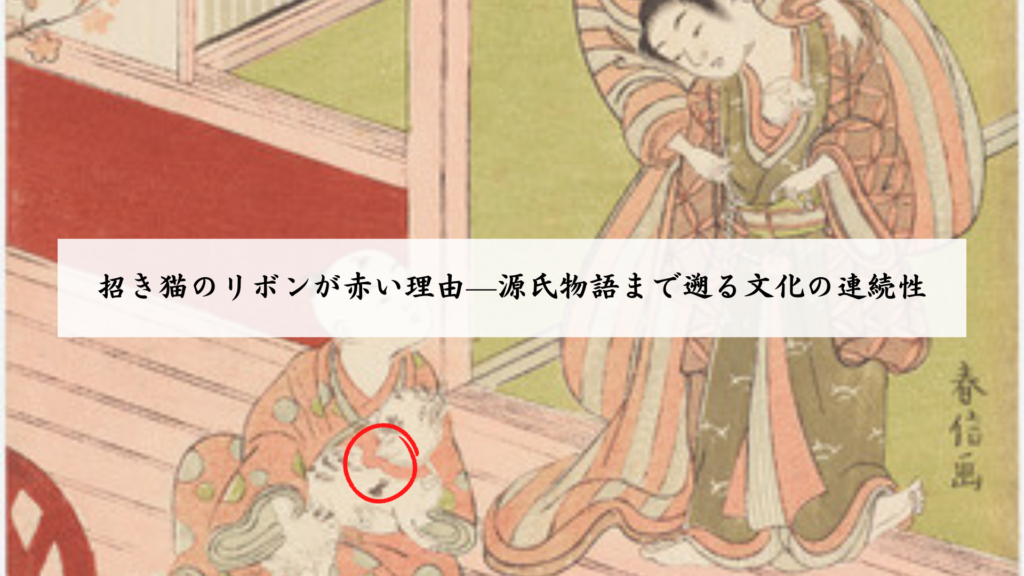
Okubo had long said she found the maneki neko’s red ribbon (collar) “personally fascinating.” Why red? Following that question takes us all the way back to the Heian period (794–1185).
Okubo’s view on why the maneki neko’s ribbon is red
- Karaneko (cats from China) were rare animals that aristocrats kept on cords
- In paintings from the Kamakura period onward, the ribbon is almost without exception red
- Edo’s revival of Heian court themes spread the “red ribbon” convention
- Original Chinese paintings of cats show no ribbon
First, we need to sort out the history of cats.
Buddhism is essential to any discussion of Japanese culture, yet in the Buddhist world cats were not treated as particularly good animals. The reason: they catch the mice that bring medicine to the Buddha.
Cats are even called enemies of the Buddha. On the other hand, cats were carried aboard the ships that brought Chinese and Buddhist scriptures and books to Japan, to get rid of the rats on board. They were also protectors of the scriptures against rats.
In this way, cats came to Japan as animals holding two opposite positions.
There is a word, “karaneko” (唐猫, “Tang cat”). Cats kept as pets at the Chinese court were passed on to Japan’s aristocracy and came to be kept inside their mansions. Because they were few and rare, only aristocrats could keep them.
What’s more, rather than roaming freely indoors as cats do today, they were kept on cords.
In paintings made from the Kamakura period (1185–1333) onward, the color of that ribbon is almost without exception red.
This is where The Tale of Genji matters. Onna San no Miya (女三宮, the Third Princess), who appears in the later years of Hikaru Genji’s life, is known as a childish, immature young woman, and one of the ways she is portrayed is in a scene showing her “doting on a cat.”
The cat was a karaneko, kept on a cord. Just as the cat tries to run off, the misu (御簾, a bamboo blind used as a curtain) is lifted, and the face of the Third Princess, who under the strict norms of the day “must never be seen by a man in broad daylight,” is seen by a young man named Kashiwagi.
From this an illicit affair begins, setting in motion the tragedy of Genji’s later years. A cat is involved in one of the most important turning points in The Tale of Genji.
The Tale of Genji itself doesn’t say the cat is tied with a red cord. The text doesn’t mention the color of the ribbon. But in the pictures made from the Kamakura period on, it’s already red.
Okubo
This scene from The Tale of Genji was painted again and again, and a set formula took hold: a dressed-up karaneko means a red ribbon.
In the Edo period, a revival of Heian court culture brought a flood of pictures based on The Tale of Genji, and the “convention” of painting cats with red ribbons spread even further.
A comparison makes this clear. Chinese painting also has the theme of “cat and butterfly” (it was considered auspicious because the pronunciation of 貓 mao, “cat,” is close to that of 耋 dié, meaning longevity to the age of 70 or 80).
However, original Chinese paintings of cats show no ribbon. In Japanese ukiyo-e, a red ribbon is added. Even in the work of artists known for loving cats, such as Utagawa Kuniyoshi, cats kept indoors almost always wear a red ribbon.
So I think maneki neko ribbons are almost always red too, and that’s what influenced it. It’s a connection going back to The Tale of Genji.
Okubo
The red collar on the maneki neko we see today: the memory behind that design passes through Edo-period ukiyo-e and reaches back to the dressed-up karaneko that came from China in the Heian period.
More than a thousand years of cultural continuity are folded into that small red ribbon.
Chapter 7: Looking Ahead as a Researcher — “Look at Ukiyo-e and You Understand Japan Today”
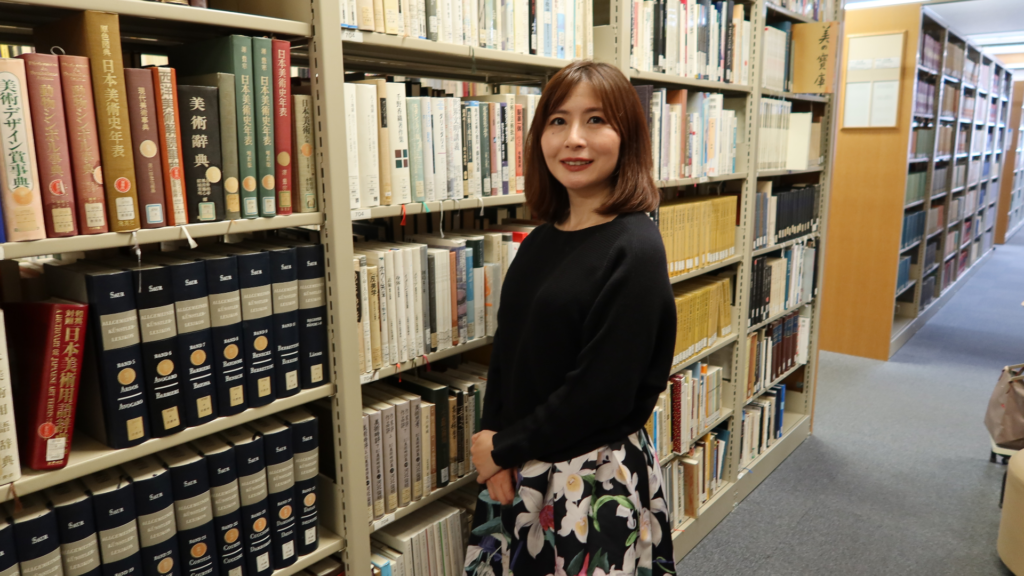
Asked what research she most wants to focus on going forward, Okubo named a book on sumo prints.
Her words, “I want to write a book about sumo prints,” carry a researcher’s long-held wish. Around that, she also spoke of the goal of systematically setting out “how popular belief in the Edo period was depicted in ukiyo-e.”
Her experience lecturing abroad is also widening the scope of her research. In North Dakota, where she visited, there were many people who had been to Japan or were about to go. With the rise in inbound tourism, interest in ukiyo-e and sumo overseas keeps growing.
I think there are quite a lot of things in Japanese culture that make people from overseas ask, “Why?” But behind them there are reasons and meanings that have been handed down over a long stretch of Japanese history.
Okubo
Things that even we today have forgotten come to the surface when we look at ukiyo-e.
Why sumo wrestlers are something like lucky charms, why the maneki neko’s ribbon is red: through the visual record of ukiyo-e, we can “check the answers” to things we have been passing down in daily life without knowing why. She wants to share this in Japan and abroad, Okubo said.
Being able to draw out, through materials left in visual form, our own history and the principles behind things rooted in the finest corners of our lives is, I think, a special experience.
Okubo
Ukiyo-e are not mere art objects of the past. What we believe today, what we feel is lucky, what we put our hands together in prayer for: ukiyo-e may be one of the histories closest to the present, one that tells us the “reasons” behind those feelings.