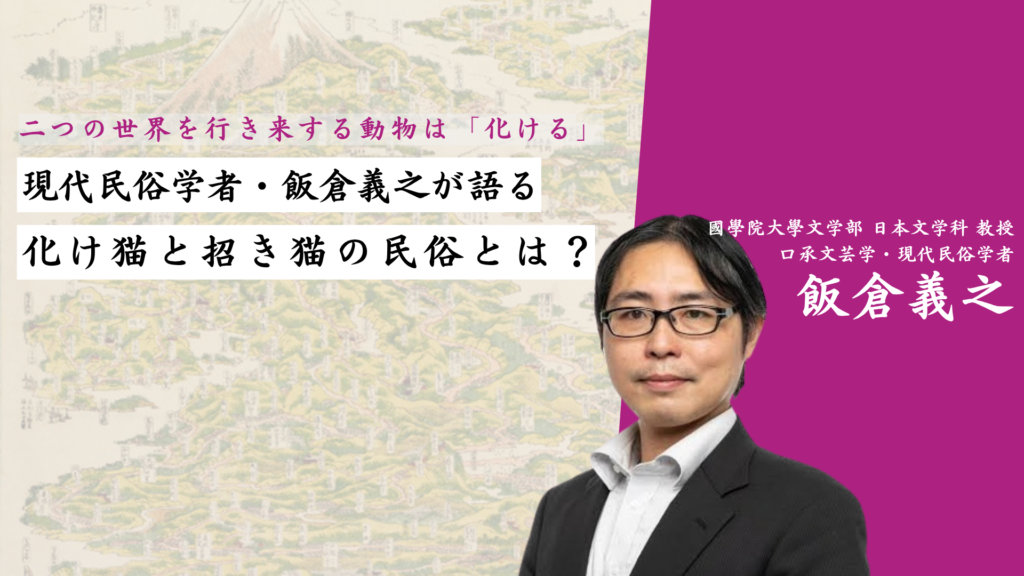
The bakeneko (化け猫, a shape-shifting cat) laps up the oil of an andon paper lantern, takes the form of a beautiful princess and attacks people. The maneki neko (招き猫, beckoning cat) raises one paw to invite customers and good fortune.
This interview was conducted in Japanese and translated by Maneki Neko Lab. Read the original Japanese interview.
It is the same cat. So why has it been told in two such opposite forms?
Folklorist Yoshiyuki Iikura (hereafter Professor Iikura) is a professor in the Department of Japanese Literature, Faculty of Letters, at Kokugakuin University. Specializing in oral literature and the study of contemporary folklore, he has researched the “stories” people tell about everyday hearsay, urban legends and yokai (supernatural creatures).
In his essay “Neko wa bakeru ga yaku ni tatsu: neko o meguru minzoku” (“Cats Shape-Shift, but They Are Useful: The Folklore of Cats”), published in Neko no kai (Hakutakusha, 2017), he reads cat folklore from the side of the “story.”
For this interview, we asked Professor Iikura to look at the bakeneko and the maneki neko through the doorway of the “story”: folktales, legends and everyday tales.
Chapter 1: The Origin of the Maneki Neko Is a “Legend” – The Three Kinds of Folk Narrative
The conversation began with a question: what is oral literature, Professor Iikura’s field?
Oral Literature Studies the “Words of Everyday Life”
Oral literature (kosho bungei, 口承文芸) was established as a branch of Japanese folklore studies by the folklorist Kunio Yanagita. It focuses on communication through words and the techniques of expression behind it.
Oral literature may bring folktales to mind, but that is not all it covers. Folk songs and children’s songs, proverbs, riddles, the coining of new words, and even dialects. According to Professor Iikura, oral literature tries to capture the whole body of words used in everyday life.
Among these, folk narratives draw the most researchers, and within that area Professor Iikura has focused on modern stories such as school ghost stories and urban legends. That work connects to his other specialty, the study of contemporary folklore.
Dialects, too, are words born of everyday life. Regions with heavy snow have many words for the condition of snow, and warnings about changes in the weather have been passed down in the form of proverbs.
Kunio Yanagita argued that dialects should be valued as a culture that arose because local life needed them. He said this at a time when there was a strong push to get rid of dialects.
The fact that dialects are disappearing so quickly also means, in part, that they are no longer particularly needed in daily life. I think it means that the areas you can only express by using dialect are steadily shrinking.
Professor Iikura
Words also become a badge of belonging to a group. The Yamanote speech of Tokyo’s uptown districts, the slang of girls’ school students, hip-hop abbreviations, the jargon of 2channel (a Japanese anonymous forum) from a while back. Knowing these words and being able to use them expresses a sense of belonging to the same group.
Folk narratives, likewise, are words that have been shared from person to person.
Folktales, Legends and Everyday Tales – Divided by How They Treat “Truth”
The Japanese word minwa (民話) is short for minkan setsuwa, or folk narrative. It refers to stories passed down by word of mouth among ordinary people, and they are mainly divided into three types, Professor Iikura explained.
The first is the folktale (mukashibanashi, 昔話). These are stories like Momotaro (the Peach Boy) and Issun-boshi (the One-Inch Boy), the kind we picture when we hear the word “folk tale.”
It starts with “Once upon a time, in a certain place,” and nobody pins down when “once upon a time” was or where “a certain place” is. Both the teller and the listener understand that it is a story that is not true, one that happened at a time that is not now, in a place that is not here, and they listen on that basis.
Professor Iikura
That is why, in folktales, the dead come back to life easily, a nose grows when fanned with a folding fan, and an old man crawls into a mouse hole and ends up in the land of mice.
The second is the legend (densetsu, 伝説). A legend explains how something in a particular place came to be the way it is. Why does this rock have this name? How did this pond spring up?
“When Minamoto no Yoritomo passed through here, he sat down to rest. This is Lord Yoritomo’s sitting stone.” In this way, a legend explains that this thing is here now because of something that happened at one point in history. A legend is tied to the land. It is “the history of our land.”
Whether it really happened, however, is another matter. Professor Iikura gave the example of legends of Heike fugitives (warriors of the defeated Taira clan).
The Heike, defeated by the Minamoto, fled here and founded this village. There are about 400 such legends across Japan, he says.
One person cannot build a village. If they fled in groups of four or five, that would mean 1,600 to 2,000 people escaped. In that case, the balance of power between the Minamoto and the Taira at the Battle of Dan-no-ura would have been reversed.
Why is there a village this deep in the mountains? Maybe there was a reason they could not stay on the plains. Nobody wants to think their ancestors were mass murderers. So when people decide there must be some distinguished origin, the imagination kicks in: maybe some noble person was being pursued. And if you are talking about nobles on the run, it must be the Heike. That is how the legend gets built. Then if there happens to be some old banner there, people say, “See, they were Heike after all.”
Professor Iikura
The third is the everyday tale (sekenbanashi, 世間話). This, too, is passed on as something that really happened. But while a legend is about the past, an everyday tale is about an unusual event of the present day that happened in a time and place close to the teller and the listener.
Someone was tricked by a fox, saw a ghost, ran into a kappa (a water imp). Professor Iikura sees urban legends and school ghost stories as the modern versions of these. In the old days it was the kappa, and today it is Kuchisake-onna (the Slit-Mouthed Woman) or Hanako-san of the school restroom.
“An Origin Story Cannot Come Before the Thing Itself”
So which of the three does the origin story of the maneki neko belong to?
Professor Iikura’s answer was “legend.” The stories told at Imado and at Gotokuji Temple in Tokyo are legends about how the maneki neko came into being, he says.
Take the story of Ii Naotaka (a feudal lord). Early in the Edo period, a cat beckoned the lord inside and saved him. So making images of cats was said to bring good things, and that is why this cat is here now. Being able to point and say, “This is it,” is the hallmark of a legend.
Then Professor Iikura explained the order in which the origin story and the maneki neko came about.
An origin story never comes before the thing itself, so I think that, to explain why something like the maneki neko exists, legends were probably created afterward, drawing on things like the temple’s ties to the Ii family or the connection to Imado ware.
Professor Iikura
Seen in light of what a legend is, it may be only natural that there are “many theories” about the origin of the maneki neko.
Chapter 2: Animals That Cross Between Two Worlds “Shape-Shift”

Before talking about the maneki neko, what kind of animal has the cat been seen as in the first place? Professor Iikura began with the cat’s arrival in Japan.
The Cat Was Originally an “Outsider”
Japan seems to have had wildcats. But today’s house cats are descended from cats that came over gradually from China. The house cat was originally an animal that did not live in Japan.
Traces of this remain in the kanji characters, he says. In China, the character 猫 meant the house cat, while the character 狸 referred to the wildcat.
Japan, however, had no house cats, and the round little creature living in the mountains was the tanuki (raccoon dog). So in Japan, the character 狸 came to mean the tanuki. The same character refers to different animals in China and Japan.
House cats are said to have come to Japan along with Buddhism.
To keep mice from gnawing through the Buddhist scriptures, temples kept cats to protect them, and that is how temples and cats became linked. Once that happens, the cat becomes something to be grateful for, protecting scriptures that are as precious as treasure. So the good side, the cat as a protector of fortune, comes to be imagined.
Professor Iikura
That means the “fortune” face that leads to the maneki neko was already there from the moment cats arrived.
Loved at Court, Yet Now and Then Showing the Eyes of a Wild Animal
From early on, cats were also seen as “cute.” They had a charm and friendliness that other animals lacked, and by the Heian period (794–1185), the cat as a pet had become established.
The Pillow Book features Myobu no Otodo, a cat permitted to live at the imperial court. In The Tale of Genji, the Third Princess is glimpsed by a man only because a cat pulls up the bamboo blind. Cats were loved in the lives of the upper classes.
On the other hand, cats now and then show the face of a wild animal.
You dote on your cat, and then it suddenly disappears, only to come back having caught a bird or a mouse. Its pupils change size with the light, so much so that, in the days before clocks, people are said to have told the time by a cat’s eyes. For all its cuteness, its claws and fangs are sharp.
What is more, wild cats are supposed to live alone rather than in groups, yet cats hold “meetings.” Back when there were many stray cats, cat meetings in vacant lots were a common sight even in cities, he says.
The Decisive Factor: Going Back and Forth Between Home and the Outside
What Professor Iikura calls “decisive” is where cats live.
A cat is an animal, but even though it is an animal, it lives in a human house. And it also goes outside. The outside world and the human house. Animals that go back and forth between two worlds tend to be called animals that shape-shift and animals that bewitch people.
Professor Iikura
Holding two meanings at once is called “ambivalence” (ryogisei, 両義性). Line up the animals said to shape-shift and bewitch, and this ambivalence comes into view.
Foxes and tanuki are animals of the fields, yet they come in and out of human settlements. The fox comes after chickens, and the tanuki comes to scavenge leftovers.
The river otter stays underwater for a long time, then surfaces with a fish in its grip. It was thought of as an animal that moves freely between the water and the land.
River otters, weasels and martens can stand on their hind legs and grasp things with their front paws. They are animals, yet they use their hands like humans. This, too, is ambivalence.
Mice are the same, he says. They can use their hands, they get into human houses, and they dig holes underground, going back and forth between below ground and above. As in the folktale Omusubi Kororin (The Rolling Rice Ball), mice are said to have a land of their own, and in places like Nagano Prefecture people have said that sleep paralysis at night is caused by mice casting a strange power from the attic.
Animals that go back and forth among several worlds are easily thought to have mysterious powers. The cat belongs to that group too.
Bears, Boars and Dogs Do Not Shape-Shift
It becomes clearer, he says, if you think about the opposite: animals that do not go back and forth between two worlds.
People hardly ever say that bears, wild boars or deer shape-shift. They belong in the mountains, and they do not come to human settlements to do anything.
Dogs are not said to shape-shift either. In the old days, dogs were not allowed inside the house and were kept outdoors. Because they are pack animals, they did not leave people to roam the hills and fields on their own. They stayed in the village the whole time.
That is why the dog was thought of as an animal on the human side, one that does not carry two meanings.
Professor Iikura
Bears and boars are on the side of the mountains. Dogs are on the side of humans. Neither one nor the other, the foxes and tanuki that travel between villages and the wild, and the cats that travel between the house and the outside, were placed in the “shape-shifting and bewitching” group.
The idea that cats and foxes were seen as the same kind of animal survives in a saying, he notes: “Behind the cat is the fox, and behind the fox is the wolf.” It means that while the cat is making mischief, the fox is pulling its strings, and behind the fox, the wolf is pulling the strings.
It is close to saying that behind the small-time thug there is a boss, and behind the boss there is a kingpin. It shows clearly, Professor Iikura says, that the cat, the fox and the wolf were seen as animals in the same category, connected along a single line.
The “fortune” face that protects the scriptures, and the “demonic” face that reveals the eyes of a wild animal. Living on the border between two worlds, the home and the outside, the cat was an animal with two faces from the very beginning.
Chapter 3: Cats Have a Society All Their Own
Cat stories have one more theme that appears again and again around the world: a society of cats alone, kept secret from humans.
The Nekomata Mansion – What the Calico Cat Someone Loved Revealed
At Mount Nekoma (猫魔ヶ岳) in Fukushima Prefecture and Mount Neko (猫岳) in Kyushu, stories say that cats who go missing travel there to train to become nekomata (猫又, cat demons with forked tails), and that cats go there when they die. There is a chief of the cats there, and cats have a society of their own, centered on a king of the cats.
One folktale set on such a cat mountain is “Nekomata Yashiki” (The Nekomata Mansion).
A traveler who has wandered onto the cat mountain finds a large mansion deep in the hills. He asks to stay the night, is welcomed warmly, and is shown to the bath. But the maid who comes to guide him whispers to him.
“Run away right now. This is the Nekomata Mansion, and everyone here is a cat. Many of the cats hold grudges after being mistreated by humans. They mean to put you in the bath, turn you into a cat, and torment you together.”
When he asks why she is telling him this, the maid answers: “I am the calico who was loved and cared for in your house.”
As the traveler flees, the cats chase after him crying “Wait!”, throwing rice cakes at him and splashing him with hot water. He somehow makes it back to a human village, and when he checks himself over, relieved to be safe, he finds that cat fur has grown thickly wherever the rice cakes and hot water hit him. Had he stayed, he would have been turned into a cat.
Somewhere there is a mansion of cats, and every cat belongs to it. People imagined a network of cats like that, he says.
Why calico cats have been considered lucky, and what the calico pattern means on a maneki neko, are explained in the following article.
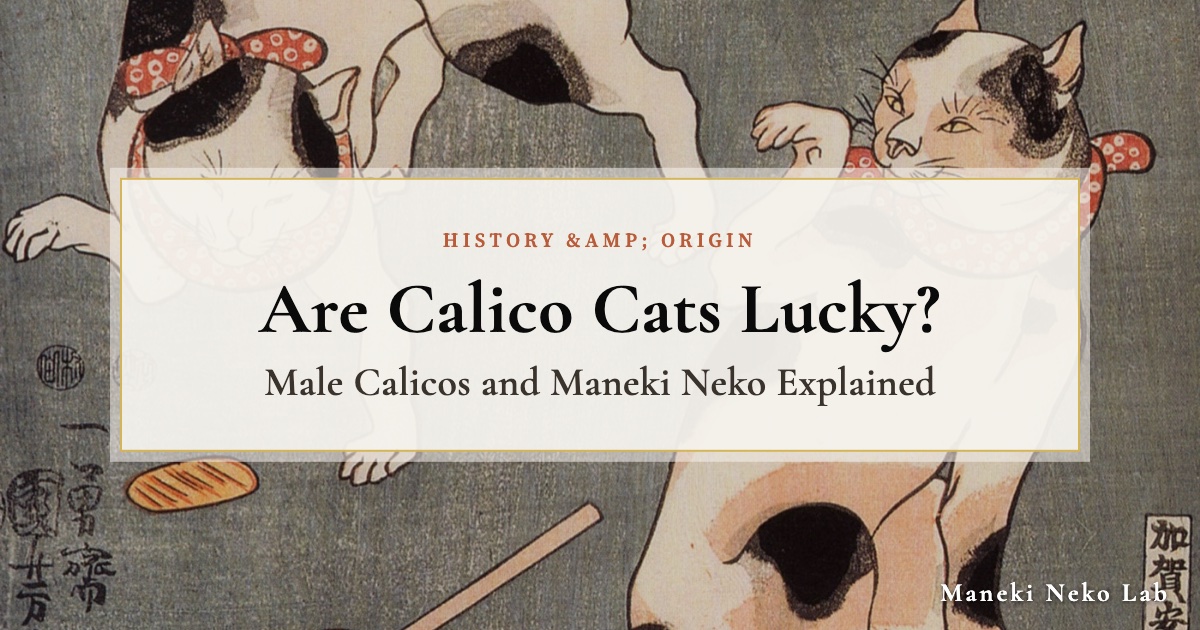
The “King of the Cats” in Europe
Europe has a very similar story, known as “The King of the Cats.”
One evening, a villager walking home sees an unfamiliar cat by the roadside. The cat names someone he has never heard of, says, “Tell Tom Tildrum that Tim Toldrum is dead,” and then suddenly vanishes.
The cat talked. What was that? The villager goes to the pub and tells everyone exactly what he heard, saying something strange has happened. Then a cat that had been sleeping in the pub gets up.
“Tim Toldrum is dead? Then I am the king now.”
With that, it went out and never came back. The cat sleeping in a country pub had actually been next in line to be king of the cats.
The network of cats stretches out with no connection to humans at all, and I wonder whether people in Europe, too, came to think that cats have a society of their own by watching things like cat meetings.
Professor Iikura
The House Where Hand Towels Disappear – The “Cat Dance” Told Across Japan
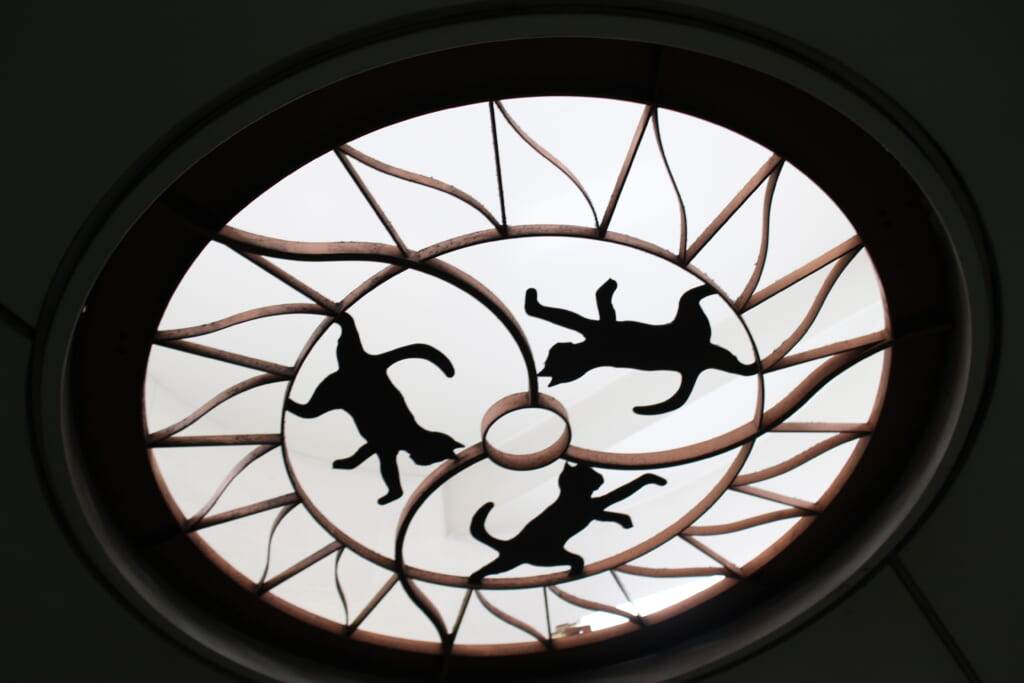
A more familiar story of cat meetings is the “cat dance” (neko no odori), told all over Japan.
It usually begins with tenugui (hand towels) going missing from a certain house.
In one version from Chiba Prefecture, the village headman passes by the edge of the village late at night and finds a crowd of cats gathered there. One of them says, “The cat from the headman’s house is late today.” Wondering if they mean his own cat, he watches, and sure enough his cat arrives with a tenugui in its mouth.
“Sorry I am so late. I took the towels out so often that they are keeping a closer watch now. And today they served the rice porridge without letting it cool, so with my cat’s tongue (the Japanese phrase for being unable to handle hot food), I was slow to finish eating.”
Then the house cat starts singing in a fine voice, and they all dance together.
When the headman gets home and checks, a tenugui is indeed missing, and the porridge had indeed been served piping hot. The next morning, when the cat comes home, he says, “So you were using the towels,” and the cat, with a look that says “Busted,” runs off and never comes back.
Why do cats dance? Professor Iikura points to the fact that cats gather for meetings, and that they stand on two legs when you play with them using a cat toy.
Cats gather, they dance, so what are they doing? It must be a Bon dance. In an age without much entertainment, the Bon dance was a major form of recreation for humans too, so people figured cats would do it as well.
Professor Iikura
Utagawa Kuniyoshi, the ukiyo-e artist of Edo, loved cats so much that he was called “Kuniyoshi of the cats.” Even in the corners of his frightening bakeneko prints, he slipped in little cats dancing adorably.
The cat dance lives on in place names today. Odoriba Station (Totsuka Ward, Yokohama) on the Yokohama Municipal Subway takes its name from a spot where cats were said to have danced (odoriba means “dancing place”). The name became a place name and then a station name. The station is full of cat-themed lights and murals.
In Kannami Town, at the base of the Izu Peninsula, a festival called Kannami Neko Odori, where people put on cat makeup and dance together based on the cat dance story, has been held since 1983. Efforts like this to celebrate folk tales locally and turn them into events can be seen in many places, he says.
Chapter 4: The Bakeneko Was Created by Edo Kabuki

So where did that image of the bakeneko, lapping up lantern oil and turning into a princess, come from?
The Nekomata in Essays in Idleness Was Just a Joke
Stories of cats transforming and attacking people are old in themselves. A nekomata story appears even in Essays in Idleness (Tsurezuregusa, 徒然草).
But that is only a rumor. What leaped on the monk who panicked, thinking a nekomata was attacking him, was actually his own dog. It is nothing more than a funny story about someone being jumpy.
The bakeneko as we picture it now, lapping up oil, turning into a woman or an old woman, a human figure with only cat ears, the point at which that kind of thing actually came to be imagined is within the culture of Edo kabuki.
Professor Iikura
In Vengeful Ghost Plays, the Bakeneko Leaped Into the Lead Role
In the Edo period, vengeful ghost plays (onryo shibai), featuring spirits with grudges, were popular, and they were staged especially in summer.
Oiwa in Yotsuya Kaidan, Okiku counting plates in Bancho Sarayashiki, Kasane-ga-fuchi, Botan Doro (The Peony Lantern). In most of them, the spirit of a woman who was cruelly treated and killed takes revenge on the men who killed her.
Meanwhile, yokai that had long held power, such as tengu (long-nosed mountain spirits) and oni (ogres), hardly appear in kabuki. Even when they do, they are only supporting characters, like the tengu who protects Yoshitsune.
Amid all that, the one that suddenly took center stage as the lead was the bakeneko. In Edo kabuki, bakeneko plays, called kaibyo-mono (monster cat plays), became hugely popular.
Professor Iikura
Even so, the bakeneko is not a pure cat monster, Professor Iikura says. It becomes a bakeneko to avenge its owner, a princess killed after being caught up in a succession dispute within a feudal house. It is half ghost.
The plot is more or less fixed. A beautiful princess is killed in a house dispute, and her pet cat laps up her blood and turns into a beauty who looks exactly like her. It slips into the enemy camp and does one eerie thing after another, licking the familiar lantern oil, flicking its hand in a beckoning-cat gesture to control people. In the end, a samurai loyal to the house puts everything right.
These monster cat plays were extremely popular, and Utagawa Kuniyoshi made many ukiyo-e prints of them.
Temples and shrines across Japan that enshrine cats, including those that enshrined cats to calm the curse of a bakeneko, are introduced in the following article.
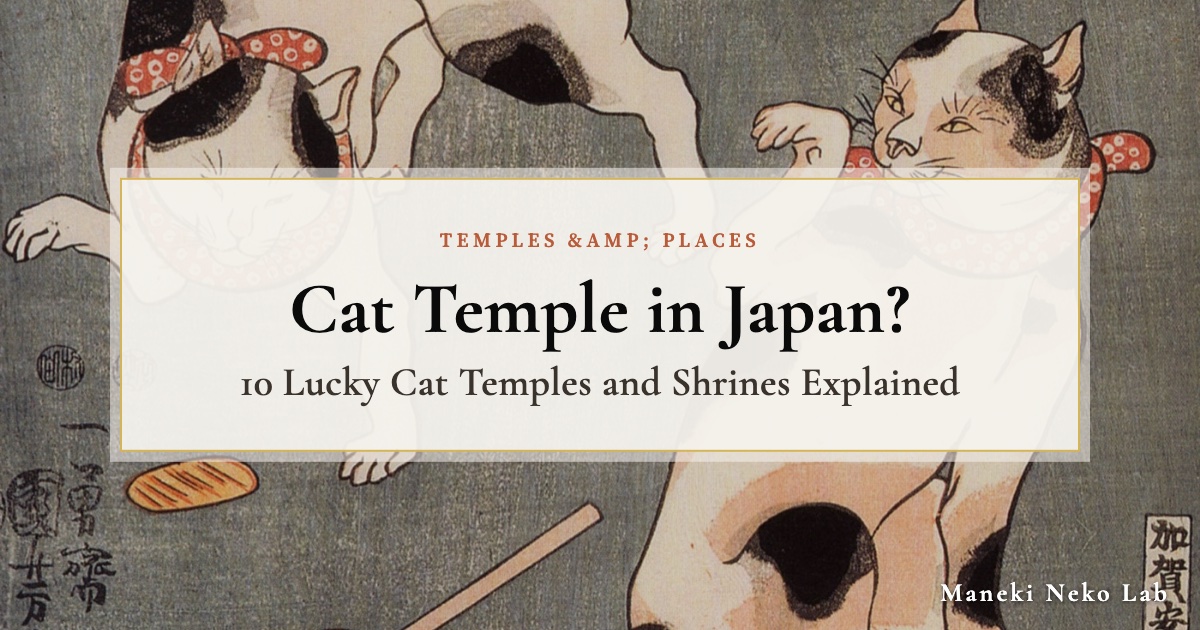
The Three Great Monster Cat Plays, and the Most Popular One Was “Fiction”
Edo monster cat plays had three home bases, he says.
The most famous is the Nabeshima bakeneko of Saga, which also has a local legend. The second is the Arima bakeneko. And the third is the Okazaki cat.
Both Saga and Arima are far from Edo. So a bakeneko story was created set in Okazaki-juku, a post town on the Fifty-three Stations of the Tokaido that was more familiar to Edo audiences. But this third one alone, he says, is complete fiction.
There is no bakeneko story in Okazaki. There is a stone called Nekoishi (Cat Stone) at Okabe, a post town nearby, but that is not a bakeneko either. It is just a roadside attraction, a stone shaped kind of like a cat. Apparently, when they wanted a bakeneko story from somewhere reasonably close to Edo, they simply invented one within kabuki.
Professor Iikura
And yet, of the three, Okazaki was the most popular. It was close to Edo, and the place name was familiar from travel.
The Nabeshima family of Saga, for its part, disliked this reputation. When kabuki troupes toured their domain, bakeneko plays were banned. In other places, the setting was sometimes rewritten to Saga in Kyoto (a district near Togetsukyo Bridge whose name sounds the same as Saga), and the play was staged with the excuse, “This is not Nabeshima, it is a story from Kyoto.”
Kabuki was the center of Edo culture, so I think the way the bakeneko was portrayed in kabuki went on to have a decisive influence on the image of cats for a long time afterward. The kabuki bakeneko was later carried over into film as well, becoming a genre called kaibyo eiga (monster cat films) that continued into the postwar years.
Professor Iikura
Lapping up oil. Controlling people like a psychic. Doing somersaults with a cat’s agility. The movements of the bakeneko in kabuki have been passed straight down into the bakeneko image we know today.
Chapter 5: Demon or Darling? The “Cuteness” of Cats That Japan Discovered
While the bakeneko was feared, in Japan the cat was also seen as “cute” from early on. So how have cats been viewed in other countries?
In Europe, the Cat Was a “Witch’s Familiar”
Europe also has cat-related culture, such as the Cat Parade (Kattenstoet) in Ypres, Belgium. But the fact that cats tended to be associated with witches worked against them, he says.
Kiki in Kiki’s Delivery Service also travels with a black cat, Jiji. Behind this lies the image of the “shaman” found all over the world.
A shaman is someone who knows things that are not of this world. Broadly, there are two ways of coming to know them.
One is the possession type. Like the itako mediums of Mount Osore (Osorezan) in Japan, the shaman calls down the soul of the dead or a god into their own body and learns about the other world from it.
The other is the soul-flight type. Siberian shamans and South American shamans were of this type, and in earlier times European witches were thought to be as well. They send their soul out of their body, give it the form of a small animal such as a bird or a cat, and sniff around here and there to learn about other people and the other world.
One image of the witch is someone who commands animals at will to do eerie things, and the cat was one of those familiars. I think a familiar is a being that slips in quietly and, before you know it, is watching you.
Professor Iikura
Witches use cats, so cats are demonic. Before people could dote on them, an anti-Christian image linking cats to the devil got in the way, he says.
How black cats and other cats have been seen as lucky in Japan is explained in the following article.
Cats Were Also Shunned in China and Korea
The situation in China was similar. Although cats were valued for protecting scriptures and guarding against mice, their wildness and eeriness remained strong for a long time, and they were somewhat avoided, he says.
Korea, too, had absorbed the idea that “cats are demons” from China, so people only began doting on cats in the last 20 to 30 years or so, Professor Iikura heard from a Korean researcher. Until fairly recently, some older people still said that cats were creepy.
Today, it seems the whole world is waking up to how cute cats are. When Professor Iikura visited India a few years ago, he was told that although there had never been a culture of keeping cats, now everyone keeps cats in their apartments. Cat culture is spreading in new ways in the present day as an urban culture.
In Japan, people focused on the “cute” side early on and built it up. I do think that may be where the foundation of Japan’s kawaii culture lies.
Professor Iikura
The Maneki Neko Is a Lucky Charm Unique to Japan
Against that backdrop, Professor Iikura suspects that the meaning of the maneki neko has gradually become known around the world as well. He has heard that it spread early not only to Taiwan and the rest of the Chinese-speaking world, but also to Brazil, home to a large population of Japanese descent.
Other cultures may have made cat-shaped ornaments, but giving them a clear meaning, like prosperity in business, and distributing them in connection with temples and shrines is unique to Japan.
Professor Iikura
Among temple and shrine cats, the Sleeping Cat (Nemuri-neko) of Nikko Toshogu Shrine has come down to us as a carving. The legend of the carver Hidari Jingoro and how it differs from the maneki neko are explained in the following article.
Chapter 6: Why Do Lucky Charms Spread and Take Root?
So how did the maneki neko spread as “the cat that beckons good fortune”? Professor Iikura’s answer goes back to how the gods of commerce came to be.
Gods of Business Prosperity Are “Borrowed”
Gods of business prosperity developed later than the gods of farming and fishing, Professor Iikura says. Without developed agriculture, there is no commerce.
When people asked which god to rely on for business prosperity, they borrowed the gods that already existed for abundant harvests or big catches. Borrow from the farming village and you get Oinari-san (the god Inari) or Daikoku-sama. Borrow from the sea and you get Ebisu-sama.
Professor Iikura
By the same logic, when farming villages began raising silkworms, the cat that protected the silkworms from mice also came to be seen as a bringer of fortune.
From the northern Kanto region through Fukushima Prefecture to southern Miyagi Prefecture, there is a culture of treasuring cats. In Joshu (present-day Gunma Prefecture), cat paintings drawn by feudal lords were believed to have the power to drive away mice, and in Marumori Town, Miyagi Prefecture, many stone monuments remain to honor the memory of cats that worked in silk farming. Marumori uses them for town revitalization, he says. There seems to be a culture of treasuring cats tied to silkworm farming.
The “Hattatsu Neko” of Sumiyoshi Taisha
Famous in western Japan are the Hattatsu Neko (初辰猫) of Sumiyoshi Taisha Shrine in Osaka.
At Hattatsu Mairi, a visit to Sumiyoshi Taisha on the first Day of the Dragon each month (by the traditional zodiac calendar), worshippers receive a small cat figure dressed in a formal haori jacket and hakama. Collect 48 of them and they can be exchanged for a slightly larger cat. You keep exchanging, and once you reach the big cat, you have reached the “goal.”
There are many customs of visiting a shrine on set days, but what is interesting, Professor Iikura says, is that the items you exchange are cats. He believes it probably took this form gradually, combining with the maneki neko within the culture of Osaka’s merchant houses.
From Fad God to “Staple”
How do lucky charms spread? The key is word of their blessings. In the early modern period there was even a term, hayarigami (流行り神, fad gods), he says.
Just like today, when people hear that going somewhere brought blessings, everyone rushes to jump on it. Edokko, the people of Edo, especially loved whatever was in fashion, so if they heard that displaying a maneki neko brought blessings, it would be “Us too, us too,” and everyone would jump on it.
Professor Iikura
Some things end as a passing fad. But the maneki neko took root as a staple, gave rise to many variations and became a culture.
Professor Iikura names how easy it is to adapt as one reason. Should the cat hold a gold koban coin, or something else? In recent years, as with daruma dolls, different colors have also been given different meanings. As part of the culture of lucky charms made of papier-mache (hariko) or ceramics, it was probably easy to adapt, he suggests.
The other reason is that it is not too big. It is easy to buy and take home as a souvenir.
Ehomaki and the Maneki Neko
As an example of how lucky customs spread, Professor Iikura also mentioned ehomaki (恵方巻, “lucky direction” sushi rolls).
Ehomaki was originally a custom practiced only in a very small number of households in places like Osaka. A 7-Eleven store owner from Hiroshima heard about it in Osaka.
Eating sushi rolls on Setsubun (the day before the start of spring) apparently brings good luck. He promoted it that way at his several stores, and because it sold, he reported it to his area manager. It was then rolled out across western Japan, and later nationwide, he says.
It was a custom that already existed, but it was spread through marketing even to regions that had nothing to do with it.
Professor Iikura
Then why did the maneki neko spread throughout Japan? Professor Iikura points to the power of souvenirs tied to temple and shrine pilgrimages. Bringing lucky charms home as souvenirs was common.
When something spreads as a souvenir, people notice it. There is this cute thing. You ask, and it is a lucky charm called a maneki neko, and apparently it is all the rage in the capital right now. Then I will buy one when I go to the capital, or I will ask someone going there to get one. I do think it may have spread something like that.
Professor Iikura
Chapter 7: Cats on Social Media and the “Voice” of the Future
From legends to everyday tales, and on to urban legends. Finally, we asked what will become of cat “stories” in the age of social media.
There Are Almost No Urban Legends About Cats
Surprisingly, cats do not have much of a presence in urban legends, he says. People stopped paying attention to the frightening side of cats, and the focus narrowed to their cuteness.
The cat-related urban legend that Professor Iikura thinks was told by the most people is a story from the 1990s.
A man is driving at night when a black kitten darts into the road. He slams on the brakes but cannot stop in time and runs it over. Oh well, he thinks, and keeps driving, but something is closing in from behind.
He looks in the rearview mirror and sees a huge black cat with the kitten in its mouth, gaining on him fast. The kitten’s mother has come back as a vengeful spirit. He floors the accelerator to escape, but the light ahead is red. It is all over, he thinks, and hits the brakes, and the black cat stops behind him too.
He turns around for a closer look, and it is a Yamato Transport delivery truck bearing its black cat logo.
As a letdown story, one you think is scary but turns out to be a joke, it became fairly popular, he says. It plays on the image of cats as vengeful and coming back to haunt you, but in the end it is not a cat, so it is not a scary story either.
After this, urban legends featuring cats all but disappeared. What spreads instead are cute videos of real cats, like “My cat talks.”
The way cats are treated on social media is that some topic about a real cat goes viral and gets shared with everyone. So maybe people do not really need netlore based on cats. I get the feeling that people’s desire to see the cute side of real cats is stronger.
Professor Iikura
The Living Voice Is Regaining Its Power
Finally, we asked Professor Iikura what he wants to explore next. The theme is not limited to cats. It is the “voice,” he says.
When Kunio Yanagita founded Japanese folklore studies in the 1930s, standard Japanese was being spread and dialects were shrinking. There was a sense of crisis that, at this rate, the culture of the voice in everyday regional life would disappear.
In a modernizing society, written words and documents carry great power. The internet, too, was basically a culture of written text up until the heyday of 2channel in the early 2000s.
Over the past ten-odd years, as video streaming and the like have gained power, the voice has to some extent been restored to its place again. Now that anyone can broadcast with their voice, a culture of the voice may be starting to gain power in a new form.
Professor Iikura
AI can now produce appearances quite well. But with voices, Professor Iikura says, people may still be able to tell. AI can reproduce the shape of a voice, but turns of phrase and timing are hard to match in each individual generation.
How are the wobbles and pauses, so to speak, of the living voice wanted in communication? I think that also connects to the question of why folktale storytelling was so popular, why there are still people who want to try it today, and whether it has power when it is passed on within a community.
Professor Iikura
The origin of the maneki neko, the Nekomata Mansion, the cat dance: all of them began as stories of the “voice,” told by someone to someone else.
The cat, traveling between two worlds, the home and the outside, and carrying both a face of fortune and a face of the demonic, has lived on in stories told from person to person.