What You’ll Learn
- A maneki neko is a Japanese cat figure that beckons customers and luck
- Its birthplace is disputed; Gotokuji Temple and Imado are best known
- It is Japanese, though often mistaken for a Chinese waving cat
- Most are made in Tokoname and Seto, two pottery towns in Aichi
A maneki neko (招き猫, “beckoning cat”) is a Japanese figure of a cat raising one front paw, a gesture that invites customers and good fortune in. Shops in Japan have displayed it at their entrances since the Edo period (1603–1868), and no single origin story has ever been proven.
You have probably seen one by a restaurant register, perhaps gold and waving. This guide explains what the raised paw, the colors and the coin mean, where the figure came from, and how the Japanese original differs from the waving cat sold worldwide.
Maneki Neko Lab is a Japan-based media dedicated to the maneki neko. We built this guide from Japanese dictionaries, temple records, public library research files and our own interviews with researchers and kiln makers.
What Is a Maneki Neko?
A maneki neko is a lucky charm, or *engimono* (縁起物, an object believed to bring good fortune), shaped like a seated cat with one paw raised. Japanese dictionaries, the meaning of its gesture, and a comparison with other Japanese charms together give a clear picture of what it is.
What Japanese Dictionaries Say
Japanese dictionaries agree that the maneki neko is a cat figure that beckons customers and wealth. The four major references we checked share three points: it is a cat figure, it carries a wish to invite, and it is displayed where people do business.
How Japanese dictionaries define the maneki neko
| Dictionary | Key points of the definition |
|---|---|
| Digital Daijisen | A cat figure raising its right or left front paw as if beckoning people. Displayed by businesses for the luck of inviting customers and wealth |
| World Encyclopedia (revised edition) | A seated cat raising one front paw, a type of lucky charm. Popular in entertainment districts and restaurants, partly because geisha were nicknamed “neko” |
| Encyclopedia Nipponica | A lucky toy cat with its paw raised to beckon. Valued by the geisha world and restaurants as a charm that brings in customers |
| Britannica International Encyclopedia (Japanese edition) | A ceramic or papier-mâché cat beckoning with one paw. Displayed by businesses as a charm for prosperity |
The name has two layers, according to the World Encyclopedia. The figure looks like a person beckoning, and “neko” was also a nickname for geisha, so the charm became a favorite of entertainment districts and restaurants.
The word itself is simple. *Maneki* means “beckoning” or “inviting,” and *neko* means “cat.” In other words, the maneki neko was tied to business through both its pose and its name.
Why the Paw Looks Like It’s Waving
The raised paw is a beckoning gesture, not a wave. Japan National Tourism Organization (JNTO) explains that people in Japan traditionally beckon with the palm facing down.
That is why the cat’s paw curls forward. Many visitors read it as “hello” or “goodbye.” In Japan, the same motion means come in, so a shopkeeper places the cat facing the street to call passersby inside.
Knowing this changes how the figure reads. The cat is not greeting you; it is inviting you, along with the customers and fortune a business hopes for.
How It Differs from Other Japanese Lucky Charms
Next to other Japanese charms, the maneki neko stands out as a charm modeled on a living animal’s gesture. The daruma doll and the kumade rake both became lucky charms through other routes.
How three Japanese lucky charms began
| Lucky charm | What it is based on | How it spread |
|---|---|---|
| Daruma doll | The color red, believed to ward off evil | During smallpox epidemics in Edo, red daruma were sought as charms against illness |
| Kumade rake | A farm rake sold at the Tori-no-ichi fair | As more visitors came from the city, it became a decorated lucky rake |
| Maneki neko | A cat’s beckoning gesture | Placed at the entrances of shops and entertainment districts, where figures were used to draw customers |
Source: Takasaki City, “History of Takasaki Daruma”(高崎だるまの歴史)
Source: Chokokuji Temple, “Origin of the Kumade”(熊手の由来)
Source: Collaborative Reference Database (National Diet Library), case from Saitama Prefectural Kuki Library, “History of Storefront Figures”(店頭人形の歴史)
A case file from Saitama Prefectural Kuki Library cites the scholar Shoichi Inoue. He describes the maneki neko as a symbol of the Japanese custom of placing figures at shop fronts to attract customers. So the maneki neko is a charm whose job has always been waiting at the door of a business.
What the Raised Paw, Colors and Coin Mean
A maneki neko’s wishes are expressed in three places: the raised paw, the body color and what it holds. These meanings are traditions, not rules, and some temples teach their own versions.
The meanings at a glance
- Right paw is said to invite money; left paw, people
- Each color carries a wish, such as gold for wealth and black for protection
- The classic cat holds a koban, an oval gold coin of the Edo period
Right Paw vs. Left Paw
The most common explanation is that a raised right paw invites money and a raised left paw invites people. Japan’s Maneki Neko Museum in Seto describes the right paw as beckoning *kane* (money) and the left as beckoning *hito* (people, meaning customers).
These meanings are less settled than many guides suggest. Aichi Prefectural Library reviewed Japanese dictionaries and found no entry that defines left and right. The books it checked even give opposite versions, and one theory holds that left-pawed cats came first because they were easier to make.
Temples add their own teachings. Gotokuji Temple in Tokyo offers cats that raise the right paw and hold no coin. Sumiyoshi Taisha Shrine in Osaka gives left-pawed cats in odd months and right-pawed cats in even months.
How the meaning of the paw varies by source
| Source | Right paw | Left paw |
|---|---|---|
| Common explanation (Maneki Neko Museum) | Money | People (customers) |
| Gotokuji Temple, Tokyo | Invites connections (*en*), not fortune itself; only right-pawed cats | ― |
| Sumiyoshi Taisha Shrine, Osaka | Prosperous business (even months) | Family safety (odd months) |
Source: Maneki Neko Museum, “About the Maneki Neko: Column”(招き猫について:コラム)
Source: Collaborative Reference Database (National Diet Library), case from Aichi Prefectural Library
Source: Gotokuji Temple, “Gotokuji and the Maneki Neko”(豪徳寺と招き猫)
Source: Sumiyoshi Taisha Shrine, “Hattatsu Mairi”(初辰まいり)
A cat with both paws raised beckons both money and people. Some people avoid it, though, because two raised hands resemble *oteage*, the Japanese gesture for giving up. Treat left and right as a guide for your wish, not a rule.
What the Colors Mean
Color is the easiest way to choose a maneki neko, and the classic calico stands for general good luck. A calico cat is white with orange and black patches. Other colors were added over time, each carrying its own wish.
Maneki Neko Lab has set one definition for each color so readers can compare them on equal terms. The table below is Maneki Neko Lab’s definition, not a rule set by any kiln or temple.
Maneki Neko Lab’s definition of color meanings
| Color | Meaning |
|---|---|
| White | Opens the way to good fortune |
| Calico | Opens the way to good fortune |
| Gold | Wealth and success at work |
| Black | Protection from misfortune |
| Red | Protection from illness |
| Green | Health and long life |
| Pink | Love and relationships |
| Yellow | Popularity and good relations with others |
| Blue | Study and success in learning |
Japanese makers do not always agree on these meanings, and some colors have older roots than others. Our color guide compares the makers’ official lists and explains why red is linked to health.
The Coin, the Collar and Other Items
The typical maneki neko holds a koban, an oval gold coin used in the Edo period, as a sign of the wealth it hopes to bring. The Maneki Neko Museum also lists sea bream, daruma dolls and the *uchide no kozuchi*, a lucky mallet said to shake out treasure.
Not every cat holds a coin. Gotokuji Temple explains that its cat beckons people and brings connections, but does not hand over fortune itself, so it is shown without a coin.
The red collar has a story of its own. Ukiyo-e researcher Noriko Okubo told us it may echo the Heian-period (794–1185) custom of keeping imported cats on cords. In her view, that memory lived on in the red collars of cats in woodblock prints.
These details show that every part of the figure carries a layer of culture. Reading them one by one is part of the pleasure of owning a maneki neko.
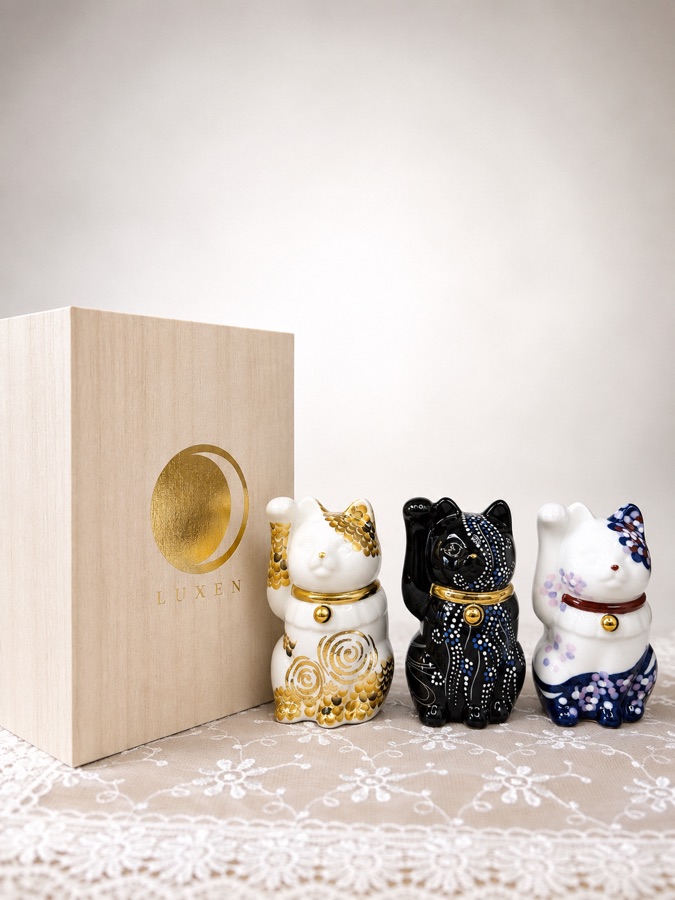
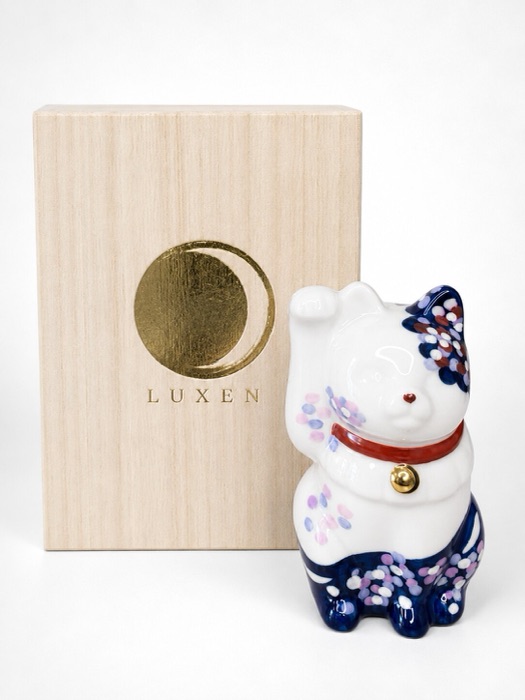
If gold is the wish you want to carry, a cat whose gold is painted by hand is one way to see that wish up close. Luxen Maneki is a brand of Japan ManekiNeko Research Institute, Inc., the company that runs Maneki Neko Lab, and artisans at a traditional Seto kiln hand-paint the gold on each piece.
Where Did the Maneki Neko Come From?
Several temples and places in Japan claim to be the birthplace of the maneki neko, and each claim rests on legend, so there is no settled answer. Following dictionaries and library research files lets you separate what is recorded from what is told.
What is known about its origin
- The best-known claims point to Gotokuji Temple and to Imado in old Edo
- The Gotokuji story appears in temple records and a place-name dictionary
- Imado ware’s Marushime cat is regarded as the oldest known example
The Main Origin Stories
The two best-known stories place the birth of the maneki neko at Gotokuji Temple and in Imado, a pottery district of old Edo (now Tokyo). Both come from temple histories or local tales, and no record has settled which is correct.
The main stories of the maneki neko’s origin
| Story | Place | What is told | Type of evidence |
|---|---|---|---|
| Gotokuji Temple | Setagaya, Tokyo | The feudal lord Ii Naotaka was beckoned in by the temple cat and escaped a thunderstorm | Temple history, place-name dictionary |
| Imado | Asakusa area, old Edo | An old woman made a clay cat after a cat appeared in her dream, and good fortune followed. Imado ware’s Marushime cat survives | Tales introduced by tourism bodies, dictionary |
| Jishoin Temple | Nishi-Ochiai, Tokyo | A “cat temple” where a black cat is said to have guided the warrior Ota Dokan | Books cited by a library case file |
| Kinneko Ginneko | Ryogoku, old Edo | In the 1780s, a shop called Kinneko Ginneko displayed gold- and silver-painted cats | Encyclopedia Nipponica |
Source: Gotokuji Temple, “Gotokuji and the Maneki Neko”(豪徳寺と招き猫)
Source: Aichi Prefecture official tourism site Aichi Now, “Visit Tokoname and Seto”(招き猫の二大産地 常滑・瀬戸へ行こう!)
Source: Kotobank, “Marushime neko”(丸〆猫)
Source: Collaborative Reference Database (National Diet Library), case from Saitama Prefectural Kuki Library, “Cat Paintings and Cat Beliefs”(猫絵と猫信仰)
The Kinneko Ginneko story appears only in Encyclopedia Nipponica, and we could not confirm it elsewhere. For that reason, Maneki Neko Lab treats it as one theory among several. Reading each claim together with its evidence is the most reliable way to approach the question.
Gotokuji Temple and Ii Naotaka
The Gotokuji story rests on a temple history in which a cat beckoned Ii Naotaka to safety. According to the temple, Naotaka, lord of the Hikone domain, was returning from falconry when a cat at the gate beckoned him in, and he escaped a sudden thunderstorm.
With his support, Gotokuji was rebuilt in 1633. The temple says it later built the Shofukuden hall to honor the cat, whose name it writes as 招福猫児 and reads as “maneki neko.”
A case file from Toyonaka City Library traced where this story is recorded. The *Kokushi Daijiten*, a major dictionary of Japanese history, does not mention it in its entry on Naotaka.
On the other hand, a place-name dictionary, *Nihon Rekishi Chimei Taikei*, records that the temple became the Ii family’s Edo temple in 1633 and includes the cat legend. In short, the story survives in records of the temple, not the man.
Source: Gotokuji Temple, “Gotokuji and the Maneki Neko”(豪徳寺と招き猫)
Source: Collaborative Reference Database (National Diet Library), case from Toyonaka City Library
Imado Ware and the Marushime Cat
The Imado story rests on two things: a tale of an old woman in Asakusa and a surviving clay cat. Aichi Prefecture’s tourism site and the Tokoname tourism association both introduce the tale from late Edo.
In the tale, a cat appeared in an old woman’s dream and told her to make its likeness in clay. She did, good things followed, and the clay cats became popular.
The surviving object is the Marushime cat (丸〆猫), a seated Imado clay doll with one paw raised and the character 〆 in a circle on its back. The Japanese dictionary Digital Daijisen Plus describes it as the oldest known example of a maneki neko.
The Edo-Tokyo Museum holds a Marushime cat in its collection, so the object can be confirmed in a public museum’s records. The Imado claim therefore rests on both a story and a physical object.
Source: Tokoname City Tourism Association, “Tokoname, a Town of Cats”(猫のまち常滑 招き猫特集)
Source: Kotobank, “Marushime neko”(丸〆猫)
Source: Edo-Tokyo Museum Digital Archives, “Imado doll: Marushime cat”(今戸人形 丸〆猫)
Why a Cat?
Cats became lucky charms in Japan largely because they protected homes and businesses from rats. A folk belief that a cat washing its face means visitors are coming was later linked to the beckoning pose as well.
A Rat Catcher Valued by Farmers and Merchants
One reason the cat became a charm is that it guarded food, silk and goods from rats. The University of Tokyo’s magazine *Tansei* notes that a court noble’s diary from 1595 records cats being lent between households to catch rats.
In 1602, a public notice in Kyoto ordered people to untie their cats and let them roam free. Art historian Yoko Yamamoto told us that the order was a response to a growing rat problem.
In silk-producing regions, cats that caught the rats eating silkworms were honored as guardians of sericulture. Ome Central Library notes that this belief appears in *Yosan Hiroku*, a silk-farming manual from 1802.
Encyclopedia Nipponica also records that papier-mâché maneki neko were sold at daruma fairs in the Kanto region, where farmers bought them to keep rats away. The cat in the maneki neko was, first of all, a worker that protected livelihoods.
Source: The University of Tokyo, “Cats as Useful Animals That Catch Rats”(鼠を捕る益獣としての猫), *Tansei* No. 37
Source: Collaborative Reference Database (National Diet Library), case from Ome Central Library, “Cats, Sericulture and Rats”(猫と養蚕とねずみ)
“When a Cat Washes Its Face, Guests Will Come”
The beckoning pose has long been linked to a saying that a cat washing its face means guests are on the way. The older edition of the World Encyclopedia traces this saying to a Chinese anecdote.
The same entry says the custom of placing a cat figure at a shop dates from the Edo period. It adds that in the Kanto region, the custom is told as a story of the Gotokuji cat repaying the temple’s kindness.
So two separate stories, a cat washing its face and a temple legend, were joined in one gesture. This anecdote is one theory introduced by a dictionary, and it does not decide where the figure itself began.
Source: Kotobank, “Maneki neko”: World Encyclopedia, older edition, entry “Neko”(ネコ)
What Researchers Say
The researchers who work with Maneki Neko Lab warn against treating the maneki neko as just a cute charm. Art historian Yoko Yamamoto points out that cuteness and a charm’s function are two separate matters.
In her interview, she also notes that who first made the beckoning cat, and when, is still disputed. Ukiyo-e researcher Noriko Okubo, as mentioned above, reads the red collar as a trace of how cats were kept in the Heian court.
Both views show that each part of the figure carries centuries of culture. Their full interviews are currently available in Japanese on our site.
Is the Maneki Neko Japanese or Chinese?
The maneki neko is Japanese in origin, and it became known worldwide through restaurants and shops across Asia and in Chinatowns. Its Chinese name and the gold waving version explain why many people assume it came from China.
A Japanese Figure That Spread Across Asia
The figure began in Japan, as both JNTO and the Japan Maneki Neko Club state. JNTO also notes that many people outside Japan first meet it in restaurants and shops around the world.
The Japan Maneki Neko Club says the figure has become popular across Asia and beyond in recent years. It also notes that many maneki neko are now produced overseas, alongside those from Japan’s own pottery towns.
The English-language site nippon.com explains that the strong link with Chinatowns has led many people to believe the maneki neko is Chinese. The face-washing anecdote above, traced to China, adds to the confusion.
The connection to China lies in a folk saying and in today’s trade. The figure itself was born in Japan, and the oldest surviving example is Imado ware from Edo.
Source: Japan National Tourism Organization, “A Trail of Cats: Journey Through Culture, Folklore, and Hidden Destinations”
Source: Japan Maneki Neko Club, “Maneki Neko Q&A”(招き猫Q&A)
Source: nippon.com, “Fortune Beckons”
The Gold Waving Cat and “Zhaocai Mao”
In Chinese, the maneki neko is called *zhaocai mao* (招財貓), “the cat that beckons wealth”. Japan’s Tourism Agency uses this term in the Chinese version of its official description of Tokoname maneki neko.
Folklorist Takanori Shimamura told us that the maneki neko seen in restaurants in China include gold cats whose paws move automatically. According to him, most of them are made and sold locally rather than imported from Japan.
Japanese maneki neko and the version common overseas
| Point | In Japan | Common overseas |
|---|---|---|
| Name | Maneki neko | Lucky cat, waving cat; *zhaocai mao* in Chinese |
| Where it is made | Pottery towns such as Tokoname and Seto | Largely made and sold locally, including in China |
| Typical look | Calico cat holding a koban | Gold cat with a battery-powered moving paw is also common |
| Where it is placed | Shops, restaurants, homes; offered by temples and shrines | Restaurants, shops, Chinatowns |
Source: Japan Tourism Agency, Multilingual Commentary Database, “Tokoname zhaocai mao”(常滑招財貓)
The overseas column draws on Shimamura’s interview with us. Neither version is more correct; the gold waving cat is a Japanese form that grew up in another culture.
Our side-by-side guide compares the two versions in more detail, from names to where each is made.
How Maneki Neko Are Made Today: Tokoname and Seto
Maneki neko come in several materials, and Tokoname and Seto in Aichi Prefecture are the two main production centers today. Cats from the two towns differ clearly in shape and expression.
Materials and Types
Maneki neko are made as earthenware, porcelain, clay dolls and papier-mâché. Pottery production is concentrated in Aichi, while Imado clay dolls and Kanto papier-mâché cats carry on older traditions.
Types of maneki neko by material
| Type | Material and method | Main place of production |
|---|---|---|
| Earthenware | Ceramic; often round with a large head | Tokoname ware (Tokoname, Aichi) |
| Porcelain | Fine white ceramic; slim shapes and detailed painting | Seto ware (Seto, Aichi) |
| Clay doll | Unglazed clay figure | Imado ware (Asakusa area, old Edo) |
| Papier-mâché | Layers of paper over a mold | Daruma fairs in the Kanto region |
Source: Aichi Prefecture official tourism site Aichi Now, “Visit Tokoname and Seto”(招き猫の二大産地 常滑・瀬戸へ行こう!)
Ceramic maneki neko are shaped in molds. At Baigetsu Tomimoto Ningyoen in Tokoname, a kiln we interviewed, liquid clay is poured into plaster molds, and the inside is drained once the outer layer sets.
That process, still in use, is why one mold can produce many identical cats. Each piece is then painted, and the painting is where makers show their individuality.
Tokoname Style vs. Seto Style
The two Aichi styles are easy to tell apart: Tokoname cats are round earthenware, while Seto cats are slim porcelain. Tokoname-style cats are said to account for about 80% of those made in Japan.
Tokoname-style and Seto-style maneki neko
| Point | Tokoname style | Seto style |
|---|---|---|
| Material | Earthenware | Porcelain |
| Shape | Large ears, round face and big eyes; large head on a small body | Slim and closer to a real cat; fine details such as a frilled bib |
| What it holds | Often a large koban | No fixed form; poses and designs vary |
| Mass production began | Around 1945 | Around 1900 (the Meiji 30s) |
Source: Aichi Prefecture official tourism site Aichi Now, “Visit Tokoname and Seto”(招き猫の二大産地 常滑・瀬戸へ行こう!)
Source: Tokoname City Tourism Association, “Tokoname, a Town of Cats”(猫のまち常滑 招き猫特集)
Source: Aichi Now, “Kurufuku Maneki Neko Festival in Seto”(来る福招き猫まつり in 瀬戸)
According to Aichi Prefecture, Seto was the first place in Japan to mass-produce porcelain maneki neko, in the Meiji 30s (around 1897–1906). The Tokoname tourism association says the round-headed Tokoname style was created in the decade after 1945 by the third-generation head of Baigetsu Tomimoto Ningyoen and a mold maker.
Neither style is better. Choose by taste: the round charm of Tokoname or the slim elegance of Seto.
Seto’s porcelain tradition is still producing new work. Luxen Maneki is a brand of Japan ManekiNeko Research Institute, Inc., the company that runs Maneki Neko Lab. Each piece is made to order at a traditional Seto kiln and painted by hand, and we ship worldwide.
Where to See Maneki Neko in Japan
Japan has several places where you can see maneki neko connected to their history. Two are in Tokyo, and the others are in the Aichi pottery towns and in Osaka.
Places connected with the maneki neko
| Place | Location | What you can see |
|---|---|---|
| Gotokuji Temple | Setagaya, Tokyo | The temple of the Ii Naotaka legend, where right-pawed cats without coins are offered |
| Edo-Tokyo Museum | Sumida, Tokyo | Holds a Marushime cat of Imado ware in its collection (check whether it is on display) |
| Tokoname Maneki Neko Street | Tokoname, Aichi | 39 ceramic cats along the street, and “Tokonyan,” a giant cat 3.8 m tall and 6.3 m wide |
| Maneki Neko Museum | Seto, Aichi | A museum displaying several thousand maneki neko |
| Sumiyoshi Taisha Shrine | Osaka | Small cats offered on the first Day of the Dragon each month, left- and right-pawed by month |
Source: Aichi Prefecture official tourism site Aichi Now, “Visit Tokoname and Seto”(招き猫の二大産地 常滑・瀬戸へ行こう!)
Source: Tokoname City Tourism Association, “Tokoname, a Town of Cats”(猫のまち常滑 招き猫特集)
Source: Sumiyoshi Taisha Shrine, “Hattatsu Mairi”(初辰まいり)
Opening hours, fees and display periods change, so check each official website before you visit. Gotokuji Temple is the best starting point if you have time for only one place, because it combines the origin legend with a living tradition of offering cats.
Frequently Asked Questions
Q. Can a maneki neko bring bad luck?
A. None of the dictionaries, temples or museums we checked describes the maneki neko as bringing bad luck. The one common hesitation concerns cats with both paws raised, which some people avoid because two raised hands resemble the Japanese gesture for giving up.
Q. When is Maneki Neko Day?
A. Maneki Neko Day is September 29 in Japan. The date was chosen because the numbers 9, 2, 9 can be read as “ku-ru-fuku,” meaning “good fortune comes,” and the day is registered with the Japan Anniversary Association. Events such as the Kurufuku Maneki Neko Festival are held around it.
Q. Where should you put a maneki neko?
A. Japanese dictionaries describe the custom of buying a maneki neko at New Year and placing it at a shop’s entrance, where it can beckon people in from outside. At home, you can follow the same idea by placing it near your entrance.
Q. Is the maneki neko a religious object?
A. The maneki neko is a folk lucky charm rather than an object of a single religion. Some temples and shrines, such as Gotokuji Temple and Sumiyoshi Taisha Shrine, offer their own maneki neko, so it can carry a religious meaning when received there.
Luxen Maneki, Made by Maneki Neko Lab
Once you know what the paw, the colors and the kilns mean, you may want a maneki neko whose story you can tell. You might also wonder how a hand-made piece differs from the mass-produced cats sold everywhere.
Luxen Maneki is a brand of Japan ManekiNeko Research Institute, Inc., the company that runs Maneki Neko Lab. Artisans at a traditional Seto kiln hand-paint the gold on each piece, which is made to order and finished in about four to six weeks.
Every cat is delivered in a paulownia wood box, and we ship worldwide. If a mass-produced cat suits your purpose, that is a fine choice too; Luxen Maneki is one option for those who want a piece made by hand.
Summary
A maneki neko is a Japanese cat figure that beckons customers and good fortune, displayed at shop entrances since the Edo period. Its raised paw is a Japanese “come in” gesture, not a wave.
Its origin is disputed. The Gotokuji Temple story survives in temple and place-name records, and the Imado clay Marushime cat is the oldest known example.
The meanings of the paw and colors are traditions, not rules: right for money, left for people, and a wish attached to each color. Use them as a guide for your own wish.
The figure is Japanese, though the gold waving cat common overseas grew up in Chinese-speaking communities. To see its roots, start at Gotokuji Temple in Tokyo, or visit Tokoname and Seto, where most maneki neko are still made.