What You’ll Learn
- Maneki Neko Lab defines nine colors with eight wishes
- White and calico invite good fortune of every kind
- Japanese makers give some colors different meanings
- Choose a color by the wish you want to carry
Maneki Neko Lab defines the colors of the maneki neko as nine colors carrying eight wishes, from white for good fortune to blue for learning. Every article on this site uses the same definition, so you can compare colors on equal terms.
Color is the first thing most people notice in a maneki neko (招き猫, the Japanese “beckoning cat”). We think of it as a way to give shape to the wish of the person who welcomes the cat, not only as a matter of taste.
This guide gives our definition first and then shows how three Japanese makers describe the same colors. It ends with a quick guide to choosing a color by your wish, including gifts.
Maneki Neko Lab’s Definition of Color Meanings
Maneki Neko Lab has set one meaning for each of the nine colors, as shown in the table below. The dot before each color name is a color sample.
Our color definition at a glance
- White and calico stand for good fortune of every kind
- Gold, black, red, green, pink, yellow and blue each carry one wish
- The definition is our standard and does not promise results
Maneki Neko Lab’s definition of color meanings
| Color | Maneki Neko Lab’s definition | How we see the color |
|---|---|---|
| White / Calico | Good fortune of every kind (the basic color for any wish) | White can take on any color, and calico is the most Japanese of cat coats; both invite good fortune without choosing a wish |
| Gold | Wealth and success at work | Gold, like a koban coin or bullion, invites money and the rewards of work and business |
| Black | Protection from misfortune | Black, which melts into the night, keeps misfortune away and protects you and your home |
| Red | Protection from illness | Red, long held to keep illness away, protects your body from sickness |
| Green | Health and long life | Green, the color of grass and young leaves, stands for vitality and a long, healthy life |
| Pink | Love and a good match | Soft pink, like cherry blossoms, invites love and good encounters |
| Yellow | Popularity (being liked and having people gather around you) | Bright yellow catches the eye and invites the luck of being liked by others |
| Blue | Learning (focus and good judgment) | Blue, like a clear sky or water, calms the mind and supports the focus and judgment needed to learn |
The table follows one rule: each color carries one wish. White and calico are the exception, since they do not narrow the wish; the other seven colors each have their own.
This definition is the standard Maneki Neko Lab applies to color. It does not promise that a wish will come true, so use it as a guide for choosing the color that holds your wish.
Colors That Invite, Nurture and Protect
We divide the seven colors into colors that invite, colors that nurture and colors that protect. Wishing for something good to come, wishing to grow, and wishing to keep bad things away point in different directions.
The seven colors grouped by the direction of the wish
| Group | Colors | Direction of the wish |
|---|---|---|
| Colors that invite | Gold, Pink, Yellow | Draw in money, work, love and connections with people |
| Colors that nurture | Green, Blue | Build up your body and abilities over time |
| Colors that protect | Black, Red | Keep misfortune and illness away from you and your home |
Colors that invite call good things from outside, and colors that nurture strengthen you from within. Colors that protect, by contrast, keep the life you already have from falling apart.
Even a wish for health splits in two. Red holds a wish to be protected from illness, while green holds a wish to grow older in good health. That difference in direction is why we separate red from green.
If you cannot narrow your wish, ask yourself whether you want to invite, nurture or protect. That single question usually narrows the choice to two or three colors.
What Each Color Means
For each of the nine colors, Maneki Neko Lab has set a meaning and a short wish to go with it. When you choose, check whether the wish feels like your own, not only the meaning.
We have also listed people and occasions that suit each color. These are our suggestions, not rules attached to the colors.
White and Calico: Good Fortune of Every Kind
Maneki Neko Lab defines white and calico as colors of all-round good fortune. They are the base colors of the maneki neko and fit any wish.
White can take on any color, so we see it as accepting whatever wish its owner brings. Calico, the white, orange and black coat so typical of Japanese cats, also invites good fortune to daily life without narrowing the wish.
Our wish for white and calico is “May small blessings add up, day after day.” These colors suit:
- People welcoming a maneki neko for the first time
- People who cannot settle on one wish
- Turning points such as a new home or a new year
If your wish is clear, you can start with white or calico and add a second cat in the color of that wish. When in doubt, begin with white or calico.
Gold: Wealth and Success at Work
Maneki Neko Lab defines gold as the color of wealth and success at work. Gold, like a koban coin or bullion, carries a wish for money to flow and for work to bear fruit.
We include success at work, not only money, because money comes as a result of work and business. Gold is therefore a color that wishes for both the ability to earn and the rewards that follow.
Our wish for gold is “May your work bear fruit and money flow your way.” Gold suits:
- People opening a shop or office
- People at a career turning point, such as going independent
- People who want to build their savings
A gold maneki neko does not promise a higher income, though. Welcome it as a color that supports your commitment to work.
Black: Protection from Misfortune
Maneki Neko Lab defines black as the color of protection from misfortune. Black, which melts into the night, keeps misfortune away and protects you and your home.
We made black a protecting color because we see a quiet strength in it. Along with red, black takes on the role of guarding daily life.
Our wish for black is “May misfortune stay away, and may your home and family be kept safe.” Black suits:
- People entering a year they consider unlucky
- Families moving into a new home
- Homes or offices that are often left empty
Black protects rather than invites, so its role differs from a wish to draw good fortune in. You can display white and black side by side to split the two roles.
Red: Protection from Illness
Maneki Neko Lab defines red as the color of protection from illness. In Japan, red was long believed to ward off smallpox, and so it has carried the wish to drive illness away.
We keep that tradition and treat red as a color that protects your body from sickness. We narrowed it to protection from illness, rather than health in general, because we give the wish for a long, healthy life to green.
Our wish for red is “May illness stay away, and may you live in good health.” Red suits:
- People heading into a season when they tend to fall ill
- A get-well gift for a family member or friend
- Homes with small children or elderly relatives
A red maneki neko is no substitute for medical care or prevention. Welcome it as a way to give shape to your care for someone’s health.
Green: Health and Long Life
Maneki Neko Lab defines green as the color of health and long life. We link green, the color of grass and young leaves, with vitality and good health.
While red protects against illness, green is a color that nurtures the strength to grow older in good health. Just as young leaves stretch their branches year after year, it carries a wish for a long and lively life.
Our wish for green is “May you stay healthy and keep smiling for years to come.” Green suits:
- Family members celebrating a milestone birthday, such as 60 or 70
- People starting to exercise or eat better
- People who wish their parents or grandparents good health
A green maneki neko does not promise good health. Keep it close as a reminder to look after yourself.
Pink: Love and a Good Match
Maneki Neko Lab defines pink as the color of love and a good match. Soft pink, like cherry blossoms, invites love and good encounters.
We give pink a wish to meet the right person, not only a wish for love to come true. It suits both people who have not yet met someone and people who already have someone in mind.
Our wish for pink is “May you be joined with someone who understands you.” Pink suits:
- People hoping to meet someone new
- People with someone special in mind
- A gift for a friend who is engaged or about to marry
If you want to widen your circle at work or among friends, yellow, the color of popularity, is closer to that role. Pink is for love; yellow is for your circle of people.
Yellow: Popularity
Maneki Neko Lab defines yellow as the color of popularity, meaning the luck of being liked by others and having people gather around you.
Bright yellow naturally draws the eye. We link that brightness with the luck of being liked and surrounded by people.
Our wish for yellow is “May you be blessed with good people and surrounded by smiles.” Yellow suits:
- People who have just become a team leader
- People in customer-facing work or public roles
- People who want to make friends at a new school or workplace
In our definition, yellow does not carry a wish for money. Choose gold for wealth and yellow for connections with people.
Blue: Learning
Maneki Neko Lab defines blue as the color of learning. We give blue, like a clear sky or water, the role of calming the mind and supporting study.
We describe learning as better focus and better judgment. Blue supports both the concentration needed at a desk and the clear judgment needed when you have to decide.
Our wish for blue is “May you learn with a calm mind and give your best.” Blue suits:
- People preparing for entrance or certification exams
- People who have started studying a new field
- People working on a task that needs deep focus
This meaning for blue is new, set by Maneki Neko Lab, and not an old tradition. Welcome it as a color that helps you settle into learning.
How Japanese Makers Describe the Colors
Japanese makers and museums also publish color meanings, and they do not always agree with one another. Comparing their official lists shows which meanings are shared and which differ.
Three Official Lists Compared
Three Japanese sources publish official color lists, and they agree on gold, white, black, red and pink. They differ on yellow, and only one of them lists blue and green.
Color meanings in three official Japanese lists
| Color | Maneki Neko Museum (Seto, Aichi) | Japan Maneki Neko Club | Baigetsu Tomimoto Ningyoen (Tokoname, Aichi) |
|---|---|---|---|
| Gold | Wealth | Wealth | “Gold = Money” |
| White | Good fortune | Good fortune, family safety | “White = Happiness” |
| Black | Protection from misfortune, family safety | Protection from misfortune | “Black = Talisman against bad luck” |
| Red | Health and long life | Health and long life | “Red = Health” |
| Pink | Love | Love | “Pink = Love” |
| Yellow | Not listed | Not listed | “Yellow = Marriage” |
| Blue | Not listed | Not listed | “Blue = Safety” |
| Green | Not listed | Not listed | “Green = To pass exams” |
Source: Maneki Neko Museum, “About the Maneki Neko: Column”(招き猫について:コラム)
Source: Japan Maneki Neko Club, “Maneki Neko Q&A”(招き猫Q&A)
Source: Baigetsu Tomimoto Ningyoen, “About the Maneki Neko”(招き猫について)
The quoted English in the right-hand column is the kiln’s own wording. The Museum’s and the Club’s lists end with “and so on,” so a blank cell does not mean those sources reject the color.
The Maneki Neko Museum explains that new benefits were added to the maneki neko as times changed. That is why newer colors such as blue, green and yellow vary most from source to source.
Many English-language guides also assign meanings drawn from feng shui, the Chinese practice of arranging spaces. Those meanings do not appear in the three Japanese lists above, so check the maker’s own explanation for the cat you choose.
Source: Maneki Neko Museum, “The Maneki Neko, a Lucky God Born in Japan”(日本生まれのラッキーゴッド、招き猫)
Why Red Is Linked to Health
Red is the one color whose meaning has deep roots in Japanese history. In the Edo period (1603–1868), people believed red could drive away smallpox.
Japanese dictionaries describe *hosoe*, prints made in red to ward off smallpox. Gunma Prefectural Museum of History also explains that the red of daruma dolls was believed to have the power to ward off evil and smallpox.
That belief shaped both red prints and red daruma dolls. All three official lists above give red to health, and Maneki Neko Lab’s definition of red as protection from illness follows the same tradition.
Source: Kotobank, “Hosoe”(疱瘡絵): Digital Daijisen, Nihon Kokugo Daijiten
Source: Gunma Prefecture, “Gunma Prefectural Museum of History: Special Exhibition of Daruma”(県立歴史博物館 春の特別収蔵品展「だるまさん大集合」)
How to Choose a Maneki Neko Color
If you already know your wish, you can pick a color from the quick guide below. If you have two wishes, you can combine two colors.
Quick Guide: Pick a Color by Your Wish
If your wish is clear, pick your color from this table. Each row also shows the wish we attach to that color.
Choosing a maneki neko color by your wish
| Your wish | Color by our definition | The wish we attach |
|---|---|---|
| Good fortune of any kind | White / Calico | May small blessings add up, day after day |
| Money, business, work | Gold | May your work bear fruit and money flow your way |
| Keeping misfortune away | Black | May misfortune stay away, and may your home and family be kept safe |
| Keeping illness away | Red | May illness stay away, and may you live in good health |
| A long, healthy life | Green | May you stay healthy and keep smiling for years to come |
| Love, a good match | Pink | May you be joined with someone who understands you |
| Being liked, a wide circle | Yellow | May you be blessed with good people and surrounded by smiles |
| Study, focus, judgment | Blue | May you learn with a calm mind and give your best |
For health, choose red to keep illness away and green for a long, healthy life. For passing an exam, the color by our definition is blue.
For wishes not in the table, such as the safety of your family, white or calico works as the color for any wish. If protecting your home is your main concern, black is another choice.
Combining Two Colors
If you have two wishes, combine two colors that point in different directions. The table below shows combinations we often suggest.
Color combinations by occasion (our suggestions)
| Occasion | Combination | Idea |
|---|---|---|
| Opening a business | Gold + Black | Invite the rewards of business and protect the shop from misfortune |
| Exams | Blue + Red | Support focus in study and protect health before the big day |
| New home | White or Calico + Black | Invite good fortune and protect the home |
| Milestone birthday | Green + Red | Grow older in good health and keep illness away |
| New workplace | Yellow + Gold | Widen your circle and wish for success at work |
When you combine colors, matching the size and shape makes the pair look unified. Three or more cats tend to blur the focus of your wishes, so start with two.
In short, a clear wish for each cat matters more than the number of cats. The raised paw adds its own meaning, which our guide to the maneki neko explains.
Choosing a Color for a Gift
For a gift, we suggest choosing a color that suits the recipient’s current milestone. Decide by the occasion they are facing, not by your own wish.
Gold suits a business opening, blue suits someone facing exams, and green suits a milestone birthday. If you do not know the recipient’s wish, white or calico is a safe choice.
Adding a short note with the wish helps the meaning reach the recipient. A card that reads “May your work bear fruit and money flow your way” explains why you chose gold.
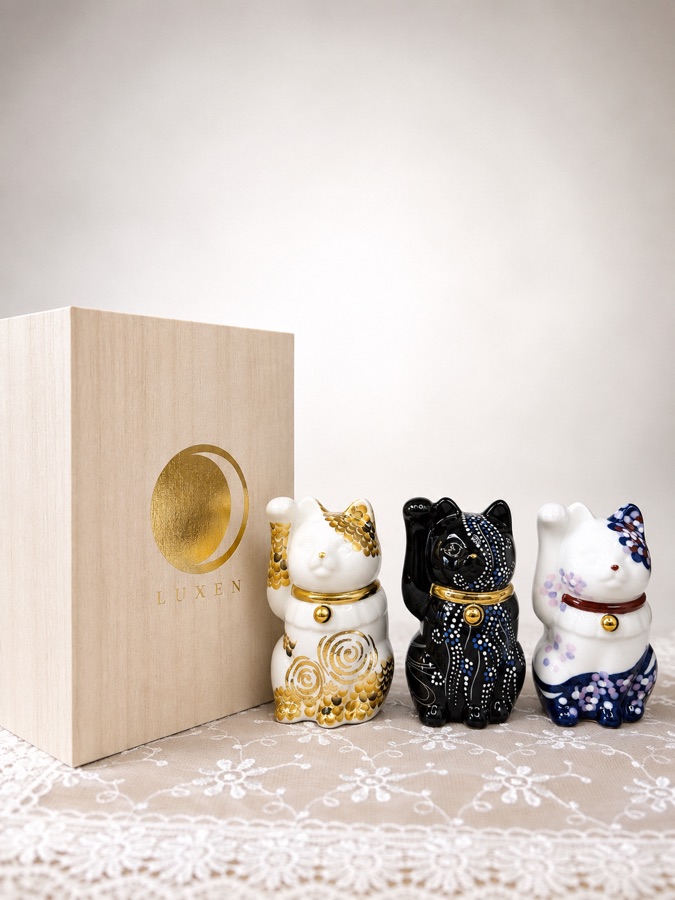
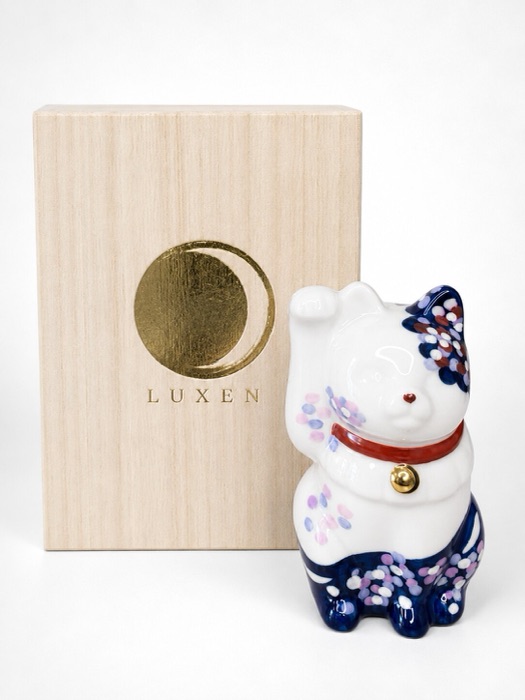
When you give a maneki neko with a wish attached, you may also want to say where it was made and by whose hands. Luxen Maneki is a brand of Japan ManekiNeko Research Institute, Inc., the company that runs Maneki Neko Lab. Artisans at a traditional Seto kiln hand-paint the gold on each piece, and we ship worldwide.
Frequently Asked Questions
Q. What is the luckiest maneki neko color?
A. In Maneki Neko Lab’s definition, the basic color for any wish is white or calico, meaning good fortune of every kind. It suits first-time owners and people without a single wish.
Q. Which maneki neko color is best for a business?
A. In our definition, gold is the color of wealth and success at work, which fits a shop or office. All three official Japanese lists we compared also give gold to money. Some owners add a black cat to protect the business from misfortune.
Q. Can you display maneki neko of different colors together?
A. Yes. We see no problem in displaying cats of different colors together, as long as each one carries a clear wish. Too many cats can blur the focus, so starting with two is a practical choice.
Q. Does a black maneki neko mean bad luck?
A. No. In Japan, a black maneki neko is chosen to keep misfortune away, and all three official lists we compared give black a protective meaning. Maneki Neko Lab also defines black as the color of protection from misfortune.
Luxen Maneki, Made by Maneki Neko Lab
Once you have chosen a color for your wish, you may also want to know where the cat was made and by whom. That is hard to tell from the cats sold in most shops.
Luxen Maneki is a brand of Japan ManekiNeko Research Institute, Inc., the company that runs Maneki Neko Lab. Its makers are artisans of Seto ware, one of Japan’s Six Ancient Kilns, and each piece is finished one at a time after you order. Because every cat is made to order, delivery takes about four to six weeks.
Each finished cat is delivered in a paulownia wood box, and we ship worldwide. Paulownia absorbs and releases moisture and resists burning, which is why it was once used for the inner boxes of safes.
Summary
Maneki Neko Lab defines maneki neko colors as nine colors carrying eight wishes. White and calico stand for good fortune of every kind, gold for wealth and work, black for protection from misfortune, and red for protection from illness.
Green stands for health and long life, pink for love, yellow for popularity, and blue for learning. The seven single-wish colors fall into colors that invite, nurture and protect.
Japanese makers agree on gold, white, black, red and pink, but differ on newer colors such as yellow and blue. To choose, first decide whether you want to invite, nurture or protect, then pick the color from the quick guide.