What You’ll Learn
- A raised right paw is said to invite money; a left paw, people
- No Japanese dictionary defines left and right
- Gotokuji Temple and Sumiyoshi Taisha teach their own versions
- Choose by your wish, the maker and where you place it
A maneki neko (招き猫, the Japanese “beckoning cat”) with its right paw raised is said to invite money, and one with its left paw raised to invite people. This is a tradition rather than a rule, and temples and regions sometimes swap the meanings.
If you have wondered which paw is “correct,” the answer is that both are. Once you know where the meanings came from, you can choose the paw that fits your wish and the place you will put the cat.
This guide sets out the meanings taught by temples and shrines and the theories found in Japanese books, each with its source.
What the Right and Left Paws Mean
A maneki neko’s meaning changes with the paw it raises, and both paws or a high paw carry meanings too. None of these were set by a temple or a kiln as a rule; they are interpretations passed on among people.
Right Paw for Money, Left Paw for People
A raised right paw is said to invite money, and a raised left paw invites people, meaning customers and connections. The Maneki Neko Museum in Seto, Aichi Prefecture, describes the right paw as beckoning *kane* (money) and the left as beckoning *hito* (people).
Splitting the two wishes into money and people fits a charm that spread as a symbol of good business. The table also shows other versions found in Japanese books.
Traditional meanings of the right and left paws
| Raised paw | What it is said to invite | Other traditions |
|---|---|---|
| Right paw | Money, wealth | For daytime business; for households |
| Left paw | People, customers, connections | For nighttime business; for shops |
Source: Maneki Neko Museum, “About the Maneki Neko: Column”(招き猫について:コラム)
Source: Collaborative Reference Database (National Diet Library), case from Aichi Prefectural Library
As the right column shows, the same two paws are also split between daytime and nighttime business, or homes and shops. Yet no record shows where any of these meanings began.
The fact that the meaning never settled says a lot about how widely the tradition has spread.
Which Paw Counts as “Right”?
The right paw means the cat’s own right paw, not the one on your right as you face it. Japanese sources describe the paws from the cat’s point of view.
When you face a maneki neko, a cat raising its right paw lifts the paw on your left. Product photos often confuse buyers for this reason.
So before you buy, check which front leg the cat itself is raising. A quick test is to imagine standing behind the cat and raising the same hand.
Both Paws and High Paws
A cat with both paws raised is said to invite both money and people. The Maneki Neko Museum also notes that some people avoid it, because two raised hands look like *oteage*, the Japanese gesture for “I give up.”
The height of the paw has a meaning as well. A cat whose paw rises above its ear, called *tenaga* (“long arm”), has been linked to big fortune or fortune from far away. A paw below the ear stands for smaller fortune close to home.
That means matching the size of your wish to the height of the paw makes choosing easier.
Source: Maneki Neko Museum, “About the Maneki Neko: Column”(招き猫について:コラム)
Why the Paws Came to Have Different Meanings
There is no scholarly consensus on the meaning of the right and left paws. What has come down to us are several theories introduced in books and the traditions that grew from them.
What is known about the left and right meanings
- Japanese dictionaries say nothing about the meaning of each paw
- One theory holds that left-pawed cats came first and meanings followed
- Some books say the right paw is correct; others reverse the meanings
Japanese Dictionaries Say Nothing
Aichi Prefectural Library registered a research case in the National Diet Library’s Collaborative Reference Database. In that case, librarians looked up the meaning of the paws in major Japanese reference works.
Encyclopedia Nipponica, the *Kokushi Daijiten* (a dictionary of Japanese history) and the *Nihon Minzoku Daijiten* (a dictionary of Japanese folklore) contain no entry on the meaning of each paw. Many popular books, on the other hand, repeat the idea of “right for money, left for customers.”
In other words, the meanings are not established scholarship. They are a tradition spread among collectors and makers, which is why temples and regions could develop their own versions.
Source: Collaborative Reference Database (National Diet Library), case from Aichi Prefectural Library
The Theory That Left Paws Came First
The same library case introduces a theory that the meanings were added later. Two Japanese books put forward this view:
- Yasuo Tsujihara, *Maneki Neko wa Nani o Maneite Iru no ka* (What Does the Maneki Neko Beckon?), Kobunsha, 2006
- Takeshi Mitsuhashi, *Migite o Ageru Maneki Neko* (The Maneki Neko That Raises Its Right Paw), PHP Institute, 1995
According to these books, the maneki neko began with the left paw because it was easier to make. Right-pawed cats came later, partly on craftsmen’s whims, and the meanings are best seen as added afterward.
If this theory is right, the shape came first and the wishes were attached later. Rather than memorizing a “correct” answer, see the paws as a history of people pinning their wishes on a shape.
Source: Collaborative Reference Database (National Diet Library), case from Aichi Prefectural Library
The Buddhist View and the Reversed Version
Some theories link the paws to religious ideas. Ryoko Miyazaki’s *Maneki Neko no Bunkashi* (Seikyusha, 1988) introduces a view based on Buddhism. Because Buddhism treats the left hand as impure, the true maneki neko beckons with its right paw.
Another book reverses the usual meanings, saying the right paw invites people and the left paw invites fortune. This version appears in a book of the same title edited by Makoto Kikuchi and the Japan Maneki Neko Club (Bensei Shuppan, 2001).
So the meaning of each paw changes from source to source. No record decides which theory is correct, so Maneki Neko Lab presents them side by side.
Source: Collaborative Reference Database (National Diet Library), case from Aichi Prefectural Library
How Temples and Regions Differ
Some temples and shrines connected with the maneki neko teach meanings that differ from the common tradition. These are the versions to follow if you receive a cat there.
Left and right by temple and tradition
- Gotokuji Temple: the right paw invites connections, and the cat holds no coin
- Sumiyoshi Taisha Shrine: right for business, left for family safety
- A business tradition: right for daytime trade, left for nighttime trade
Gotokuji Temple: The Right Paw Invites Connections
Gotokuji Temple in Setagaya, Tokyo, is one of the places named as the birthplace of the maneki neko. The temple calls its cats 招福猫児 and reads the name “maneki neko.” According to the temple, its cats raise the right paw and hold no coin.
The common tradition treats the right paw as the money paw, but the temple teaches something else. Its cat invites people and brings connections (*en*), yet does not hand over fortune itself.
The teaching is that making the most of a connection is up to you, which is why the cat raises only its right paw and holds no coin. Gotokuji is therefore a key example of a right paw that stands for connections rather than money.
The cat’s story goes back to Ii Naotaka, a feudal lord who was beckoned into the temple by a cat at the gate and escaped a thunderstorm. With the support of the Ii family, the temple was rebuilt in 1633, according to Gotokuji.
Source: Gotokuji Temple, “Gotokuji and the Maneki Neko”(豪徳寺と招き猫)
Sumiyoshi Taisha: The Paw Changes by Month
Sumiyoshi Taisha Shrine in Osaka holds *Hattatsu Mairi* on the first Day of the Dragon each month. At its Nankunsha sub-shrine, odd months bring a small left-pawed cat, for the safety of the family.
In even months, visitors receive a right-pawed cat to pray for prosperous business, according to the shrine’s official site. Here the right paw means business and the left means family safety, a different split from the usual “money and people.”
Collecting 48 cats over four years completes the set. The number 48, read *shijuhattatsu*, is a pun on “ever-growing,” which is why it counts as lucky.
A Japanese guide to lucky charms published in 1997 printed these meanings the other way around. That is why you should check the shrine’s own guidance for any cat you receive there.
The shrine’s official site notes that its offering fees changed from September 2026 (as of October 2026). Check the latest information before you visit.
Source: Sumiyoshi Taisha Shrine, “Hattatsu Mairi”(初辰まいり)
Daytime Trade and Nighttime Trade
Another tradition splits the paws by business hours: a right-pawed cat for daytime trade and a left-pawed cat for nighttime trade. The Aichi Prefectural Library case lists books such as *Shiawase no Maneki Neko* (1995) that carry this view.
A book about Kyoto lucky charms, *Engimono Kyo no Takarazukushi* by Chikara Iwagami (Mitsumura Suiko Shoin, 2003), adds a local example. It notes that black cats are said to be for business, and that right paws are sometimes linked to daytime trade and left paws to nighttime trade.
The idea is that shops welcoming customers by day and those entertaining guests at night chose different paws. Even within “inviting people,” choosing a paw by who you want to welcome, and when, is wisdom born in the marketplace.
Source: Collaborative Reference Database (National Diet Library), case from Aichi Prefectural Library
How to Choose Between Left and Right
Because the meanings are not fixed, three questions make the choice easy: your wish, the maker and the place.
Choose by Your Wish
If your wish is clear, following the common tradition is the simplest approach. For a cat received at a temple or shrine, though, respect the meaning that temple teaches.
Choosing a paw by your wish
| Your wish | Paw to choose | Note |
|---|---|---|
| Money, business | Right paw | At Sumiyoshi Taisha, the right-pawed cat is also for business |
| People, customers, connections | Left paw | Gotokuji’s cat invites connections with its right paw |
| Both money and people | Both paws | Some people avoid it because it resembles “I give up” |
| A temple or shrine cat | Follow that place’s meaning | Meanings differ by temple and shrine |
Source: Maneki Neko Museum, “About the Maneki Neko: Column”(招き猫について:コラム)
Source: Gotokuji Temple, “Gotokuji and the Maneki Neko”(豪徳寺と招き猫)
Source: Sumiyoshi Taisha Shrine, “Hattatsu Mairi”(初辰まいり)
If you are torn, narrow your wishes down to the one that matters most and choose the paw that fits it. With more than one wish, you can also welcome two cats raising different paws.
Choose by Maker and Form
The kilns that make maneki neko keep the meanings of the paws alive in their shapes. Fujikou Ceramic, a maker in Seto, shared its approach with us in an interview.
The kiln avoids novelty and respects the basic form that people have loved for generations. It values shapes that keep the traditional readings intact, such as the meaning of each paw and the position of the ears.
At the same time, the kiln told us that the maneki neko “can be freer than it is”. Choosing by form rather than meaning is a view only a maker would offer.
Knowing the meanings and then deciding by how the cat feels in your hands is a valid way to choose.
Choose by Where You Will Place It
Matching the paw to the role of the place makes the wish behind your cat clearer.
Following the tradition, a left-pawed cat suits a shop front or entrance, where you welcome people. A right-pawed cat suits a register or cash desk, where money is handled.
At home, you might choose a left paw if you wish for family ties and a right paw if you wish for a comfortable life. For a cat received at a temple or shrine, follow that place’s guidance on how to keep it.
The raised paw is one part of what a maneki neko means; its color and the coin it holds carry wishes too.
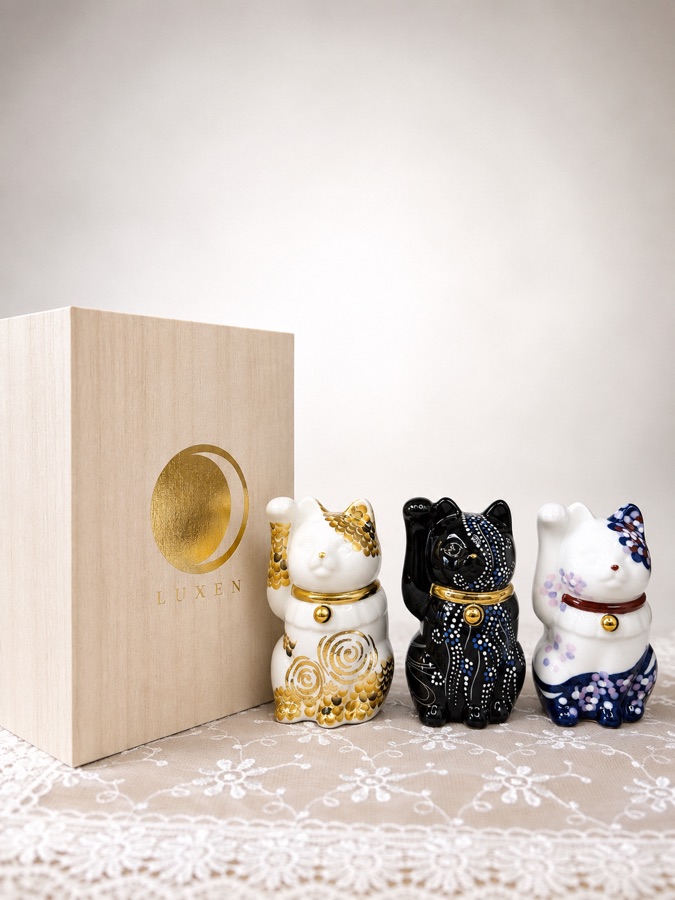
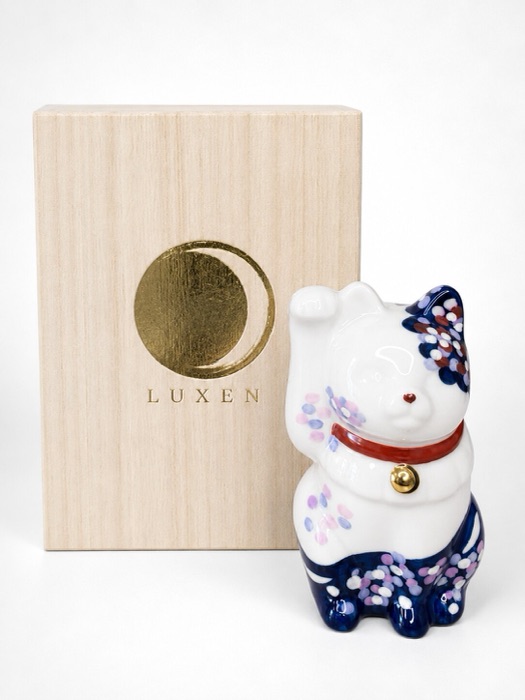
Once you have chosen a paw by your wish and your space, the next question is where your cat was made and by whom. Luxen Maneki is a brand of Japan ManekiNeko Research Institute, Inc., the company that runs Maneki Neko Lab. Artisans at a traditional Seto kiln hand-paint the gold on each piece, finishing it in about four to six weeks after you order.
Frequently Asked Questions
Q. What does it mean if a maneki neko raises its left paw?
A. A left-pawed maneki neko is said to invite people, customers and connections, which is why it has often been placed at shop entrances. One theory also holds that left-pawed cats were made first because they were easier to shape, and the meaning was added later.
Q. Will a right-pawed maneki neko make me rich?
A. A right-pawed cat is said to invite money and has long been displayed to wish for good business. It does not promise wealth, though. Treat it as a charm that holds your wish and encourages your daily effort.
Q. Which direction should a maneki neko face?
A. Japanese dictionaries describe the custom of placing the maneki neko at a shop’s entrance, where it can beckon in the people who arrive. For a cat received at a temple or shrine, follow that place’s guidance.
Q. Is a left-pawed maneki neko unlucky?
A. No. None of the temples, museums or books cited in this guide describe a left paw as unlucky. In the common tradition, the left paw invites people and customers, and at Sumiyoshi Taisha Shrine it stands for the safety of the family.
Luxen Maneki, Made by Maneki Neko Lab
Because the meaning of each paw is not fixed, what you wish for and who made your cat become its real value. Luxen Maneki, made by Maneki Neko Lab, offers maneki neko whose gold is hand-painted, one at a time, by artisans at a traditional Seto kiln.
Luxen Maneki is a brand of Japan ManekiNeko Research Institute, Inc., the company that runs Maneki Neko Lab. Unlike mass-produced cats, each piece is finished one at a time over about four to six weeks after you order.
Every cat is delivered in a paulownia wood box, a wood once used for the inner boxes of safes because it resists moisture and fire. We ship worldwide.
Summary
A maneki neko’s right paw is said to invite money, and its left paw people. These meanings are a tradition passed down among people, not something defined in Japanese dictionaries, and one theory says left-pawed cats simply came first.
Temples teach their own versions. Gotokuji Temple’s right-pawed cat invites connections, and Sumiyoshi Taisha alternates left and right by month.
To choose, start with the wish that matters most, then consider the maker’s form and the place you will put the cat. Remember that “right” means the cat’s own right paw.