What You’ll Learn
- The maneki neko was born in Japan in the late Edo period
- In Chinese it is called zhaocai mao, “the cat that beckons wealth”
- The gold cat with a moving paw is common in Chinese-speaking communities
- Its Japanese gesture is a beckon, which can look like a wave
The lucky cat is Japanese in origin. The figure known in Japan as the maneki neko (招き猫, “beckoning cat”) first appears in records from Edo, today’s Tokyo, in the mid-19th century. It later spread to China, Taiwan and Chinatowns around the world, where it took on a new name and look.
That is why the same cat is called a “Chinese lucky cat” in many shops. The difference lies less in the cat itself than in how each culture names, makes and displays it.
This guide compares the two versions point by point, using Japanese museums, government tourism texts and our own interview with a folklorist.
Japanese vs. Chinese Lucky Cat: The Main Differences
The Japanese maneki neko and the lucky cat seen in Chinese communities differ in name, look, where it is made and where it sits. The core idea, a cat that raises a paw to invite good fortune, is shared by both.
Comparison at a Glance
The clearest way to see the difference is to set the two versions side by side. Name and place of production differ the most, while the raised paw and the coin stay the same.
The Japanese maneki neko and the lucky cat common in Chinese communities
| Point | Japanese maneki neko | Lucky cat in Chinese communities |
|---|---|---|
| Name | Maneki neko, “beckoning cat” | Zhaocai mao (招財貓 / 招财猫), “lucky cat,” “fortune cat” |
| Typical look | Calico cat holding a gold koban coin | Gold cat, often with a battery-powered moving paw |
| Gesture | Palm-down Japanese beckon | Same pose, often read as a wave by English speakers |
| Where it is made | Pottery towns such as Tokoname and Seto | Largely made and sold locally, including in China |
| Where it sits | Shops, restaurants, homes; temples and shrines | Restaurants and shops, Chinatowns |
The look and production rows also draw on our interview with folklorist Takanori Shimamura, a professor at Kwansei Gakuin University who studies lucky charms and folk beliefs. Neither column is the “real” one; they are two branches of one charm.
Names: Maneki Neko and Zhaocai Mao
The Japanese name means “beckoning cat,” while the Chinese name puts wealth into the word itself. Zhaocai mao reads as “the cat that beckons wealth.”
Japan’s Tourism Agency publishes official texts for visitors in several languages. Its English text on Tokoname calls the figures maneki neko (lucky cats). The Traditional Chinese version of the same text calls them 招財貓 throughout.
In other words, the Japanese government itself uses zhaocai mao as the Chinese word for maneki neko. The Japanese name says only that the cat invites; the Chinese name says what it invites.
This also explains the English labels. “Beckoning cat” translates the Japanese, while “lucky cat” and “fortune cat” follow the meaning stressed in Chinese.
The kanji, the pronunciation and the English names are explained in our guide to the name.
Look: Calico Cat and Gold Cat
The classic Japanese maneki neko is a calico cat in white, black and orange, holding a gold coin in its lowered paw. The Tourism Agency’s text describes this as the usual form, while noting that many colors and designs now exist.
The lucky cat in Chinese communities is often gold all over. Shimamura told us that cats seen in restaurants in China include gold ones whose paws move automatically.
Gold is not foreign to Japan, either. In the Japanese color tradition, a gold maneki neko stands for money luck and success at work. The gold cat simply became the standard form in other markets.
Color meanings in Japan go well beyond gold; our color guide covers each one.

Gesture: Beckoning, Not Waving
Both versions raise a paw, but the pose is a Japanese beckon with the palm facing down. Japan National Tourism Organization (JNTO) notes that this differs from the outward-facing gesture common in many other countries.
nippon.com adds that to someone from an English-speaking country, the cat might look like it is waving. A moving paw that swings back and forth makes the “waving cat” reading even more natural.
So when someone calls it a waving cat, the cat is in fact beckoning you in. In Japan, the cat’s right paw is said to invite money and its left paw people.
What each paw means, and how temples sometimes swap them, is explained in our left and right paw guide.

The difference in gesture also explains why the cat seems to wave. Our guide covers the beckon and how moving arms work.
Is the Lucky Cat Chinese or Japanese?
The lucky cat is Japanese. Museums and Japanese dictionaries trace the figure to the late Edo period in Edo, and no older Chinese figure has been put forward in the sources we checked.
The Earliest Records Are Japanese
The oldest dated record of the figure comes from Edo in 1852. According to the Museum of Kyoto, the Marushime cat, a clay doll made in the Imado district, became popular in Edo that year.
The Japanese dictionary Digital Daijisen Plus describes the Marushime cat as the oldest known maneki neko. The Japan Maneki Neko Club, a society of maneki neko enthusiasts, calls the figure “a lucky charm born in Japan.”
Even so, the Museum of Kyoto notes that no record shows exactly when the beckoning cat doll was first made. In short, “when” is still open, but “where” is Japan.
The temple legends and local tales behind the figure’s birth are compared in our complete guide.
Why Many People Think It Is Chinese
People often take the lucky cat for Chinese because they first meet it in Chinese restaurants and Chinatowns. The English-language site nippon.com writes that this Chinatown connection has become so strong that many assume the cat began in China.
A second reason lies in an old saying. The older edition of the Japanese World Encyclopedia links the beckoning pose to a belief that a cat washing its face means guests are coming. It traces that belief to a Chinese anecdote.
The saying, however, explains the gesture, not the object. The figure itself, a clay or ceramic cat with a raised paw, first appears in Japanese records.
How Chinese Communities Made It Their Own
The lucky cat did not simply pass through Chinese communities; it became part of local culture there. Shimamura told us that most cats seen in China are made and sold locally rather than imported from Japan.
According to him, people in China still tend to see the figure as something Japanese. Yet it has already blended into local life.
The Japan Maneki Neko Club gives one route by which this happened. Some cats first made abroad as souvenirs for Japanese travelers later took root in those places, the club says.
The Chinese lucky cat is therefore a Japanese charm that grew up in another culture. Asking which one is “authentic” misses how charms travel.
How the Maneki Neko Traveled Abroad
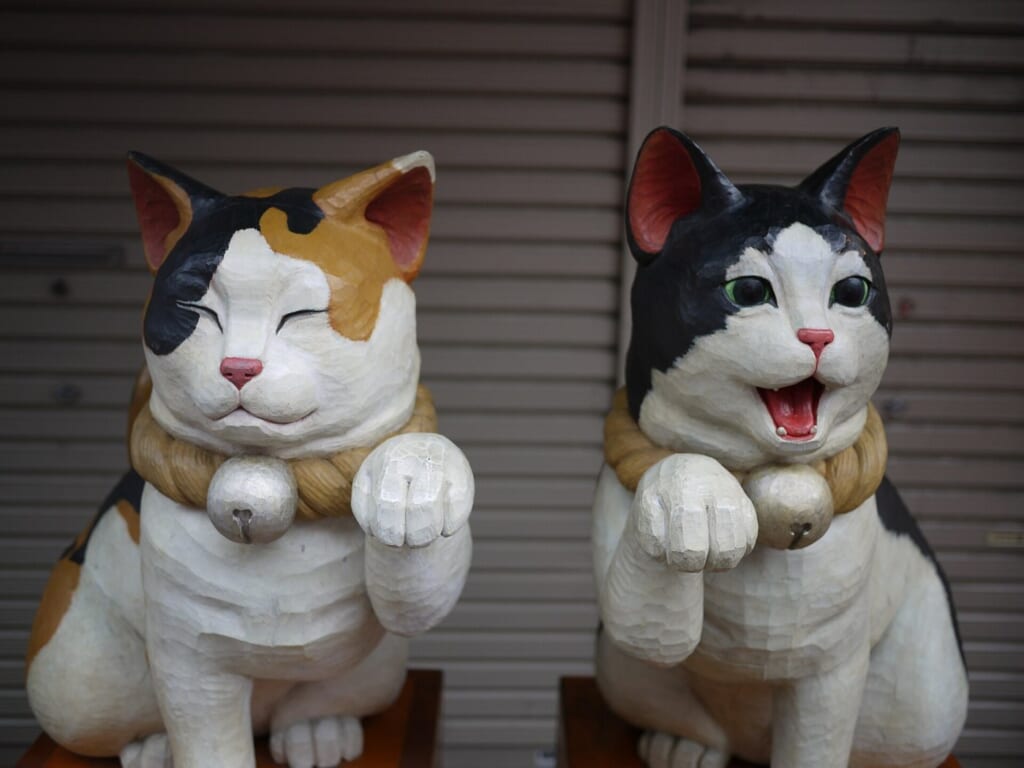
Japanese pottery towns made figurines for export from about a century ago, and museums outside Japan now record the maneki neko as Japanese design. Both show that the cat’s travels began well before today’s souvenir trade.
Seto and Tokoname: The Pottery Towns Behind It
Seto in Aichi Prefecture began making figurines for export in the Taisho era (1912–1926). The Hyogo Museum of Ceramic Art explains that these export pieces, called “novelties,” took off when World War I cut off German supplies to America.
Seto filled the gap and reached its peak after World War II.
Nearby Tokoname began making maneki neko in the late 1930s. By 1950, it was Japan’s top producer, and its style of large eyes and ears with a plump body was set.
These two towns in Aichi remain the main centers of maneki neko production in Japan today.
A century after Seto’s first export pieces, the town’s kilns still make maneki neko. Luxen Maneki is a brand of Japan ManekiNeko Research Institute, Inc., the company that runs Maneki Neko Lab. Artisans at a traditional Seto kiln hand-paint the gold on each piece, and we ship worldwide.
A Hong Kong Museum Records It as Japanese
M+, a museum of visual culture in Hong Kong, holds a 1996 poster titled Cat in Japan. The artist Tadanori Yokoo designed it for the Japan Maneki Neko Club, founded in Gunma Prefecture in 1993.
The museum’s description calls the maneki neko the iconic “beckoning cat,” with legends dating back to the Edo period. It presents the cat as a widely recognized symbol of good fortune in Japan.
A museum in a Chinese-speaking city, in other words, files the lucky cat under Japanese design. That record supports what Japanese sources say about the figure’s Japanese roots.
How to Tell a Japanese-Made Maneki Neko
The surest way to tell a Japanese-made cat is to check the country of origin on the box or base. Style alone cannot settle it, because many figures in the Japanese style are now made overseas.
Knowing where to buy also makes a Japanese-made cat easier to find. Our buying guide lists temples, kiln towns and shops in Japan.
Check the Label First
The Japan Maneki Neko Club lists Seto and Tokoname in Aichi, Tajimi in Gifu, and Kanazawa and Komatsu in Ishikawa as the main production areas. It adds that production overseas is also widespread.
So a calico cat with a koban is not proof of Japanese origin. Look for “Made in Japan” and the name of a town or kiln on the box, the base or the seller’s page.
Clues in Shape and Material
Japanese pottery towns each have a recognizable house style. Aichi Prefecture’s tourism site describes Tokoname cats as round earthenware and Seto cats as slim porcelain with fine painting.
Material is another clue. Cats from these towns are fired ceramic pieces, while automatic waving cats need a battery-powered mechanism inside the body.
Neither clue is decisive on its own, and a battery-powered cat can be just as cheerful. Choose the version that suits your space, and check the label if Japanese craft matters to you.
Regional styles and materials are compared in our guide to the types of maneki neko.
What is the lucky cat called in Chinese, Cantonese and Korean? See our name guide.
In Thai shops you may see Nang Kwak next to the maneki neko. Here is how the two differ.
Want one made in Japan? Here is a checklist for telling an authentic Japanese maneki neko.
Frequently Asked Questions
Q. Is the lucky cat Chinese or Japanese?
A. It is Japanese. The figure first appears in records from Edo, today’s Tokyo, in the mid-19th century. It is very common in Chinese restaurants and Chinatowns, which is why many people assume it is Chinese.
Q. What is the lucky cat called in Chinese?
A. It is called zhaocai mao (招財貓 in Traditional Chinese, 招财猫 in Simplified Chinese), meaning “the cat that beckons wealth.” Japan’s Tourism Agency uses this name in the Chinese version of its official text on Tokoname maneki neko.
Q. Why does the lucky cat wave?
A. It is not waving but beckoning. In Japan, people beckon with the palm facing down, which can look like a wave to English speakers. Battery-powered cats that swing their paw make the waving reading even more common.
Q. Which lucky cat is for money?
A. In the Japanese tradition, a cat with its right paw raised is said to invite money, and a gold cat is linked to money luck and success at work. These are traditions, not promises.
Luxen Maneki, Made by Maneki Neko Lab
If you want a maneki neko from the place where the export craft began, the maker and the town matter more than the color. Luxen Maneki, made by Maneki Neko Lab, offers Seto ware maneki neko whose gold is hand-painted by artisans at a traditional kiln.
Luxen Maneki is a brand of Japan ManekiNeko Research Institute, Inc., the company that runs Maneki Neko Lab. Each piece is finished one at a time over about four to six weeks after you order.
Every cat is delivered in a paulownia wood box, a wood once used for the inner boxes of safes because it resists moisture and fire. We ship worldwide.
Summary
The lucky cat is Japanese in origin, with its oldest dated record in Edo in 1852. In Chinese it became zhaocai mao, “the cat that beckons wealth,” and the gold cat with a moving paw grew common in Chinese communities.
The two versions differ in name, look, place of production and display. Yet both raise a paw to invite good fortune, and the gesture is a beckon rather than a wave.
If Japanese craft matters to you, check the country of origin and the town on the label. Seto and Tokoname in Aichi remain the main centers of production.

