What You’ll Learn
- The earliest maneki neko image is Hiroshige’s print from 1852
- Kuniyoshi’s cat prints were sold as charms against rats
- Museums in Tokyo and New York show these works online
- Old prints show how to draw the paw, collar and bell
Maneki neko (招き猫, “beckoning cat”) art begins with a woodblock print published in Edo in 1852. Utagawa Hiroshige drew a street stall lined with small white cats, the same year clay beckoning cats became a craze in the city.
That print matters because no one knows when the first beckoning cat was made. Art records are among the few dated traces we have, so they help fix when the figure took shape.
This guide walks through the key works, from Hiroshige and Utagawa Kuniyoshi to toy prints for children and a 1996 poster. It also lists the museum pages where you can view them, checked on October 29, 2026, and what the old images teach about drawing a lucky cat.
Maneki Neko Art at a Glance
Maneki neko art covers prints, toy sheets, posters and the figures themselves. The oldest datable image of a beckoning cat comes from a print, not from a surviving figure.
Maneki neko art in brief
- Hiroshige’s 1852 print shows a stall selling white cat figures
- Kuniyoshi led an Edo cat print boom around 1841–1842
- Some cat prints were pasted up at home to scare off rats
Key Works of Maneki Neko and Cat Art
The works below trace how the beckoning cat entered Japanese art. Each one is held by a museum that publishes it online.
Key works of maneki neko and cat art
| Work | Artist | Date | What it shows | Collection |
|---|---|---|---|---|
| Prosperous Joruri District (浄瑠璃町繁花の図), seven sheets | Utagawa Hiroshige | 1852 | Street vendors, including a stall with small white cat figures | Edo-Tokyo Museum |
| Cat to Keep Rats Away (鼠よけの猫) | Utagawa Kuniyoshi | 19th century | A cat with a bell on its neck, printed as a charm against rats | Tokyo National Museum |
| Cats Cooling Off (猫のすゞみ), fan print | Utagawa Kuniyoshi | 19th century | Cats as a geisha, a boatman and a guest holding a koban coin | Tokyo National Museum |
| The Okazaki Cat Demon, diptych | Utagawa Kuniyoshi | ca. 1850 | A ghost cat in a scene from a ghost story | The Metropolitan Museum of Art |
| Pilgrimage to the Torinomachi Festival across the Ricefields of Asakusa | Utagawa Hiroshige | 1857 | A white cat on a windowsill looking toward Mount Fuji | The Metropolitan Museum of Art |
| Poster, Cat in Japan | Yokoo Tadanori | 1996 | Three maneki neko against a rising sun | M+, Hong Kong |
Only the first row shows maneki neko figures. The others show the cat images Edo audiences already knew, from a rat-chasing guardian to a ghost.
Read together, they explain why a cat could become a charm. Edo prints had shown cats as protectors, money holders and household pets long before the beckoning figure spread.
Why Prints Help Date the Maneki Neko
Prints matter because the first beckoning cat figure has no known date. The Museum of Kyoto states that the origin of the maneki neko is unclear, since no one can say when the raised-paw doll first appeared.
What survives is a record from 1852. That year Edo saw a craze for the Marushime-neko, a clay cat of Imado ware. In the museum’s account, it is where the name “maneki neko” and the raised paw appear together in records of the time.
Hiroshige’s print is dated to the same year. The Japan Tourism Agency’s multilingual text for Tokoname also says the first maneki neko are thought to have appeared in the mid-19th century.
Origin legends from temples such as Gotokuji are older stories, but they are not dated objects. Our history guide compares the legends and the records in full.
Hiroshige’s 1852 Print: The Earliest Maneki Neko Image
Hiroshige’s Joruri-cho Hanka no Zu is the earliest known picture of maneki neko for sale. It shows the cats as goods in a busy market, which places them in daily Edo life.
Hiroshige’s 1852 print
- The Edo-Tokyo Museum holds a set of seven sheets
- One stall displays rows of small white cat figures
- The Marushime-neko craze lasted only four or five years
What the Museum Record Says
The Edo-Tokyo Museum lists the work as a set of seven nishiki-e color prints by Utagawa Hiroshige (the first). Its record dates the set to 1852 (Kaei 5) and names the publisher as Ibaya Senzaburo.
Each sheet measures about 36.7 by 25 cm. The museum’s English title is “Prosperous Joruri District (Street Vendors and Customers in a Busy Market).”
Joruri is a style of chanted storytelling used in puppet theater. The print imagines a whole town of street vendors, with food stalls, toy sellers and lantern stands spread across the sheets.
Source: Edo-Tokyo Museum Digital Archives, “Prosperous Joruri District”(浄瑠璃町繁花の図)
The Cat Stall on the Fourth Sheet
On the fourth sheet in the museum’s set, a stall at the top left is stacked with small white cats. A seller sits under a blue awning beside a red stand and baskets full of the figures.
The Lab’s library timeline records this scene as a shop selling Marushime-neko. When the Shizuoka City Museum of Art showed another impression of the print, its caption read “Marushime-neko on sale!”
The Digital Daijisen Plus dictionary describes the Marushime-neko as a seated cat with one front paw raised. A circled 〆 mark sits on its rear, and the dictionary calls it the oldest example of the maneki neko.
The Shizuoka museum adds that these clay cats seem to have been sold on the grounds of Sensoji Temple in Asakusa. The craze faded after four or five years, yet makers kept producing beckoning cats across Japan.
So the print records a short boom, not a lasting custom. Imado Shrine stands in the area where Imado ware was made, one of the places named as a birthplace of the maneki neko.
A Later Figure in the Same Museum
The Edo-Tokyo Museum also holds a Marushime-neko made in the 20th century. Its maker, Kanazawa Harukichi, worked in Imado ware, and the museum dates the figure to the Taisho to early Showa years.
The figure is tiny, about 1.9 by 4.3 by 2.9 cm. It belongs to a group of Imado ware and Imado dolls by Kanazawa Harukichi in the museum’s archives.
Seen beside the 1852 print, it shows that the Marushime design outlived its craze. The print fixes the date, and the later figure shows what the cats looked like in the hand.
Source: Edo-Tokyo Museum Digital Archives, “Imado Doll: Marushime-neko”(今戸人形 丸〆猫)
Kuniyoshi and the Cat Prints of Edo
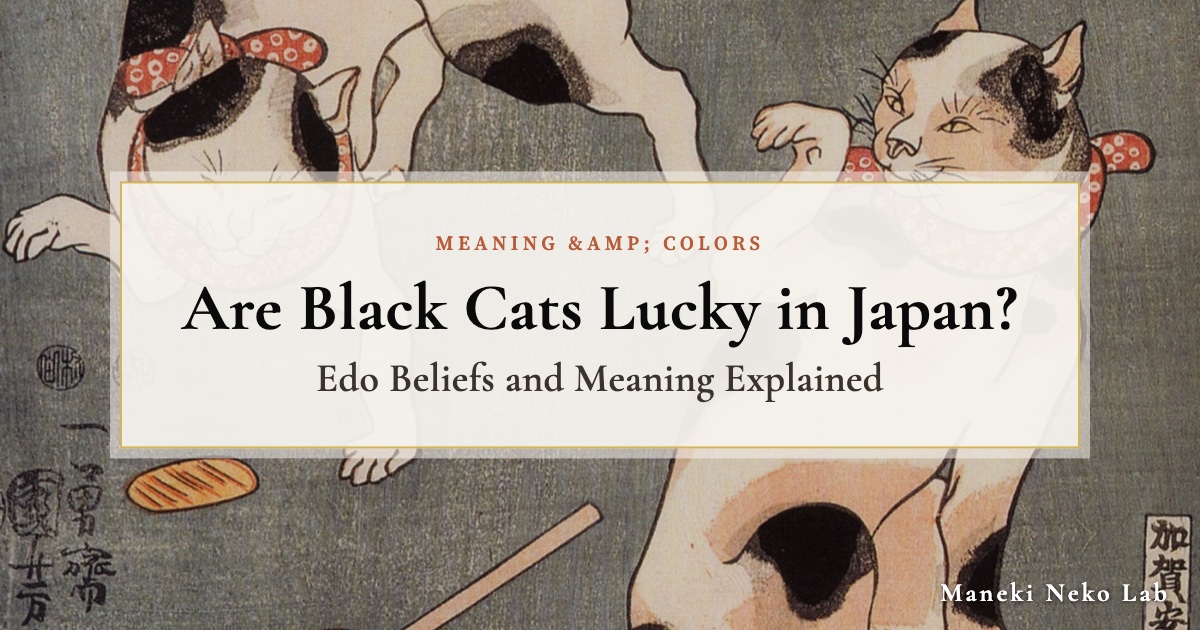
Utagawa Kuniyoshi made cats a leading subject of Edo prints. His work gave the city a large stock of cat images a decade before the Marushime craze.
Kuniyoshi’s cats
- The Museum of Kyoto dates the cat print boom to 1841–1842
- One Kuniyoshi print claims to keep rats away when pasted up
- His indoor cats almost always wear a red collar
The Cat Print Boom of 1841–1842
The Museum of Kyoto dates a major cat boom in Edo to around 1841–1842. It names Kuniyoshi, a devoted cat lover, as its leading figure.
His prints turned kabuki actors into cats and dressed cats as people. The museum notes that Kuniyoshi filled kimono patterns and titles with things cats love, such as fish, octopus and shellfish, along with koban coins and bells.
Ukiyo-e researcher Noriko Okubo, an associate professor at Okayama University, explained to Maneki Neko Lab why such prints reached so many people. In her view, ukiyo-e were the mass media of Edo, made and sold in large numbers.
Woodblock printing made pictures cheap enough for ordinary townspeople. Okubo adds that illustrated books sold better, and buyers soon wanted the pictures alone as single sheets.
So the cat boom spread through the same channel as actor portraits and travel scenes. A beckoning cat figure arrived in a city where cat pictures were already everywhere.
A Print to Keep Rats Away
Some cat prints were bought as charms, not only as pictures. Tokyo National Museum describes Kuniyoshi’s Nezumi-yoke no Neko (Cat to Keep Rats Away) as one of them.
The cat wears a bell on its neck and stares upward, as if about to pounce. The museum quotes the text printed on the sheet:
> “If you paste this picture up at home, the rats will be afraid and will not come out.”
Source: Cultural Heritage Online, “Cat to Keep Rats Away” (Tokyo National Museum)(鼠よけの猫)
The museum explains that cat pictures circulated in Edo as rat charms. Silk farmers had the same need, since rats ate silkworms and cocoons.
A case from Saitama Prefectural Kuki Library on the Collaborative Reference Database (National Diet Library) cites the Shinpen Saitama Kenshi, a prefectural history. It records that silk farmers used cat pictures and paper talismans against rats.
A picture of a cat could protect a home before any figure did. The maneki neko inherited that role and added a new wish, to beckon customers in. Our guide to why cats are lucky in Japan covers these beliefs.
Coins, Bells and a Red Collar
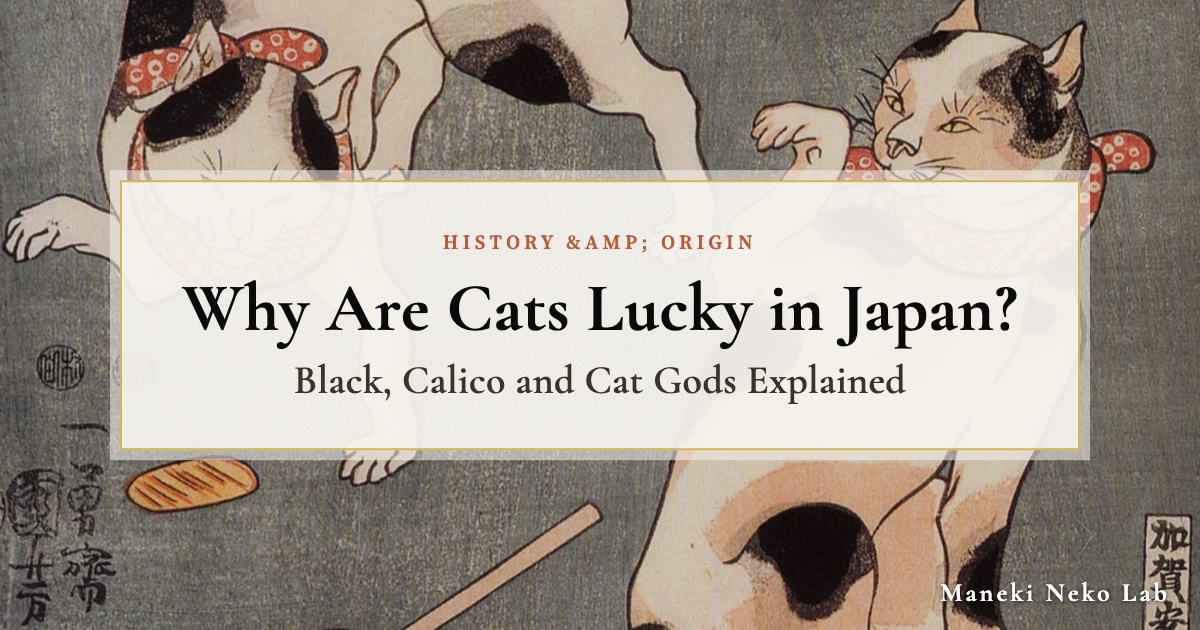
Kuniyoshi’s cats already carry many of the items a maneki neko holds today. In his fan print Neko no Suzumi (Cats Cooling Off), Tokyo National Museum points to the guest cat with a koban coin.
That detail plays on the saying neko ni koban, “a gold coin to a cat,” meaning a treasure wasted on someone who cannot use it. The same print wraps its title in dried bonito flakes, another favorite food of cats.
Okubo traces the red collar through art. She told Maneki Neko Lab that cats from China, called karaneko, were kept on cords by Heian aristocrats, and paintings from the Kamakura period on show those cords in red.
She also contrasts Japanese and Chinese art. Chinese paintings of cats with butterflies show no ribbon, while Kuniyoshi’s indoor cats almost always wear a red one, a convention she links to the maneki neko.
The coin, bell and collar each carry a wish in Maneki Neko Lab’s definitions. Our guide to the coin and bell explains each item.
Ghost Cats Before Lucky Cats
Edo art also showed the cat as something to fear. The Museum of Kyoto notes that in 1827 the actor Onoe Kikugoro III won fame playing a ghost cat in a kabuki revenge story.
Ghost-cat plays were staged again and again after that success. The Met holds Kuniyoshi’s diptych The Okazaki Cat Demon, dated around 1850, a scene from one such ghost story.
So the same artist drew cats as demons, as pets and as charms. The beckoning cat took the friendly side of that range and made it a figure for shops and homes.
After seeing how Edo prints mixed cats with coins and red collars, you may wonder whether that look survives in craft today. One answer is Ukiyo (浮世, black) from Luxen Maneki, a brand of Japan ManekiNeko Research Institute, Inc., the company that runs Maneki Neko Lab. Its name means “the floating world,” the word behind ukiyo-e, and Seto artisans hand-paint its gold.
Toy Prints and Cats in Everyday Scenes
Beyond Kuniyoshi, cats filled prints made for children and for city views. These works show how ordinary the cat had become in Edo art.
Cats beyond Kuniyoshi
- Omocha-e toy prints were made in great numbers from the late Edo period
- Cats star in more toy prints than any other animal
- Hiroshige’s 1857 window cat is a real pet, not a charm
Omocha-e: Toy Prints for Children
Omocha-e (おもちゃ絵, toy prints) were ukiyo-e sold for children to play with. The Museum of Kyoto says they were mass-produced from the end of the Edo period into the Meiji era (1868–1912).
They included board games, riddles and card games. Some were sheets to cut out, and others paper models to assemble.
Animals such as cats, mice, dogs and tanuki often took the lead roles, dressed and acting like people. Among them, the museum says, toy prints starring cats far outnumber the rest.
It links that flood of cat prints to the Kuniyoshi boom. Children who played with these sheets grew up with the same friendly cats that shops would soon beckon with.
Hiroshige’s Cat at the Window
The best-known cat in Hiroshige’s work is a real pet, not a maneki neko. In his 1857 print from One Hundred Famous Views of Edo, a white cat sits on a windowsill.
It looks out over the ricefields of Asakusa toward Mount Fuji, on the day of the Torinomachi festival named in the title. The Metropolitan Museum of Art holds an impression, accession number JP60.
This is not a lucky cat image, since the cat raises no paw and holds no coin. It shows how cats lived in Edo rooms, which is the world the beckoning figure came from.
Where to See Maneki Neko Art
You can see most of these works online in museum collection pages. The table lists pages checked on October 29, 2026, with what each one shows.
Where to see the works
- Edo-Tokyo Museum: Hiroshige’s 1852 print, all seven sheets
- Tokyo National Museum, via Cultural Heritage Online: Kuniyoshi’s cat prints
- The Met and M+: later cat prints and a 1996 poster
Museum Collection Pages to Visit Online
These pages show the works with museum records attached. Images load on each page, and the records give the artist, date and size.
Maneki neko and cat art online (as of October 29, 2026)
| Museum | Work | What the page offers |
|---|---|---|
| Edo-Tokyo Museum Digital Archives | Prosperous Joruri District (1852) | All seven sheets, date, publisher and size |
| Edo-Tokyo Museum Digital Archives | Imado Doll: Marushime-neko | A 20th-century Marushime-neko by Kanazawa Harukichi |
| Cultural Heritage Online (Tokyo National Museum) | Cat to Keep Rats Away | Image and the museum’s description in Japanese |
| Cultural Heritage Online (Tokyo National Museum) | Cats Cooling Off | Image and the museum’s description in Japanese |
| The Metropolitan Museum of Art | The Okazaki Cat Demon (ca. 1850) | Diptych, free-to-use Open Access image |
| The Metropolitan Museum of Art | Torinomachi Festival across the Ricefields of Asakusa (1857) | Free-to-use Open Access image |
| M+ | Poster, Cat in Japan (1996) | Image and an English description |
Source: Edo-Tokyo Museum Digital Archives(江戸東京博物館 デジタルアーカイブス)
Source: Cultural Heritage Online, “Cats Cooling Off” (Tokyo National Museum)(猫のすゞみ)
Source: The Metropolitan Museum of Art, “Scene from a Ghost Story: The Okazaki Cat Demon”
Source: The Metropolitan Museum of Art, “Pilgrimage to the Torinomachi Festival across the Ricefields of Asakusa”
Source: M+, “Poster, Cat in Japan”
Online pages are the surest way to see these works, since prints on paper are not always on display. The Edo-Tokyo Museum in Tokyo has reopened after renovation, with its permanent exhibition open again (October 2026).
For figures rather than prints, Tokyo has temples and shrines where you can meet maneki neko in person. Our guide to Tokyo’s lucky cat temples lists them by area.
Modern Maneki Neko Art and How to Draw One
Modern artists treat the maneki neko as a symbol of Japan itself. The old prints also give practical hints for anyone drawing a lucky cat today.
Modern art and drawing tips
- Yokoo Tadanori made a maneki neko poster in 1996
- A San Diego museum showed 155 maneki neko in 2011–2012
- Draw the paw, collar and bell to match the wish
From Folk Figure to Poster and Museum
In 1996, graphic designer Yokoo Tadanori made the poster “Cat in Japan” for the Association of Manekineko Japan, a club founded in 1993. M+, a museum of visual culture in Hong Kong, holds the screen print.
M+ describes three cats standing against a rising sun, with torii gate imagery and household prayers on the pillars. It calls the maneki neko the most widely recognized symbol of good fortune in Japan.
Museums outside Japan have shown the figures as folk art. Mingei International Museum in San Diego held “Maneki Neko: Japan’s Beckoning Cats, From Talisman to Pop Icon” from March 13, 2011, to January 15, 2012.
The exhibition, curated by Alan Scott Pate, drew on 155 cats given by collector Billie Moffitt. Most were clay, with others in wood, metal, ceramic and papier-mache.
Today’s maneki neko take many forms, from Imado clay to Tokoname’s round, big-headed figure. Our guide to the types of maneki neko compares them.
Drawing a Maneki Neko: What the Old Images Teach
A lucky cat drawing reads clearly when the paw, collar and bell match the wish. Maneki Neko Lab sets one meaning for each paw, and the 1852 Marushime-neko raised a single front paw.
Maneki Neko Lab’s definition of paws
| Paw | Maneki Neko Lab’s definition |
|---|---|
| Right paw | Money luck (invites money) |
| Left paw | Inviting people (customers and connections) |
| Both paws | Invites both money and people |
| Paw raised above the ear | Invites distant or large fortune |
| Paw raised below the ear | Invites fortune close to home |
The items follow the same logic. In the Lab’s definitions, a bell invites fortune and wards off harm, a collar binds lasting ties, and a koban coin stands for money luck.
Kuniyoshi gives the details. His rat-chasing cat wears a bell, his indoor cats wear red collars, and his guest cat holds a koban, so all three items have long roots in prints.
Color carries a wish too. In Maneki Neko Lab’s definition, white invites good fortune of every kind, gold stands for wealth and black for protection from misfortune.
So decide the wish first, then pick the paw, the items and the color. Our guides to the paws and to colors explain each choice.


Ukiyo-e also shows the dark side of cats. Meet the bakeneko.
Black cats in Japanese belief, from Edo cures to the Western omen:
Frequently Asked Questions
Q. Who made the first maneki neko artwork?
A. The earliest known image is by Utagawa Hiroshige. His set of seven prints, Prosperous Joruri District, is dated 1852 by the Edo-Tokyo Museum and shows a stall of small white cat figures. No one knows who made the first beckoning cat figure itself, since its origin is not recorded.
Q. Is a lucky cat drawing or picture good luck?
A. In Edo Japan, cat pictures were used as charms. Tokyo National Museum notes that Kuniyoshi’s cat print was sold to keep rats away when pasted up at home. A drawing of a beckoning cat carries the same wish as a figure, so the paw and color you choose decide its meaning.
Q. What is the most famous cat in ukiyo-e?
A. Two works are widely shown. Hiroshige’s 1857 print of a white cat at a window, from One Hundred Famous Views of Edo, is held by The Met. Kuniyoshi’s many cat prints from the 1840s are the other, and Tokyo National Museum publishes several of them online.
Q. Why do maneki neko in old pictures wear red collars?
A. Ukiyo-e researcher Noriko Okubo links the red collar to court cats kept on cords in the Heian period. Paintings from the Kamakura period onward show those cords in red, and Kuniyoshi’s indoor cats almost always wear one. Edo audiences also saw red as a color against smallpox.
Luxen Maneki, Made by Maneki Neko Lab
The art of the maneki neko began in a print, and a print is something you look at. A figure, by contrast, stays with you for years, so it is worth knowing how it was made.
Luxen Maneki is a brand of Japan ManekiNeko Research Institute, Inc., the company that runs Maneki Neko Lab. Its black Ukiyo (浮世) joins the white Hanaikada (花筏) and the gold Nishikigoi (錦鯉), all made in Seto ware, one of Japan’s Six Ancient Kilns.
Unlike mass-produced figures, each piece is made to order over about four to six weeks, with gold hand-painted by artisans. It arrives in a paulownia wood box, and we ship worldwide.
Summary
Maneki neko art starts with Utagawa Hiroshige’s print of 1852, which shows a stall of white cat figures in Edo. It is the earliest datable image of the beckoning cat, from the same year as the Marushime-neko craze.
Before that, Kuniyoshi’s cat prints had filled Edo, some sold as charms against rats. They already show the bell, the koban coin and the red collar that maneki neko wear today.
You can view these works on the Edo-Tokyo Museum, Tokyo National Museum, Met and M+ collection pages. To draw a lucky cat of your own, choose the wish first, then match the paw, items and color.

