What You’ll Learn
- A bakeneko is a house cat believed to shape-shift with age
- Old reports name age, weight, towel dances and lamp oil
- The nekomata has a split tail, but stories often merge the two
- Kabuki made the ghost cat, while shops kept the lucky cat
A bakeneko (化け猫, “changed cat”) is a cat that Japanese folklore says can transform once it grows old or large. It may take human form, dance with a towel on its head, lick lamp oil or haunt the people who wronged it.
Its close relative is the nekomata (猫又), an old cat whose tail splits in two. Dictionaries keep the two names apart, yet village tales and Edo plays often blend them.
This guide draws on Japanese dictionaries, folklore reports collected by the International Research Center for Japanese Studies and museum collections. It also uses Maneki Neko Lab’s interview with folklorist Yoshiyuki Iikura of Kokugakuin University.
What Is a Bakeneko?
A bakeneko is a cat with the power to change its shape, most often into a person. The name joins bake (to transform) with neko (cat), and the creature belongs to the large Japanese family of yokai, or supernatural beings.
Bakeneko meaning in brief
- A cat that disguises itself as a person, or holds that power
- Old reports link the change to age, weight and odd habits
- The nekomata is the fork-tailed cousin with older records
The Dictionary Definition of Bakeneko
The Nihon Kokugo Daijiten, Japan’s largest Japanese dictionary, defines a bakeneko as a cat that transforms into a person or other shape, or a cat that holds that power. The Daijisen dictionary calls it simply a cat yokai with magical power.
The same dictionary records a second meaning. In a haikai poetry collection of 1750–1776, “bakeneko” was slang for a geisha or other woman who led men astray.
That double use shows how the word worked in Edo Japan (1603–1868). A bakeneko was something that looked familiar but hid a different nature, whether a cat or a person.
Encyclopedia Nipponica describes the wider category of bakemono, things that change shape. It notes that in ghost stories, foxes, tanuki and cats most often appear as women or monks.
Japan’s other cat yokai, such as the corpse-snatching kasha, and the reasons cats joined the shape-shifters are covered in our overview of cat yokai.
Bakeneko vs Nekomata
The short answer is that a nekomata is defined by its forked tail, while a bakeneko is defined by its disguise. The Nihon Kokugo Daijiten describes the nekomata as a cat that grows old, splits its tail in two and harms people by shape-shifting.
Bakeneko vs nekomata compared
| Point | Bakeneko (化け猫) | Nekomata (猫又・猫股) |
|---|---|---|
| Defining mark | The power to take another shape | A tail split in two |
| Usual form | A house cat posing as a wife, an old woman or a lady | An aged cat, or in some tales a large beast in the mountains |
| Typical behavior | Replaces a person, dances, licks lamp oil, takes revenge | Shape-shifts, speaks, harms or eats people |
| How it begins | A cat that grows old or heavy | A cat that grows old, then forks its tail |
| Earliest dictionary example | A haikai collection of 1750–1776, used as slang | Meigetsuki, the diary of Fujiwara no Teika, 1233 |
Source: Kotobank, “Bakeneko”(化猫), Nihon Kokugo Daijiten
Source: Kotobank, “Nekomata”(猫股), Nihon Kokugo Daijiten and Daijisen
In practice, village tales often let the two overlap. A 1931 report from Marugame in Kagawa Prefecture says an old cat becomes a nekomata and splits its tail. It then stands on its hind legs to dance, which is classic bakeneko behavior.
The Nabeshima ghost cat story shows the same blend. The Heibonsha World Encyclopedia lists its 1853 play as Hana no Saga Nekomata Zoshi, with “nekomata” written in characters meaning cat demon. It also lists an undated tale, Hizen Saga Nio Jikki, the “true record of two tails.”
So the safest reading is a broad one. A nekomata can be seen as one kind of changed cat, marked out by its tail, whereas “bakeneko” names the transformation itself.
How Does a Cat Become a Bakeneko?
Japanese folklore gives three main signs: old age, a heavy body and strange habits. Reports gathered in the Yokai Folklore Database of the International Research Center for Japanese Studies (Nichibunken), a research institute in Kyoto, record them region by region.
Signs of a bakeneko in old beliefs
- A cat kept for too many years
- A cat that reaches about one kan (3.75 kg)
- Towel dancing at night and licking lamp oil
Old Age: A Cat Kept Too Long
The most common belief is that a cat gains the power to change as it grows old. A 1931 report from Okinawa states it plainly, and a 1996 report from Miyama in Kyoto Prefecture adds that a black cat that grows old becomes a bakeneko.
Some places turned this belief into a household rule. In Noto, Ishikawa Prefecture, a 1937 report says that when you take in a cat, you should decide in advance how long to keep it. Otherwise, it may become a bakeneko in old age.
A report from Oizumi in Gunma Prefecture, printed in the 1982 prefectural history, gives the same rule. Cats are kept for a fixed number of years, it says, and a cat hides when it is about to die.
Read together, these rules show a fear of the cat that outlives its place in the house. A cat that lingered for years, and then vanished to die unseen, invited stories about what it did in secret.
Source: Nichibunken Yokai Folklore Database, case 1230533 (Noto, Ishikawa)(怪異・妖怪伝承データベース)
Weight: One Kan or Seven Kin
Size mattered as much as age. Encyclopedia Nipponica notes that in many regions, a cat close to one kan (about 3.75 kg) was said to transform, and that calico cats feature in many of these tales.
Other places set their own line. On Iki Island in Nagasaki Prefecture, the folklorist Shinobu Orikuchi recorded in 1930 that a male cat reaching seven kin, an old unit of weight, would transform.
A report in the Miyazaki prefectural history (1992) adds a story of training. A cat over one kan leaves home for the mountains, coats its fur with pine resin and sand so arrows and bullets cannot pierce it, and returns as a nekomata.
According to the same report, the nekomata’s tail tip is split in two, and red male cats are most likely to change. Families placed a newborn kitten in a masu, a square wooden measure, as a charm to keep it from growing too big.
Source: Nichibunken Yokai Folklore Database, case C4510104-000 (Miyazaki)(怪異・妖怪伝承データベース)
The Towel Dance
The best-loved bakeneko habit is dancing at night with a towel on its head. Iikura told Maneki Neko Lab that tales of the neko no odori, the cats’ dance, are told across Japan and usually begin with towels going missing from a house.
In a version from Chiba Prefecture, a village head passes a crowd of cats at night. His own cat arrives late with a towel in its mouth and apologizes, saying the hot porridge at home was too much for its cat’s tongue.
The next morning, he confronts his cat about the towel. The cat looks caught out, runs away and never returns.
Records in the Nichibunken database follow the same pattern. A 1982 report from Maebashi in Gunma Prefecture tells of a doctor’s black cat that began dancing with a towel on its head. A 1970 report from Fukushima Prefecture links a dancing cat to a towel that kept getting dirty night after night.
The towel could also send a nekomata away. The Marugame report says that a fork-tailed cat given red bean rice with fish and a red towel on its head will leave without harming the family.
Iikura explains why cats dance in these stories. Cats gather in groups and stand on two legs when you tease them with foxtail grass, so people imagined them holding a Bon dance, the summer festival dance.
Source: Nichibunken Yokai Folklore Database, case C1040284-000 (Maebashi, Gunma)(怪異・妖怪伝承データベース)
Source: Nichibunken Yokai Folklore Database, case 0640390 (Marugame, Kagawa)(怪異・妖怪伝承データベース)
The dance even named a station. Yokohama City says the name of Odoriba Station, meaning “dancing place,” comes from a local folktale about a place where cats once danced.
Licking Lamp Oil
A cat licking the oil of an andon, a paper-covered lamp with an oil dish inside, became the classic sign that a cat was not what it seemed. Folk reports and the kabuki stage both use the image.
A 1980 report from Hachinohe in Aomori Prefecture tells of a samurai who caught the old woman of his house licking lamp oil in the form of a huge cat. An old cat, the tale says, had eaten her and taken her place.
A 1933 story from Aso in Kumamoto Prefecture ends the same way. After the cat-woman is shot and flees, the old woman’s bones are found under the floor of her house.
The act itself was enough to raise suspicion. A 2001 folklore study cites a man at an inn in Shinjuku who saw a woman sipping lamp oil at night. He took her for a monster cat, though she was only soothing a sore tongue.
One everyday detail fits the image. The Nihon Kokugo Daijiten records that fish oil pressed from sardines and herring was used for lighting, and the Heibonsha World Encyclopedia notes its strong fishy smell.
In Maneki Neko Lab’s reading, a cat drawn to a fish-scented lamp gave storytellers a ready-made scene. The dictionaries themselves do not link the two.
Source: Kotobank, “Gyoyu”(魚油), Nihon Kokugo Daijiten and Heibonsha World Encyclopedia
Famous Bakeneko Legends and Their Sources
Japan’s famous bakeneko legends are stories laid over real family histories. Dictionaries treat the history and the ghost cat as separate layers, and that is how they are presented here.
Bakeneko legends and their sources
- Nabeshima: a Saga Domain feud, retold as a ghost cat tale
- Okazaki: a cat story invented for the kabuki stage in 1827
- Shozenin in Kumamoto: a temple built in 1625 to calm a cat’s curse
The Nabeshima Cat of Saga
The Nabeshima cat is a legend built on a succession dispute in Saga Domain (today’s Saga Prefecture). In the early 17th century, power there passed from the Ryuzoji family to its chief retainer, the Nabeshima family.
Encyclopedia Nipponica says the Ryuzoji heir Takafusa died in 1607, and his son’s appeals to restore the family were rejected. Later writers told these events from the Ryuzoji side as a “cat disturbance.”
The Heibonsha World Encyclopedia summarizes the 1853 play. A lord kills a blind go player over a game. Then the player’s cat takes the form of the widowed lady of the house to torment him each night, until a loyal retainer exposes it.
The play never opened, because Saga Domain protested. The story still spread through a reading book of 1854 and a later play first staged in 1864, according to the same encyclopedia.
Iikura told Maneki Neko Lab that some troupes moved the setting to Saga in Kyoto, claiming it was a Kyoto story, not a Nabeshima one.
Source: Kotobank, “Nabeshima Sodo”(鍋島騒動), Encyclopedia Nipponica and Heibonsha World Encyclopedia
The Okazaki Cat: A Stage Invention
The Okazaki cat is the oil-licking ghost cat of kabuki, and it has no local legend behind it. The Heibonsha World Encyclopedia traces it to the 1827 play Hitori Tabi Gojusan Tsugi by Tsuruya Nanboku IV.
In that play, a ghost cat in a court lady’s twelve-layered robe licks oil from a lamp. Iikura said that Okazaki, a post town on the Tokaido road, has no ghost cat legend of its own.
The nearby post town of Okabe has a neko-ishi, a cat stone, which Iikura described as a roadside sight shaped like a cat. The Museum of Kyoto notes that Onoe Kikugoro III played the role as the spirit of that cat stone.
So the most famous ghost cat is the one with the least local history. Writers wanted a cat tale closer to Edo, and the stage supplied one.
Shozenin, the Cat Temple of Kumamoto
Shozenin (生善院) in Mizukami Village, Kumamoto Prefecture, is a temple founded to calm a bakeneko’s curse. Known as Neko-dera, the cat temple, it belongs to the Shingon school of Buddhism.
According to the Nihon Rekishi Chimei Taikei, a historical gazetteer, a priest of the earlier Fumonji Temple there died under a false charge in 1582. His mother then drowned herself in a river pool, holding her beloved cat in her arms.
Misfortunes then struck the Sagara family, who ruled the Hitoyoshi Domain at the time. In 1625, the family founded Shozenin to calm the spirits of the priest, his mother and the cat.
The Daijisen Plus dictionary describes the cat as one that became a bakeneko and brought a curse. It adds that the temple’s Kannon Hall is a national Important Cultural Property.
A 1957 folklore report adds a story about the castle. It says a bakeneko was rumored to haunt Hitoyoshi Castle, and that the main hall had a room where no one who stayed could sleep.
Source: Kotobank, “Shozenin”(生善院), Nihon Rekishi Chimei Taikei and Daijisen Plus
Tokushima has a similar avenging cat, whose story is now told at Omatsu Daigongen Shrine. Our guide to that shrine covers its legend and cat charms.
Famous bakeneko legends: history and story
| Legend | Place | Historical layer | Legend layer |
|---|---|---|---|
| The Nabeshima cat | Saga Domain, Kyushu | Ryuzoji to Nabeshima succession, settled in 1607 | A cat avenges its master as the lord’s mother |
| The Okazaki cat | Okazaki, a Tokaido post town | None in Okazaki | A ghost cat licks lamp oil in an 1827 play |
| Shozenin | Mizukami, Kumamoto | A priest’s death in 1582 and a temple founded in 1625 | A cat drowned with its mistress curses the Sagara family |
Bakeneko in Kabuki and Ukiyo-e
The ghost cat most people picture today took shape on the Edo stage and in woodblock prints. Cat plays existed for more than a century before the famous 1827 production.
Bakeneko on stage and in prints
- A play titled Nekomata was staged in Kyoto in 1696
- Cat disturbance plays mixed family feuds with monster cats
- Prints show fork-tailed cats dancing with towels
From the Puppet Stage to Kabuki
Monster cats reached the theater by the end of the 17th century. According to Kotobank, a kabuki or puppet play titled Nekomata was first staged in 1696 at the Mandayu-za theater in Kyoto.
The Heibonsha World Encyclopedia traces the genre of “cat disturbance plays” to a puppet play of 1740 in Osaka. Imagawa Honryo Nekomata Yakata placed a monster cat inside a feud of the Imagawa family.
Then came 1827. The Museum of Kyoto notes that Onoe Kikugoro III won great fame as the ghost cat, and cat plays were staged again and again afterward.
The museum describes Nanboku’s ghost cat as a blend of older Edo images of cats. They include the cat of the Third Princess in The Tale of Genji, dancing cats and cats that possess old women.
Iikura added that the stage cat is only half a cat yokai. It changes to avenge a mistress killed in a family feud, so it is partly a ghost, and the image later passed into film.
Ghost Cats in Woodblock Prints
Prints spread the stage image far beyond the theater. The Metropolitan Museum of Art holds Utagawa Kuniyoshi’s diptych The Okazaki Cat Demon, dated around 1850.
The Met also holds a triptych by Toyohara Kunichika, dated 1870. It shows Onoe Kikugoro V, a later holder of the same stage name, as a cat spirit in the play Tokai Kidan Nekomata Yashiki.
Source: The Metropolitan Museum of Art, “Scene from a Ghost Story: The Okazaki Cat Demon”
Source: The Metropolitan Museum of Art, Toyohara Kunichika, “Onoe Kikugoro V as Otowake Neko no ke”
Smaller prints and picture books held by Nichibunken show the folk side. One sheet of 48 monsters by Yoshimori shows a fork-tailed cat dancing with a towel on its head.
In a picture book titled Kaibutsu Ehon, a two-tailed nekomata wears a red towel and stands upright on a veranda. A print by Gyokuen shows a cat monster with “bakeneko” written on its robe, holding a koban coin under its towel.
Source: Nichibunken Yokai Image Database, Yoshimori, “Shinban Bakemono Zukushi”(しん板化物尽し)
Source: Nichibunken Yokai Image Database, Gyokuen, “Bakeneko”(画本西遊記百鬼夜行ノ圖)
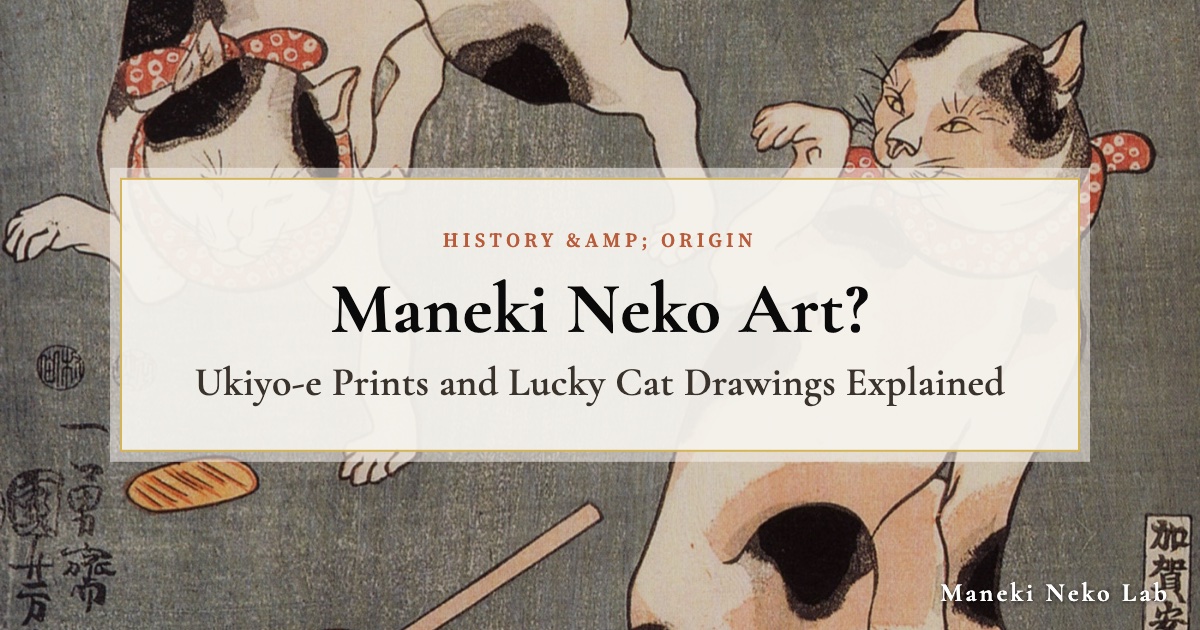
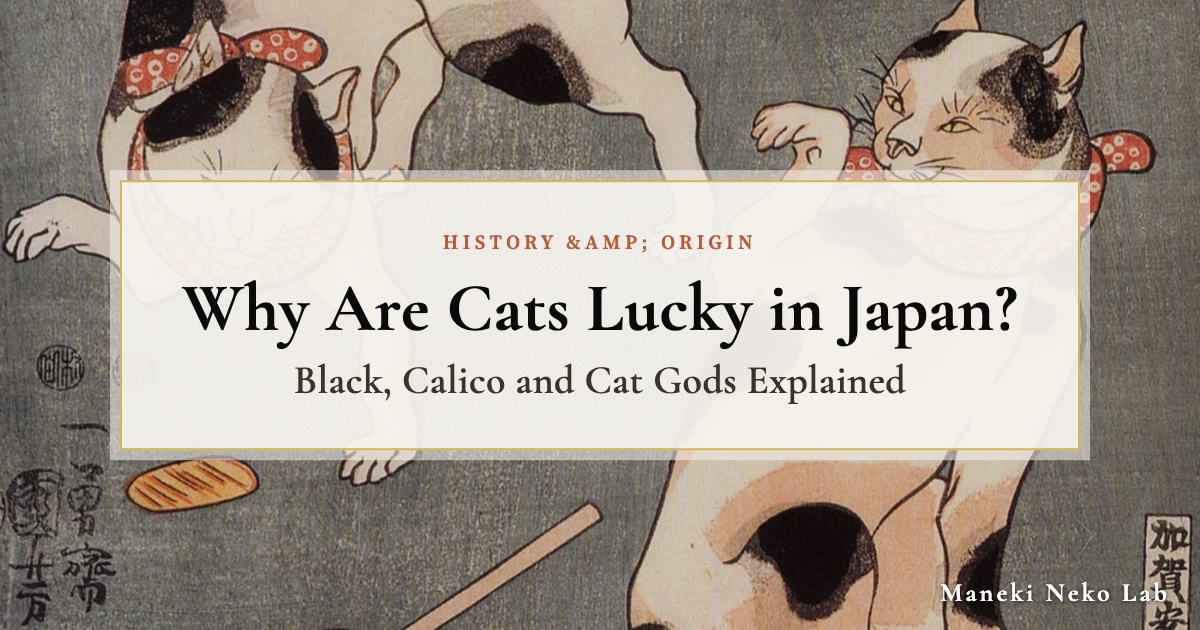
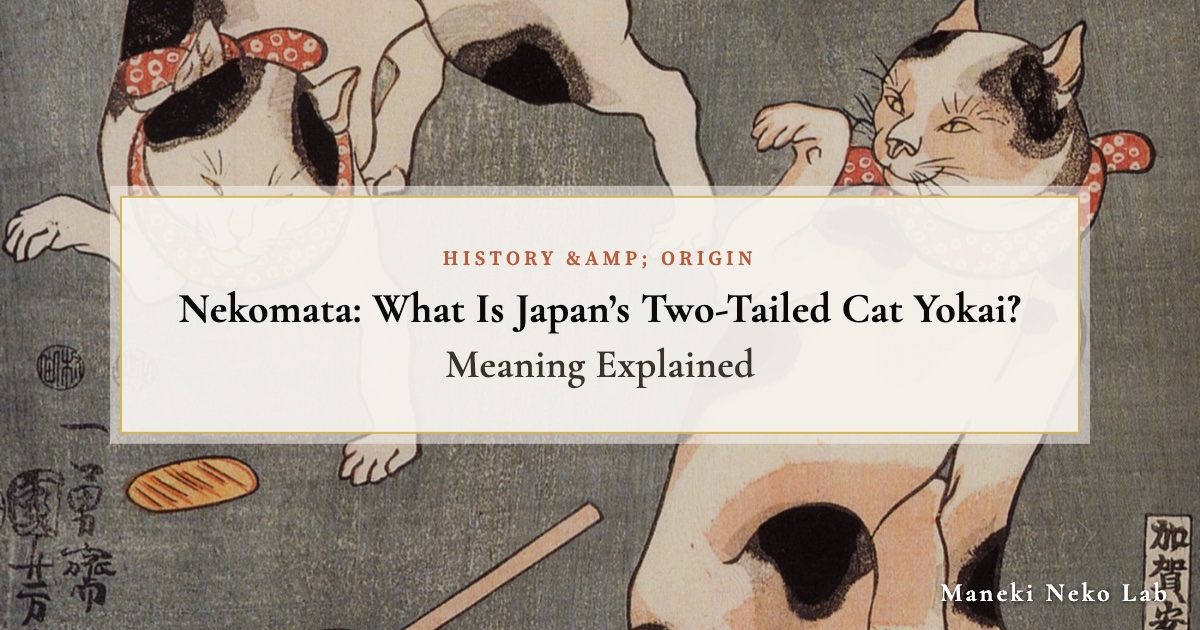
These prints show the towel, the forked tail and the coin together. How Kuniyoshi and others drew friendlier cats in the same period is covered in our guide to maneki neko in ukiyo-e.
Why Did Japan Also Make the Lucky Maneki Neko?
The same Japan that feared the bakeneko also made the maneki neko (招き猫, “beckoning cat”), because Edo people saw cats as both uncanny and useful. In Maneki Neko Lab’s view, the two figures are two readings of one animal.
Bakeneko and maneki neko
- Edo cats were valued rat catchers and charms against evil
- Japan either drove off a feared spirit or enshrined it
- Both figures use the beckoning paw, for opposite ends
Feared and Valued at Once
The Museum of Kyoto explains that in the Edo period, cats became part of ordinary life. They were prized for catching rats and also seen as charms that drive off evil.
The Heibonsha World Encyclopedia describes two Japanese ways of dealing with a feared spirit. People could drive it off, or enshrine it as a god that brings good fortune, and in Maneki Neko Lab’s reading, Shozenin and Omatsu Daigongen took that second path.
Iikura told Maneki Neko Lab that the cat’s two faces have one root. Animals that move between the house and the outside world are the ones folklore makes into shape-shifters.
In Maneki Neko Lab’s reading, the bakeneko is the cat’s secret life seen with fear. The maneki neko is the same watchful cat, put to work for the household. Our guide to why cats are lucky in Japan traces the useful side in full.
The Beckoning Paw, Turned Toward Fortune
The kabuki ghost cat and the maneki neko share one gesture, the beckoning paw. Iikura described how the stage cat moves its paw in a beckoning motion to control people, while the maneki neko beckons to welcome them.
Maneki Neko Lab defines the raised right paw as inviting money and the left as inviting people. The koban held by Gyokuen’s bakeneko also returns, since the Lab defines the koban as the maneki neko’s sign of money luck.
The name and the raised paw appear together in records by 1852, with the Marushime-neko of Imado ware in Edo. Our Library timeline lists that entry with its sources.
After seeing how Edo prints turned the cat into both a demon and a charm, you may want a figure that carries the Edo look on its friendly side. One answer is Ukiyo (浮世, black) from Luxen Maneki, a brand of Japan ManekiNeko Research Institute, Inc., the company that runs Maneki Neko Lab. Artisans at a traditional kiln in Seto hand-paint its gold.
The bakeneko’s close cousin is the nekomata, the cat with two tails.
Frequently Asked Questions
Q. Are all bakeneko evil?
A. No. Many tales show a cat that eats and replaces a person, but others are kinder. A 1970 report from Fukushima tells of a cat that turned on the robbers who kept it and gave money to the traveler who had fed it. Japanese folklore judges a bakeneko by what it does, not by being a cat.
Q. How do people defeat a bakeneko in Japanese folktales?
A. Often with a hidden bullet. In the folktale “The Cat and the Hunter,” a pet cat watches its master count his bullets, then attacks him in the mountains as a monster. He survives because he carried one extra bullet the cat never saw. A 1941 tale from Hida uses a bullet carved with a Buddhist prayer.
Q. Does China have shape-shifting cats too?
A. Yes, but as a separate tradition. The Heibonsha World Encyclopedia says Chinese lore also turns old cats eerie, with tales of cats that speak or sing. Some held that a cat, like a fox, absorbs moonlight to become a spirit, with males taking male form and females female form. These are Chinese beliefs, distinct from Japanese bakeneko tales.
Q. Which cats were most likely to become bakeneko?
A. Answers differ by region. Encyclopedia Nipponica notes that many tales involve calico cats, while a 1996 report from Kyoto Prefecture names black cats. A Miyazaki report says red male cats change most easily. No single coat color decides it, and age or weight matters more in most accounts.
Luxen Maneki, Made by Maneki Neko Lab
The bakeneko shows how closely Edo people watched their cats, and the maneki neko keeps the friendly half of that gaze. If you bring one home, it is worth knowing where it was made.
Luxen Maneki is a brand of Japan ManekiNeko Research Institute, Inc., the company that runs Maneki Neko Lab. Its three cats are the black Ukiyo (浮世), the white Hanaikada (花筏) and the gold Nishikigoi (錦鯉), all made in Seto ware, one of Japan’s Six Ancient Kilns.
Unlike mass-produced figures, each piece is made to order over about four to six weeks, with gold hand-painted by artisans. It arrives in a paulownia wood box, and we ship worldwide.
Summary
A bakeneko is a cat believed to transform after growing old or heavy, often into a woman, and the nekomata is its fork-tailed relative. Village reports add the towel dance, the licked lamp oil and rules for how long to keep a cat.
The famous Nabeshima, Okazaki and Shozenin stories are legends laid over real places, and the Okazaki cat was invented for the stage. Kabuki and woodblock prints then fixed the ghost cat’s look.
The same Edo culture also valued cats as rat catchers and charms. To meet the friendly side of the Japanese cat, start with our guide to what a maneki neko is.