What You’ll Learn
- A maneki neko gives a cat lover a cat and a wish
- Cat ukiyo-e, calico and black cat motifs each carry a story
- Choose the color and paw by the wish you want to send
- Ship ceramics tracked and well packed, with a card
For a cat lover, the most meaningful Japanese gift carries a wish as well as a cat. The maneki neko (招き猫, “beckoning cat”), a good-luck figure placed at shopfronts since the Edo period, is the classic choice.
Japan also offers cat-themed crafts with their own stories. Cat ukiyo-e prints, calico and black cat motifs and a famous cat novel each say something beyond “I know you love cats.”
This guide lists those gifts with the meaning each one carries, drawn from Japanese dictionaries and museum records. It then shows how to choose a maneki neko for a cat lover, using Maneki Neko Lab’s own definitions, and how to send one from Japan.
Why a Japanese Cat Gift Carries a Wish
In Japan, a cat gift can also be a good-luck gift. Cats were long believed to bring fortune, so a cat figure says “may good things come to you” along with “you love cats.”
Cats and luck in Japan
- Japanese encyclopedias record the belief that cats bring fortune
- Cat figures have stood at shopfronts since the Edo period
- A maker told us a cat lover was glad to receive a maneki neko
Cats as Bringers of Fortune
The Heibonsha World Encyclopedia notes that cats were believed to have a spiritual power to bring good fortune. It also records that placing a cat figure at a shopfront dates back to the Edo period (1603–1868).
Japan’s Tourism Agency adds that the first lucky cat figurines are thought to have appeared in the mid-19th century. Several temples tell competing origin stories, so our Library sorts them by source instead of picking one.
Silkworm farmers, temples and sailors each had reasons to value cats. Our guide to why cats are lucky in Japan covers those beliefs in full.
A Gift Handed Over at a Turning Point
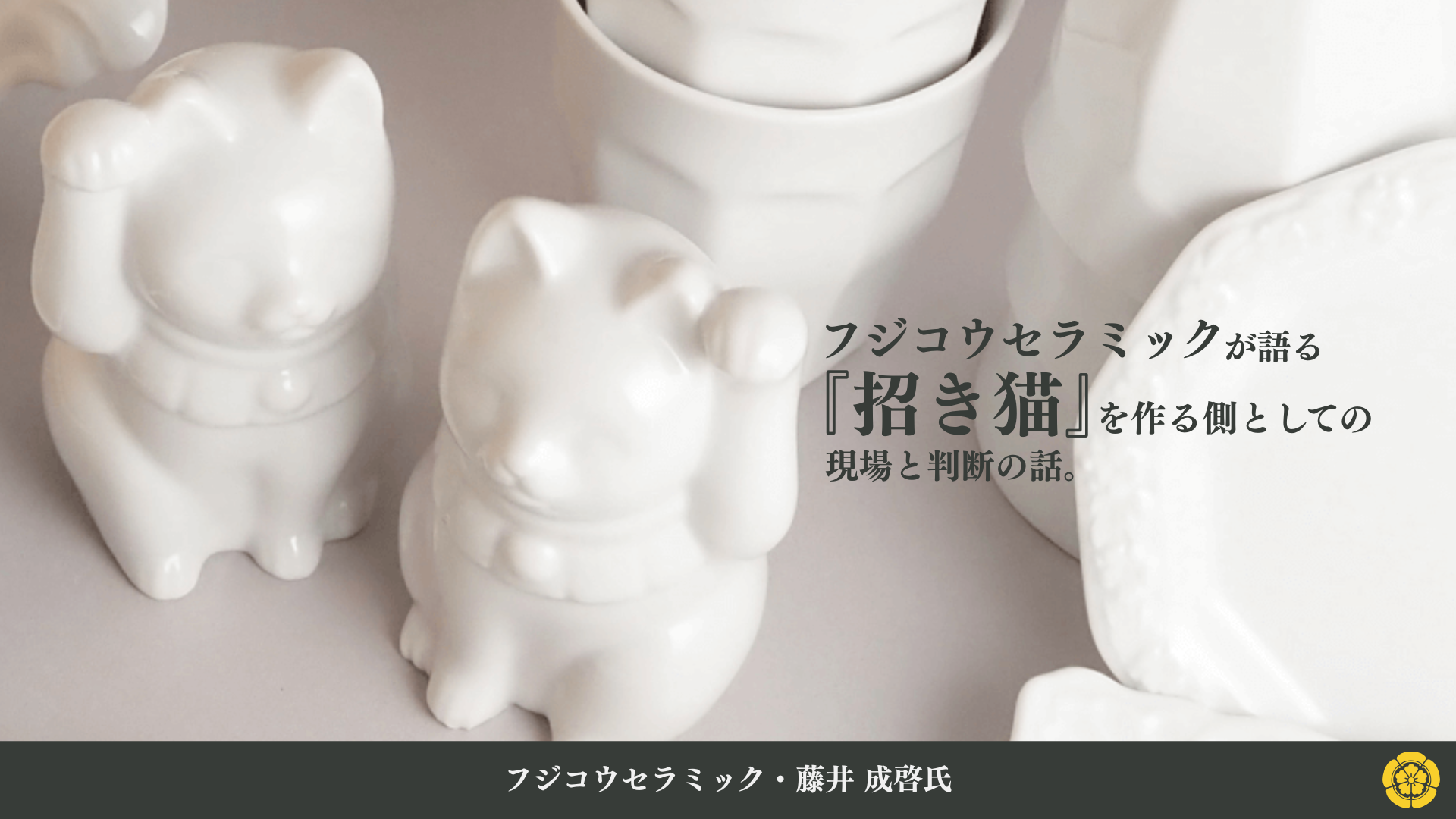
Makers see the maneki neko as a gift more than a purchase for oneself. Fujicou Ceramic, a maneki neko maker in Aichi Prefecture, told Maneki Neko Lab about cats it had given away.
One went to a classmate who had just married, and his cat-loving wife was glad to receive it. Others went to friends moving house and to a new home.
The maker described the maneki neko not as a tool that changes a life, but as something handed over quietly at a turning point. For a cat lover, that turning point can be a new home, a birthday or a new cat.
Japanese Gifts for Cat Lovers and What They Mean
The gifts below pair a cat with a meaning recorded in Japan. Each one suits a different kind of cat lover, from the collector to the reader.
Gift ideas in brief
- A maneki neko invites people and fortune
- A cat ukiyo-e print was once hung to keep mice away
- Calico and black cats each carry their own lore
Gift Ideas at a Glance
Each row names the meaning a Japanese source gives, or Maneki Neko Lab’s definition where sources say nothing. Brand names are left out on purpose.
Japanese gifts for cat lovers
| Gift | What it means | Suits |
|---|---|---|
| Maneki neko (招き猫) | A figure that invites customers and wealth | Any cat lover, a new home or a new shop |
| Imado-style cat figure | The Marushime cat, an Imado doll, is called the oldest maneki neko | A collector of folk toys |
| Cat ukiyo-e print | Edo cat prints were sold to keep mice away | Art lovers |
| Calico cat motif | Sailors treasured male calico cats as guardians of the voyage | A traveler, or the owner of a calico |
| Black cat motif | Edo folk belief held that a black cat cured tuberculosis | The owner of a black cat |
| I Am a Cat (吾輩は猫である) | Natsume Soseki’s first novel, narrated by a cat | A reader |
Source: Kotobank, “Maneki neko”(招き猫), “Marushime neko”(丸〆猫), “Neko”(ねこ), “Kuroneko”(黒猫), “Wagahai wa neko de aru”(吾輩は猫である)
I Am a Cat ran in the magazine Hototogisu from 1905 to 1906. Its nameless cat watches human society and laughs at it, which makes it a gift with a cat’s point of view.
Most rows are cats seen as animals, loved for catching mice or for their coats. The maneki neko is the one made to face outward and invite something good toward its owner.
Encyclopedia Nipponica notes that Imado, in Asakusa, Tokyo, later made clay maneki neko in large numbers. Our Imado guide explains the Marushime cat in more depth.
Cat Ukiyo-e Prints
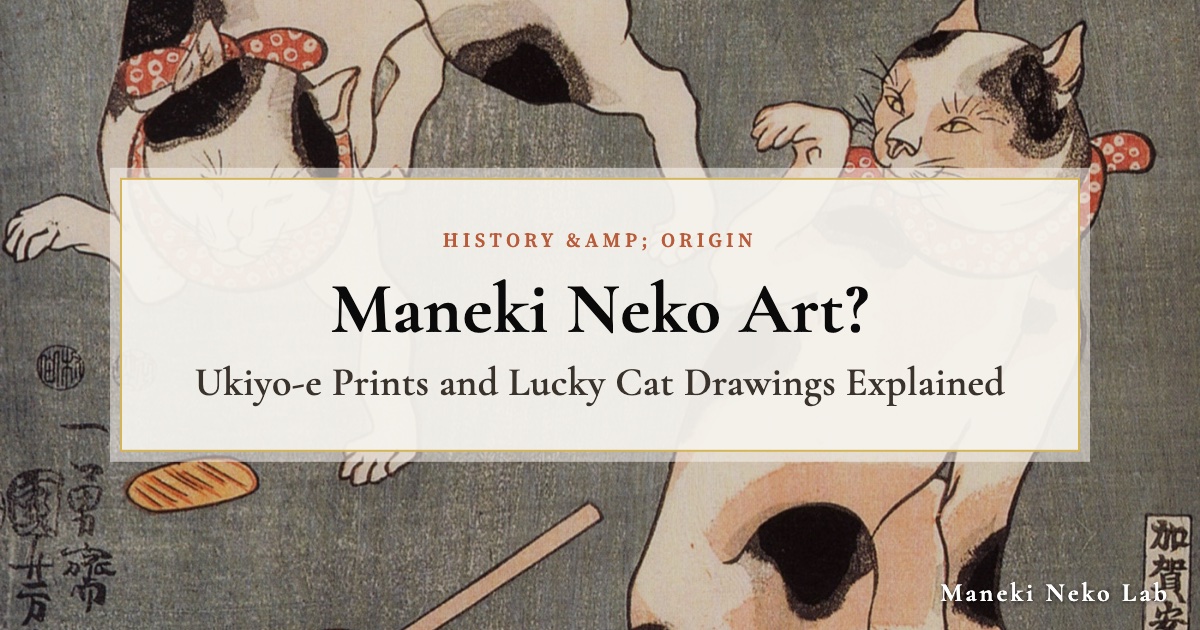
Ukiyo-e suits a cat lover because one of its masters was a cat lover himself. The Tokyo National Museum describes Utagawa Kuniyoshi, an Edo print artist, as a lover of cats.
His print Nezumi-yoke no neko (鼠よけの猫, “Cat to Ward Off Mice”) shows a belled cat staring upward. Its text reads, “If you put this picture up in your house, the mice will be afraid and stay away.”
Source: Cultural Heritage Online, “Cat to Ward Off Mice”(鼠よけの猫, Tokyo National Museum)
So a cat print once had a job in the home, not only a place on the wall. Our ukiyo-e guide follows cats and maneki neko through Edo prints.
Calico and Black Cats
A calico gift carries the lore of sailors. Encyclopedia Nipponica records that sailors treasured male calico cats as guardians of the voyage, and male calicos are almost never born.
Japan’s Tourism Agency notes that the traditional calico is still the most popular maneki neko. Our calico guide explains why a male calico was prized.
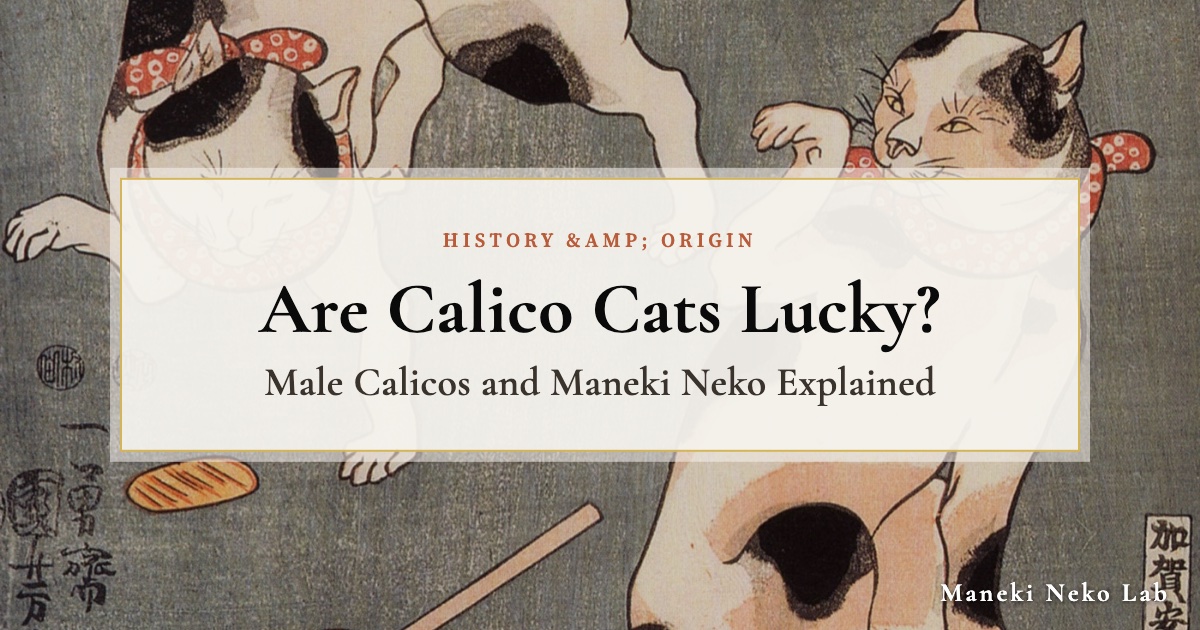
A black cat gift may puzzle a Western friend, yet Japan has read black cats kindly. In the Edo period, keeping one was believed to cure tuberculosis, the Nihon Kokugo Daijiten records.
Our black cat guide covers the healer, the guardian and the Western omen side by side.
A Phrase to Keep Off the Card
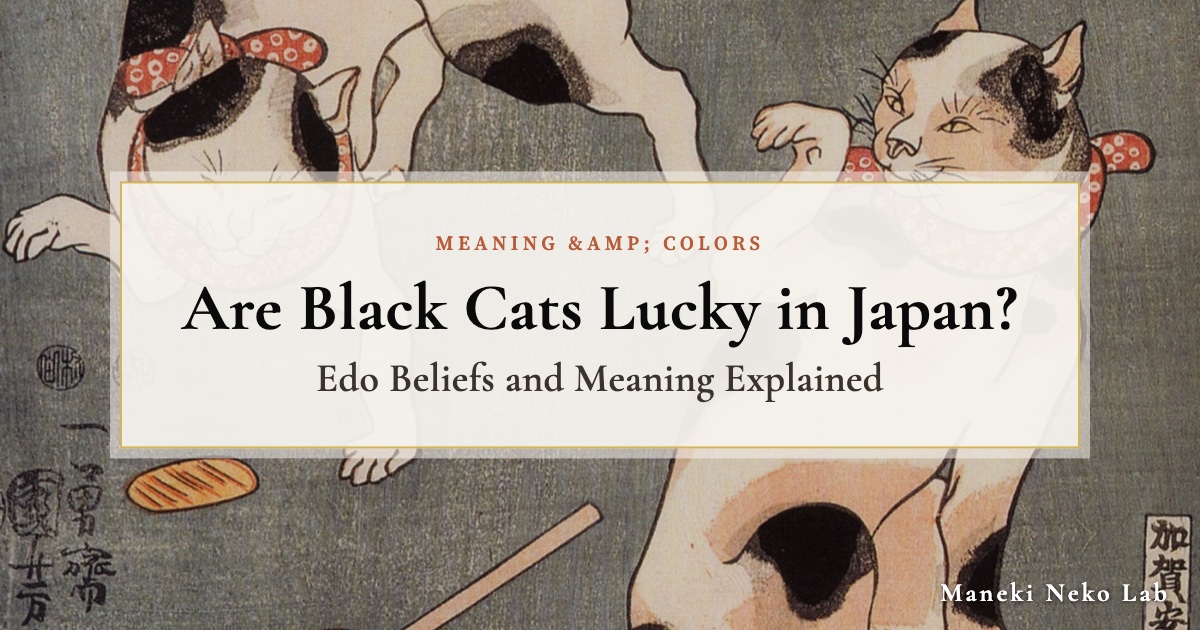
One cat phrase does not belong on a gift card. Neko ni koban (猫に小判), “a gold coin to a cat,” means giving something precious to someone who cannot value it.
Kuniyoshi made a joke of it in his fan print Neko no suzumi (猫のすゞみ), where a cat customer carries the phrase. On a card, though, it would tell your friend they cannot value your gift.
Source: Kotobank, “Neko ni koban”(猫に小判)
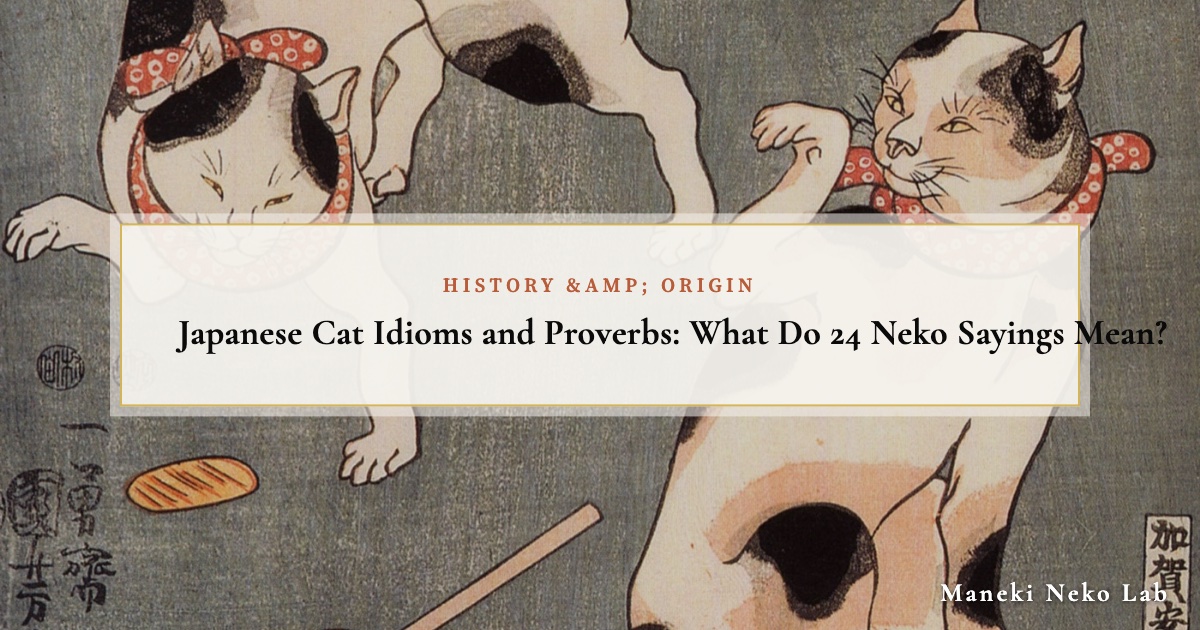
Other cat sayings, kinder ones among them, are collected in our guide to Japanese cat idioms.
Choosing a Maneki Neko for a Cat Lover
Start from the wish, then match the coat. The color and the paw carry the message, and a coat like their own cat makes it personal.
Choosing the cat
- Maneki Neko Lab gives each color one wish
- The raised paw adds money or people
- Check the label, the painting and the box
Color by Wish
Maneki Neko Lab defines one wish for each color. These four suit a cat lover most often.
Maneki Neko Lab’s definitions for a cat lover’s gift
| Color | Maneki Neko Lab’s definition | Fits |
|---|---|---|
| White / Calico | Good fortune of every kind (the basic color for any wish) | Any cat lover, or the owner of a white cat or a calico |
| Black | Protection from misfortune | The owner of a black cat, or a new home |
| Gold | Wealth and success at work | A cat lover with a new job or a shop |
| Green | Health and long life | A wish for many healthy years |
In our definition, black guards rather than invites. That reading suits a friend whose own black cat already watches over the house.
These are standards set by the Lab, not promises of an effect. Our color guide sets out all eight colors.
Paw by Wish
In Maneki Neko Lab’s definition, the raised paw adds a second wish. Right invites money, left invites people.
Maneki Neko Lab’s definition of paws
| Paw | Maneki Neko Lab’s definition |
|---|---|
| Right paw | Money luck (invites money) |
| Left paw | Inviting people (customers and connections) |
| Both paws | Invites both money and people |
For a cat lover who hosts friends, a left paw fits the wish for good company. No number of cats is lucky or unlucky in our definition, so a second cat for a second wish is fine.

What to Check Before You Buy
A good ceramic gift shows where it was made and who painted it. Check four points before you choose.
What to check on a ceramic maneki neko gift
| Point | What to look for |
|---|---|
| Label | Country of origin, pottery town and maker together |
| Painting | Painted by hand, or printed |
| Box | A wooden or sturdy box that keeps it for years |
| Lead time | Ready-made, or made to order over several weeks |
A town name alone does not prove origin. Look for the country and a maker’s name side by side, then check how the face and gold were painted.
Our guides explain how ceramic cats are made and how to tell one made in Japan.
If a cat lover also loves Edo prints, you may look for a cat that joins both worlds. Ukiyo (浮世, black) from Luxen Maneki, a brand of Japan ManekiNeko Research Institute, Inc., the company that runs Maneki Neko Lab, takes its name from ukiyo-e. Its gold is hand-painted on Seto ware.
Cat Days and Cat Places
A date or a trip can make a cat gift land better. Japan has two cat days, and many cat temples and islands.
Dates and places
- February 22 is Cat Day in Japan
- September 29 is Maneki Neko Day
- Cat temples and islands make a trip into a gift
Cat Day and Maneki Neko Day
Japan marks Cat Day on February 22. A committee set up by the pet food industry chose the date in 1987, since 2-2-2 sounds like “nyan nyan nyan,” a cat’s meow.
Source: Kotobank, “Neko no hi”(猫の日)
September 29 is Maneki Neko Day, a second date for a cat gift. Our guide explains how that day began.
Cat Places in Japan as a Trip Gift
For a cat lover who travels, a trip to a cat temple or island is a gift in itself. Our guides list temples with cat legends and islands known for their cats.
Sending a Cat Gift From Japan
Send ceramics by a tracked service, packed on every side. Add a card that names the wish so the meaning travels too.
Before you send
- Japan Post’s EMS offers tracking to over 120 countries
- Raised paws and ears need the most cushioning
- A card explains the wish abroad
Shipping, Packing and the Card
Japan Post’s EMS service carries parcels up to 30 kg to over 120 countries and territories, with tracking and a compensation system (as of November 2026).
Source: Japan Post, “Express Mail Service (EMS)”
A ceramic cat breaks first where it sticks out, at the raised paw and the ears. Wrap those parts first, then fill the box so nothing moves.
Write the wish on the card, such as “a black cat to guard your home.” Our gift ideas guide covers wrapping and duties in more detail.
If you order from overseas, packing decides how the cat arrives. Luxen Maneki ships every piece in a paulownia box, double-packed with cushioning and sent as fragile, with a tracking number.
Frequently Asked Questions
Q. Can you give a maneki neko as a gift?
A. Yes. A maneki neko is made to invite people and fortune, so it suits a new home, a new shop or a birthday. Explain the color and paw in a short card, since the meaning is part of the gift. Our maneki neko gift guide covers etiquette by occasion.
Q. What souvenir from Japan suits a cat lover?
A. A small maneki neko from a pottery town or a cat temple suits most cat lovers, since it travels well and carries a wish. A cat ukiyo-e reproduction or a copy of I Am a Cat suits readers and art lovers.
Q. Is a black cat gift bad luck in Japan?
A. No. Edo Japan believed a black cat cured illness, and Maneki Neko Lab defines black as protection from misfortune. For a friend in the West, add a note on the Japanese meaning.
Q. Should the maneki neko look like the recipient’s own cat?
A. It can. A white, black or calico cat close to their pet’s coat makes the gift personal. If the coat and the wish disagree, Maneki Neko Lab suggests choosing by the wish first.
Luxen Maneki, Made by Maneki Neko Lab
A cat lover will look closely at a cat. That makes it worth knowing where the cat was made and how it was painted.
Luxen Maneki is a brand of Japan ManekiNeko Research Institute, Inc., the company that runs Maneki Neko Lab. Its cats are Seto ware, from one of Japan’s six ancient kilns, and artisans at a traditional kiln hand-paint the gold on each one.
Each piece is made to order over about four to six weeks, so order well before the day. It arrives in a paulownia box, and we ship worldwide. Ukiyo (浮世, black) is joined by Hanaikada (花筏, white) and Nishikigoi (錦鯉, gold).
Summary
For a cat lover, a Japanese gift that carries a wish says more than a cat alone. The maneki neko has invited fortune at Japanese shopfronts since the Edo period.
Cat ukiyo-e prints, calico and black cat motifs and I Am a Cat each bring their own story. Leave neko ni koban off the card.
To choose a maneki neko, pick the color and paw by the wish, then check the label, the painting and the box. Ship it tracked and well packed, with a card that names the wish.

