
Visit Shigaraki in Koka City, Shiga Prefecture, and you will find ceramic tanuki (raccoon dog) figures in straw hats lined up everywhere: in front of the station, under the eaves of the kilns, along the roadside. Tokoname and Seto in Aichi Prefecture are known as production centers of the maneki neko (beckoning cat). Pottery towns and lucky charms seem to be inseparable.
This interview was conducted in Japanese and translated by Maneki Neko Lab. Read the original Japanese interview.
Surprisingly, though, the Shigaraki tanuki was born in a fairly recent era. What is more, that tanuki was, we are told, a “revolutionary” presence in the history of lucky charms.
Why have pottery towns given birth to lucky charms? And how have lucky charms changed shape over time?
This time we spoke with Eiji Hatanaka, Professor in the Department of Comprehensive Art Studies, Faculty of Fine Arts, Kyoto City University of Arts (hereafter, Hatanaka). He has studied Shigaraki ware from the standpoint of archaeology, and his work includes the paper “Changes in Shigaraki Ware Techniques” (in Manufacturing Techniques of Shigaraki Ware: Folk Cultural Property Survey Report, Koka City, 2020) and the book An Archaeological Study of Shigaraki Ware. He has formed a study group with researchers of the Six Ancient Kilns, and he also studies kisha dobin (汽車土瓶), the ceramic tea pots once sold at train stations.
We asked him about the story of Shigaraki ware since the Kamakura period (1185–1333), about the tanuki and the maneki neko, and about the birth of “kawaii” (cute) lucky charms.
Chapter 1: Almost Everything Dug Up from Sites Is Pottery – Why an Archaeologist Studies Shigaraki Ware
The Deep Bond Between Japanese Archaeology and Pottery
Archaeology is the study of how people lived and how societies worked, based on the “things” that come out of excavation sites. According to Hatanaka, Japanese archaeology and the study of pottery are an especially good match.
This is especially true in Japan, but we have a lot of acidic soil. So organic matter rots away and disappears. That means when you dig a site, most of what comes out is pottery, and many people doing archaeology in Japan have a very strong affinity with pottery research.
Eiji Hatanaka
Born and raised in Kyoto, Hatanaka found the pottery of the Kinki region (the area around Kyoto and Osaka) a natural subject of study. Because clay can be shaped freely, all kinds of things were made from it, and pottery is very close to people’s daily lives. Around Kyoto and Osaka, many industries also grew up to serve the populous capital. Studying Kinki pottery from before the Meiji era (1868–1912), he says, offers clues to a great deal about the Japanese archipelago as a whole.
The Fun of Studying “Today as a Continuation of Yesterday”
Of all Japan’s pottery centers, why Shigaraki? Hatanaka looks back on what his teachers taught him as a student.
When you do research, it is easier to draw a line around “a certain thing in a certain era.” But human activity does not end there. Unless you look at the flow of what came before and after, you cannot understand the truth. Having been taught this, Hatanaka found Shigaraki, which has kept making pottery from the Kamakura period to the present day, a fascinating place to study.
The direct trigger was the 2001 excavation of the Kanayama site, a Shigaraki ware kiln site, which he was put in charge of.
There hadn’t been any survey or research for more than 30 years. Then it was, “All right, we’re going to dig,” and I was given the job, so I thought, well, let’s take this seriously for a change. That’s pretty much how it went.
Eiji Hatanaka
Studying an industry that is still alive today through the eyes of archaeology, he says, has a kind of fun that other fields do not.
There’s a phrase, “today as a continuation of yesterday,” and it really comes to life here. Revealing how things used to be is fun, of course, but the part where you can say, “That’s why things are the way they are now,” is really exciting, I’d say.
Eiji Hatanaka
Are the “Six Ancient Kilns” Really Seven?
Hatanaka now runs a study group with researchers from each of the Six Ancient Kilns (Rokkoyo, 六古窯: Shigaraki, Tokoname, Seto, Echizen, Tamba and Bizen), sharing information, presenting research and making books together.
Hatanaka suggests that the name “Six Ancient Kilns” may have been chosen partly because it sounds good.
Actually, you know, it became the Six Ancient Kilns because it had a nice ring to it. So it became the Six Ancient Kilns, but strictly speaking it’s seven. Mino isn’t included. And Iga, right next to Shigaraki, isn’t included either.
Eiji Hatanaka
When the name “Six Ancient Kilns” was decided, it was apparently not yet known that Mino (Gifu Prefecture) had kilns dating back that far. In fact, Mino has also been making pottery from early times until now. Iga and Shigaraki are so close that they could perhaps be counted as one. In Hatanaka’s view, there were at least seven.
Chapter 2: Shigaraki Has Always Made “What Sells” – From Mortars to Tea Ceramics and Chemical Industry Ware
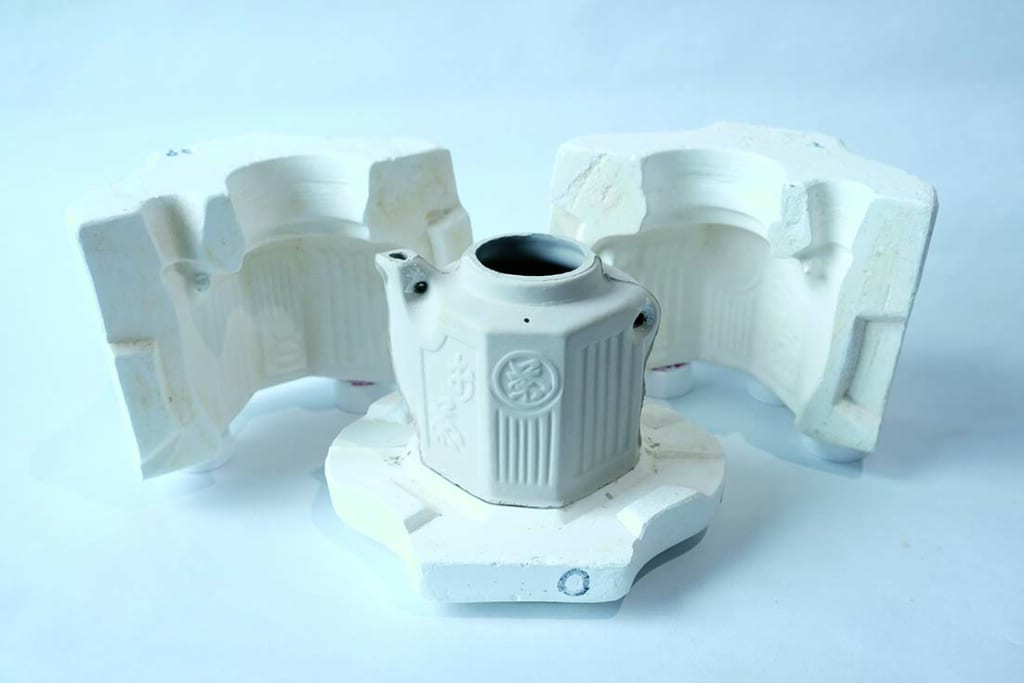
Big, Heavy Wares, Made Close to Where They Were Used
What the Six Ancient Kilns mainly made in the medieval period were jars, large storage jars (kame, 甕) and mortars (suribachi, すり鉢), all fired hard without glaze. The suribachi is the same tool you use today to grind sesame seeds at a tonkatsu (pork cutlet) restaurant. Hatanaka calls it “the food processor of its day.”
Jars, kame and suribachi are big and heavy. If you make them all in one place, transport costs keep climbing. So each production center came to make them for the regions it could easily reach.
| Production center | Main role in the medieval period (from Hatanaka’s account) |
|---|---|
| Bizen | A coastal center. Supplied the whole Seto Inland Sea area |
| Tokoname | Right on the sea. Shipped long distances by sea |
| Echizen | Supplied the Sea of Japan side |
| Seto | The exception: specialized in glazed wares resembling Chinese ceramics |
| Tamba, Shigaraki | Supplied big, heavy wares to Kyoto, the largest city of the medieval period |
Shigaraki Ware Was a Kamakura-Period “Startup”
Shigaraki ware began in the 13th century, in the Kamakura period. Large production centers already existed around it. Even seen from Tokoname in the east, the Shigaraki area was the farthest away.
Well, you could call it a startup business. Like, “If we set up a base here, maybe we can fill the gap.” So in a place where there was originally nothing at all, in the 13th century, the Kamakura period, people said, “Let’s give it a try.”
Eiji Hatanaka
Starting from nothing meant learning the techniques from somewhere. The candidates were Tokoname or Harima in Hyogo Prefecture. Shigaraki chose Tokoname. Hatanaka thinks the lords of the two areas may have had close ties.
The people themselves probably came. It wasn’t that they received some book with the know-how written in it. Somebody said, “I want to start a business,” put together a team of several people and brought them all the way to Shigaraki. That seems to be how it was.
Eiji Hatanaka
Not “We Make It Because It’s Tradition,” but “We Make What Sells”
Over the centuries, Shigaraki ware changed its main products: kame and suribachi, tea ceramics, braziers (hibachi), kisha dobin. When we asked why, Hatanaka questioned the very image of a “traditional industry.”
There’s the idea of a traditional industry we have today, right? Like, “We’ve always made this, so we’ll keep making it.” Actually, nobody thinks like that. If anything, they make what sells, so they can make a living.
Eiji Hatanaka
If another center’s products had a good reputation, they copied them. If word went around that “it sells better if you do it this way,” they took on something new without hesitation. That, he says, is what a production center was really like.
Even so, until the Meiji era the main products were the “set of three”: jars, kame and suribachi. On top of that, Shigaraki went through two major turning points.
Turning Point 1: Making the “Bodies” for Kyoto Ware in the 18th Century
The first came in the mid-18th century, in the middle of the Edo period (1603–1868). In the late 17th century, master potters such as Ninsei and Kenzan had appeared, and the brand of Kyoto pottery, Kyo-yaki (京焼), was firmly established. People in Edo (today’s Tokyo) and elsewhere began to say, “We want things from Kyoto.”
But Kyoto was a small city, without much clay. The hills where firewood for fuel could be gathered were small too. Kyoto had been heading not toward mass production but toward raising its brand value and selling at high prices. Still, he says, to meet demand for more, Shigaraki, one of the kiln areas close to Kyoto, began making the same things as Kyoto.
For example, just the body is made in Shigaraki, the finished piece is taken to Kyoto, painted there, and then it’s “This is Kyoto ware.” Something like that.
Eiji Hatanaka
The body of the ware was made in Shigaraki and painted in Kyoto. From around this time, a very strong bond continued between Shigaraki and Kyoto.
Turning Point 2: Meiji, When Pottery Became a “Substitute for Glass”
The second came in the modern era, from Meiji onward. When the chemical industry started in Japan, it became necessary to handle strong acids like sulfuric acid and nitric acid. Metal pipes would corrode and dissolve. In Europe and America glass was used, but Japan, just entering the Meiji era, could not yet make enough glass.
What caught people’s attention was the glaze on the surface of pottery.
This is called glaze, right? It’s on the surface of maneki neko too. This is glass. It’s a state where there’s a layer of glass on top of the clay. Which means, “Why not make factory pipes and things out of this?” And there were people who went all in that direction.
Eiji Hatanaka
Shigaraki made a great deal of this kind of pottery for the chemical industry (acid-resistant ceramics). Each center took a different path: Bizen made bricks, and Tokoname made clay pipes. Tokoname went on from pipes to toilets, which led to today’s INAX (LIXIL). Shigaraki kept making the jars, kame and suribachi essential to ordinary people’s lives while also producing these new products in large numbers.
Shigaraki and Bizen, Chosen by the World of Tea
From the Sengoku (Warring States) period to the Momoyama period (late 15th to early 17th century), Shigaraki also held a special place in utensils for the tea ceremony (tea ceramics).
Until then, the standard in the tea ceremony was to use plenty of expensive utensils imported from China. But the people who spread wabi-cha (侘び茶, the rustic, simple style of tea), such as Sen no Rikyu, were “new money,” so to speak, and did not own famous tea utensils with long histories. So they needed to put forward new values.
According to Hatanaka, it was probably the tea masters of Sakai (a merchant city near Osaka) who, out of the many kiln areas, approached only Shigaraki and Bizen to make tea ceramics. None were made in Tamba or Echizen. Seto was asked to make pieces resembling Chinese ceramics, but those were treated as everyday or practice pieces and were not used at formal tea gatherings.
In the records of tea gatherings, the only ones that appear are Shigaraki or Bizen. There must have been some quite special circumstances behind that.
Eiji Hatanaka
Chapter 3: The Shigaraki Tanuki Was the Beginning of “Lucky Charms You Can Put Outside”
Tetsuzo Fujiwara, Master of Large Pieces
So when was the Shigaraki tanuki born? “That’s the thing, it’s surprisingly recent,” Hatanaka says. And the story, he says, is connected to the maneki neko of Tokoname and Seto as well.
The birth of the tanuki involved Tetsuzo Fujiwara (藤原銕造), a potter from Iga. Tetsuzo made pottery in Kyoto, and he was extremely good at making large pieces.
Even now, if you go to a country inn known for its food, you sometimes see a huge earthenware teapot about as tall as a person sitting in the big banquet hall. He was really good at that kind of thing.
Eiji Hatanaka
Kyoto, however, was a center that sold small, beautifully made things at high prices, and its kilns were compact. If he went to Shigaraki, which was busy making large ceramics for the chemical industry, maybe he could make what he wanted. With that in mind, Tetsuzo moved to Shigaraki in the Taisho era (1912–1926) and made large teapots and tanuki figures. In this way a “master of large pieces” appeared in Shigaraki, and by the early Showa era (from 1926) tanuki figures had become a local specialty, he says.
Lucky Charms Stepped “Outside the Shop,” into the Rain
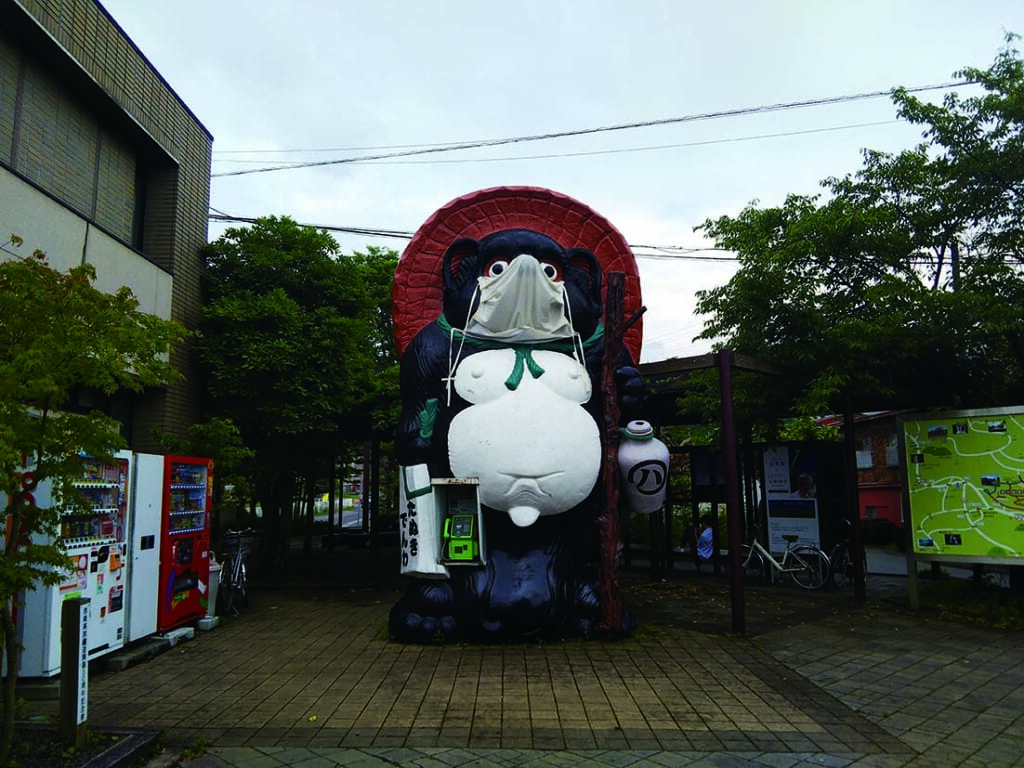
Hatanaka stresses one major feature of the Shigaraki tanuki: it is made of fired pottery, and it is placed outdoors.
Something that used to be kept where the rain doesn’t reach suddenly goes outside. It goes out to the shopfront and beckons. And that is, within the world of lucky charms up to then, revolutionary, isn’t it?
Eiji Hatanaka
What were lucky charm figures like before that? Both the maneki neko and the tanuki appear as figures in the late Edo period. Strictly speaking, similar things existed from the early Edo period, but they were few, and almost all of them were only a little bigger than the palm of your hand. Their roots are thought to lie in Fushimi ningyo (伏見人形), the clay dolls of Kyoto.
They’re bisque-fired and then painted with pigments. Which means you can’t wipe them with a damp cloth. And on top of that, you can’t put them outside either, right? It breaks through those limits.
Eiji Hatanaka
The “Strength” of Pottery, Which Taro Okamoto Also Noticed
The artist Taro Okamoto also saw that pottery is durable enough to stand outdoors. Originally a painter, Okamoto began making three-dimensional works at a certain point. The “Black Sun” on the back of his Tower of the Sun for the Osaka Expo (1970) is known to have been made in Shigaraki. Before that, Okamoto had been making works in pottery.
I mentioned that when you dig a site, it’s nothing but pottery coming out, but pottery doesn’t change even after a thousand years. And glaze, too, once the color is set in the main firing, doesn’t change.
Eiji Hatanaka
You can make three-dimensional works in bronze, but you cannot give them color. If you want people to see your work for a long time, pottery is the right answer. With that thinking, Okamoto eventually arrived at the Tower of the Sun.
The same goes for the Shigaraki tanuki. Made of pottery, it can be put outside. If it gets a little dirty, you just wipe it. Looking after it is very easy.
Are Colonel Sanders and Peko-chan Descendants of the Tanuki?
The fact that lucky charms went out in front of shops, Hatanaka says, is also deeply connected to the Japanese mentality.
The example he gave was the Colonel Sanders statue that stands in front of KFC restaurants. In 1985, fans celebrating the Hanshin Tigers’ Japan Series win threw one of these statues into the Dotonbori River in Osaka, an incident people still talk about.
Apparently they turned him into a statue in Japan because they figured that Japanese people would love that kind of figure. And if you trace its ancestry back, no matter how you look at it, it’s the Shigaraki tanuki.
Eiji Hatanaka
Peko-chan at Western-style sweets shops, Sato-chan at pharmacies. In Japan, many shops put character figures out front.
“Let’s make it three-dimensional and just put it out front.” And I think it wouldn’t be wrong to say that the first to make that possible, the one that took on that challenge, was the Shigaraki tanuki. In the sense that it opened up that new horizon, I think it was something very meaningful.
Eiji Hatanaka
From One-of-a-Kind Pieces to Mass Production with Molds
Shigaraki tanuki then came to be mass-produced more and more. Technically, the basic method is to make an original model, make a mold from it and produce one after another. The tanuki and the maneki neko are made the same way, he says.
Old tanuki, on the other hand, are one-of-a-kind pieces.
The ones Tetsuzo Fujiwara probably made early on. You look at them and go, “Ah, this one’s one of a kind.” That sort of thing.
Eiji Hatanaka
Shigaraki Clay, Which Made Big Tanuki Possible
The nature of the clay is part of why large tanuki could be made in Shigaraki. Pottery shrinks when fired. If you try to make something big from clay that shrinks easily, the risk of cracking or warping rises accordingly.
In that sense, the clays of Seto and Shigaraki have a very low shrinkage rate. So, well, things do get smaller, but they end up at a size you can predict. With other production centers, that’s quite often not the case.
Eiji Hatanaka
That tradition continues today. Shigaraki even makes the large ceramic bathtubs found at Japanese inns and “super sento” (large public bath complexes), he says.
Chapter 4: The Story Comes Later – The “Eight Virtues” and the “Blank Space” of the Maneki Neko
The Tanuki That “Outdoes Others” and the Showa-Era “Eight Virtues”
The tanuki is considered lucky because “tanuki” sounds like ta wo nuku (他を抜く, “to outdo others”). On top of that, the Shigaraki tanuki has a story called the Hasso Engi (八相縁起, the “Eight Lucky Features”). It assigns an auspicious meaning to each of eight features of the tanuki’s appearance, such as its straw hat, sake bottle, account book and big belly.
According to the official website of Japan’s Six Ancient Kilns, when Emperor Showa visited Shigaraki in 1951 (Showa 26), the townspeople welcomed him with a line of tanuki holding small Japanese flags. This was reported in the news, and the Shigaraki tanuki became known nationwide. Also, Gocho Ishida, a researcher of tanuki culture, devised the Hasso Engi, and by selling the figures with a Hasso Engi leaflet attached, tanuki figures came to be loved as lucky charms.
According to Hatanaka, the Hasso Engi was created in “Showa 27 (1952), I believe.”
So where there had been nothing before, a story is suddenly reconstructed. Well, that’s what it comes down to.
Eiji Hatanaka
The World of Lucky Charms Is “Loose”
Stories being attached afterward is not limited to the tanuki. Hatanaka describes the nature of the world of lucky charms itself this way.
This world of lucky charms is a bit loose. Rather than a rigid, set-in-stone story, there’s lots of blank space, and it gets reconstructed. It’s the same with Tokoname maneki neko, right? The raised right paw is for money, the raised left paw is for people, and so on. And you want to ask, “Were they really saying that from the start?”
Eiji Hatanaka
Maneki Neko Lab has often written about the difference in meaning between a raised right paw and a raised left paw. Hatanaka’s view is that explanations like these may also be cases where “fins and tails” (embellishments) were added later to something that already existed.
A Tolerance That Welcomes New Maneki Neko
That “blank space” keeps expanding today. At the Japan Maneki Neko 100 Artists Exhibition (日本招き猫100人展), held in the maneki neko town of Seto, artists create one new maneki neko after another. Maneki neko with modern designs that suit interiors, and daruma as art, are also on the rise.
Over in Seto City there’s the Japan Maneki Neko 100 Artists Exhibition and so on, and basically they’re trying to make new maneki neko. That’s blank space galore. Nobody fusses, “If it isn’t like this, you can’t call it a maneki neko.” The entrance is wide, wide open. And it says, “We welcome new things too.” It’s a very interesting way of being.
Eiji Hatanaka
Hatanaka suggests that what makes this possible may be “the tolerance of the Japanese people.”
Chapter 5: Lucky Charms Became “Kawaii” – From Words to Pictures, to Figures, to Two-Heads-Tall
After the War, Both Maneki Neko and Tanuki Became “Two Heads Tall”
Lucky charms have changed their form with the times. If today is the age of “diversity,” Hatanaka says, the big change before that came after World War II. The maneki neko shows that change especially clearly.
When they were made in Seto before the war, maneki neko were a bit long. Long and slender. And then the Tokoname-style maneki neko that appear after the war are two heads tall.
Eiji Hatanaka
The same change happened to the Shigaraki tanuki. Whether or not its makers took a peek at Tokoname’s maneki neko after the war is unknown, but the Shigaraki tanuki also became two heads tall (a chibi-like build with a head as big as the body), he says.
For more on Tokoname-style maneki neko and where they are made, see our guide to Tokoname maneki neko.
Yuru-Chara Mascots Followed the Same Path
Hatanaka sees the same trend in yuru-chara (ゆるキャラ), the cuddly local mascots found all over Japan. At first, they were designed for a person to wear as a costume, so they were shaped close to the human body. They grew rounder and rounder until they looked like “two dumplings.”
To do that, they circulate air inside, you know. There’s a blower in there, inflating it from the inside. They want to be cute so badly they’ll even bring in that kind of technology.
Eiji Hatanaka
From Words, to Pictures, to Figures
Going back even further, lucky charms went through change over a much longer span of time.
Until the late Edo period, most lucky charms were two-dimensional, drawn in pictures. The craftsmen of Fushimi ningyo and of Tokyo’s Imado ware turned them into three-dimensional clay dolls. Then in Seto, they came to be mass-produced with plaster molds.
It also took a long time for stories to become pictures. For example, the Gotokuji Temple story told as an origin of the maneki neko is said to date from the early Edo period.
The story was born by the early Edo period, but it becomes two-dimensional much later, right? 100, 150 years later. The beginning is a story, koto no ha, words, spoken words. From that world of words, it becomes two-dimensional, then three-dimensional, then cute. And now, diversity.
Eiji Hatanaka
| Stage | The form of lucky charms (from Hatanaka’s account) |
|---|---|
| Words | Told as stories or words (e.g. the Gotokuji maneki neko story, early Edo period) |
| Two-dimensional | Drawn in pictures (100 to 150 years after the story) |
| Three-dimensional | Made into clay dolls such as Fushimi ningyo and Imado ware (late Edo period) |
| Mass production | Mass production with plaster molds spreads, in Seto and elsewhere |
| Outdoors | The ceramic Shigaraki tanuki is placed outside shops |
| Kawaii | After the war, Tokoname-style maneki neko and the Shigaraki tanuki become two heads tall |
| Diversity | Today. New maneki neko by artists appear at events such as the Japan Maneki Neko 100 Artists Exhibition |
A Century in Which the Population Tripled
Until the Edo period, change was slow: it took 100 years for words to become pictures. From the modern era on, it suddenly sped up. Hatanaka explains why in terms of “population.”
In the population survey of the early Meiji era, Japan’s population did not reach 40 million. By the late 1960s (the Showa 40s) it had passed 100 million. Even across periods when many people died, such as the First Sino-Japanese War, the Russo-Japanese War and the two World Wars, the population roughly tripled in about 100 years.
A population tripling is a frightening thing, you know. In today’s terms, it means that where one air conditioner per household should be enough, three get sold. So business opportunities grow astonishingly large, even if you leave them alone.
Eiji Hatanaka
If the population triples, the number of shops selling tanuki becomes three. All sorts of things sell without effort, and makers can try new things.
Our understanding is that the pottery industry has gone through a tremendously abnormal century.
Eiji Hatanaka
Round Things Put People at Ease
So why did lucky charms move in the “kawaii” direction?
Hatanaka says that even before figures appeared, the Japanese had a culture of taking great care over “signs” such as shop signboards. Beyond that, he thinks a major reason for placing lucky charms in shops is that they are “innocent forms.”
Teaching at an arts university, Hatanaka is also interested in the effect artworks have on people’s minds.
Well-balanced shapes seem to really put people at ease. When you see something jagged and asymmetrical, you get a creepy, prickly feeling. It might be exciting, maybe, but you don’t get peace of mind. Instead, when something round, perfectly round, is just sitting there, you feel a little reassured.
Eiji Hatanaka
He mentions an example of an experiment in which an animal, given a spiky object and a round object, chose the round one, carried it back to its nest and acted as if to keep it warm. Babies look cute because they are small and round, too. In The Pillow Book (枕草子), the Heian-period writer Sei Shonagon wrote that all small things are lovely.
Like two circles, the kind typified by Tokoname-style maneki neko. They’re just unbearably cute, aren’t they? Without meaning to, they go straight for human psychology.
Eiji Hatanaka
Doraemon and Hello Kitty are also two heads tall, built from a collection of circles. Lucky charms, which overlap with Japan’s “kawaii” culture, may be content that can make its mark on the world, Hatanaka says.
Chapter 6: The Future of “Ceramic Lucky Charms”
Production Centers Should Picture “the Faces of the People Who Want It”
What will become of production centers from here? Hatanaka looks back and says that until now, they have turned their hand to whatever people wanted, and made it cheaply too. With that in mind, he describes the road ahead like this.
Looking at the results of questionnaires and surveys, Japanese people still really love pottery as tableware, you know. So rather than cheap and shoddy, I hope they keep making things so that people can come across a piece they truly love. So rather than trying to make the pie bigger, picturing once again the faces of the people who want these things is, I think, one way to survive.
Eiji Hatanaka
Even as online shopping spreads, he says, sales of pottery have been sluggish compared with other categories. That is because the feel and weight of tableware matter. Figures like the maneki neko, on the other hand, come across well in photos. As long as buyers can get a sense of the size, they may be easier to sell online.
The Reign of “Ceramic Lucky Charms” Will Continue
About the future of lucky charms, Hatanaka is optimistic.
I secretly think that the term “ceramic lucky charms” could hold up as a category. If it gets a little dirty, you can just wipe it. You can even put it outside. And yet the mass-produced ones aren’t that expensive. There are a lot of good points, really.
Eiji Hatanaka
If you do not need a one-of-a-kind piece, pottery is an excellent material for lucky charms.
I kind of think their reign will continue for a while yet.
Eiji Hatanaka
If You Visit Shigaraki
Finally, we asked what he would recommend to people visiting Shigaraki.
I think the most important thing is to go and take a look at the places where they’re actually making it. As for tanuki, you’ll meet more than enough of them, believe me.
Eiji Hatanaka
There are tanuki all over town. If he started listing which tanuki to go and see, there would be no end to it, Hatanaka laughs.
Summary: Pottery Towns Have Fired What Each Era Wanted
Shigaraki ware began as a “startup” in the Kamakura period and kept making what sold in each era: mortars and storage jars, bodies for Kyoto ware, tea ceramics, wares for the chemical industry. The tanuki figure born along the way used the durability of pottery to take lucky charms outside the shop for the first time.
The stories of lucky charms are added later and rearranged. From words to pictures, from pictures to figures, and after the war, to round, cute, two-heads-tall shapes. The maneki neko and the tanuki have both changed shape within the same current.
What Hatanaka’s story reveals is that, rather than settling on one “correct form” or “true meaning” of the maneki neko, it is more interesting to look at what people of each era wanted and what kind of lucky charms they made. What era, and what wish, gave rise to the shape of the maneki neko in front of you? Look at it that way, and lucky charms become all the more fascinating.