What You’ll Learn
- Draw the head, ears, paw, body, bib, koban, then the face
- A right paw invites money, a left paw invites people
- Colors and items carry Maneki Neko Lab’s own meanings
- Japan Post accepts 2027 New Year cards from December 20
A lucky cat drawing starts with a big round head, one raised paw and a koban coin, and the face goes on last. The lucky cat is the maneki neko (招き猫, “beckoning cat”), a Japanese charm that raises a paw to invite good fortune.
Seven simple shapes are enough, so the steps below work for beginners and children. What turns a cartoon cat into a maneki neko is the beckoning paw, the bib and bell, and the coin.
This guide also explains which paw and colors to draw for each wish, using Maneki Neko Lab’s definitions. It ends with ways to use a drawing as a charm, such as a New Year card, with Japan Post dates checked on November 3, 2026.
How to Draw a Maneki Neko in 7 Easy Steps
Draw from big shapes to small details, and leave the face for the end. A pencil and an eraser are enough for the outline, and colored pencils or markers finish it.
Lucky cat drawing in brief
- Aim for a big head on a small body, about two heads tall
- Draw the head, ears, paw, body, bib and bell, koban, then face
- The face sets the expression, so draw it last and lightly
The Shape to Aim For: A Big Head on a Small Body
The easiest maneki neko to draw is the Tokoname style, about two heads tall. Tokoname, a pottery town in Aichi Prefecture, was Japan’s main producer of lucky cats by 1950, and its cats have large eyes and ears on a plump body.
Aichi Prefecture’s official tourism site describes that cat as two heads tall, with big ears, a round face and large eyes. It contrasts it with the slim Seto style from a neighboring pottery town, known for soft lines and details such as frills on the bib.
Two classic maneki neko shapes to draw
| Style | Proportion | Features to draw | Suits |
|---|---|---|---|
| Tokoname style | About two heads tall | Large ears, round face, large eyes, a big koban held firmly | Beginners, kids, cute drawings |
| Seto style | Slim, close to a real cat | Soft lines, frills on the bib, many poses | Detailed or elegant drawings |
Source: Japan Tourism Agency, “Tokoname Maneki Neko (Lucky Cats)”(常滑系招き猫)
Source: Aichi Now (Aichi Prefecture’s official tourism site), “Visit Tokoname and Seto, the Two Great Maneki Neko Towns”(招き猫の二大産地 常滑・瀬戸へ行こう!)
The steps below follow the Tokoname shape, since a round head hides uneven lines. Once the shapes feel easy, stretch the body and slim the face for a Seto-style cat.
How Tokoname’s round, big-headed cat took shape is covered in our Tokoname guide.
Step by Step: From Head to Face
Each step adds one shape on top of the last. Sketch lightly at first so you can erase the guidelines later.
- Head. Draw a wide circle in the upper half of the page. Make it a little wider than it is tall, and add a faint curved line across the middle as a guide for the eyes.
- Ears. Add two rounded triangles on top of the head, set wide apart. Draw a smaller triangle inside each one for the inner ear.
- Raised paw. Beside the head, draw a short arm rising from the shoulder, ending in a round paw at about ear height. Bend the paw tips forward and add two or three short lines for toes.
- Body. Under the head, draw a pear shape about as tall as the head. Add the other front paw resting low against the body, and two small oval feet at the bottom.
- Bib and bell. Draw a collar where the head meets the body, then a bib below it shaped like a rounded triangle. Hang a small round bell from the center of the collar, with a slit line across it.
- Koban. Draw a tall oval in the lowered paw, or let it lean against the body. Add a thin inner oval as a rim, and write a wish in the middle if you like.
- Face. Draw two eyes on the guideline, a small triangle nose and a mouth shaped like a soft “w.” Finish with three whiskers on each side, then erase the guides and trace the final lines in pen.
Leaving the face for last follows how makers paint their cats. Baigetsu Tomimoto Ningyoen, a kiln in Tokoname, told Maneki Neko Lab that painting the eyes is the step that demands the most care.
The size of the eyes, their outline and the balance between left and right change the whole impression of the cat. The kiln added that a painted line cannot be redone, and that the eyes and whiskers give each cat its own face.
So draw the eyes in pencil first and compare both sides before inking. A face that differs a little from your last drawing is not a failure, but the mark of a cat drawn by hand.
Easy Tips for a Cute Lucky Cat Drawing
A lucky cat looks right when the paw beckons instead of waving. Japan’s Tourism Agency explains that the raised paw copies the Japanese gesture for “come here,” a raised hand with the palm facing down and fingers moving up and down.
That is why step 3 bends the paw tips forward, as if scooping air toward you. A flat, open paw facing the viewer reads as a wave to most English speakers, which changes what the cat says.
Common lucky cat drawing problems and fixes
| Problem | Fix |
|---|---|
| The cat looks like it is waving | Bend the paw tips forward and down |
| The head looks too small | Make the head about as tall as the body |
| The face looks stiff | Try curved, smiling eyes, or round eyes with a white highlight |
| The coin gets lost | Draw it large, close to the width of the face |
| It looks like any cartoon cat | Add the bib, the bell and the koban |
Source: Japan Tourism Agency, “Tokoname Maneki Neko (Lucky Cats)”(常滑系招き猫)
Most of these fixes come back to the Tokoname proportions: a large head, a large coin and a clear beckon. Our guide to why the lucky cat waves explains the gesture in full.
Which Paw Should Your Lucky Cat Raise?
The raised paw carries the wish of the drawing. Decide what you want the cat to invite before you reach step 3.
Choosing the paw
- A right paw invites money, a left paw invites people
- A paw raised above the ear reaches for distant fortune
- The gold cat with a moving arm is a separate Chinese form
Maneki Neko Lab’s Definition of Paws
Maneki Neko Lab sets one meaning for each paw and each height. Use the table to choose the arm you draw in step 3.
Maneki Neko Lab’s definition of paws
| Paw | Maneki Neko Lab’s definition | How we see it |
|---|---|---|
| Right paw | Money luck (invites money) | A right-paw beckon invites money and the rewards of business |
| Left paw | Inviting people (customers and connections) | A left-paw beckon invites customers, friends and good encounters |
| Both paws | Invites both money and people | The wishes of both paws joined in one pose, which we do not read as “giving up” |
| Paw raised above the ear | Invites distant or large fortune | A high paw reaches for customers and fortune not yet in sight |
| Paw raised below the ear | Invites fortune close to home | A paw near the face invites the small fortunes of daily life |
In a drawing, the height of the paw is the easiest wish to show. Raise it well above the ear for a big goal such as a new business, or keep it near the cheek for a wish about daily life.
The left and right readings follow a long-told tradition, while the heights add a second layer. A right paw drawn high, for example, reads as a wish for large wealth.
Our paw guide compares right, left and both paws in more detail.

Japanese vs Chinese Lucky Cat Drawings
A Japanese maneki neko drawing usually shows a calico cat holding a koban, while the lucky cat common in Chinese communities is often gold all over. Search results mix both under the single name “lucky cat.”
Its Chinese name, zhaocai mao (招財貓), means “the cat that beckons wealth” in English. Many of those gold cats have a battery-powered arm that swings back and forth, which is why they are often taken for waving.
To draw the Japanese version, keep the calico patches, the palm-down beckon and the bib. Feng shui placement rules belong to a separate Chinese system, and Maneki Neko Lab does not recommend a direction for any cat.
How to Color a Lucky Cat Drawing
Choose the color by the wish, then add the items. The classic maneki neko is a calico cat, which Japan’s Tourism Agency describes as white with black and orange markings.
Coloring in brief
- White and calico stand for good fortune of every kind
- Gold invites wealth, black protects, red keeps illness away
- A bell, bib, collar and koban each add a wish
Maneki Neko Lab’s Definition of Color Meanings
Maneki Neko Lab gives each color one meaning, so a colored drawing states its wish at a glance. The definitions apply to a drawing as much as to a figure.
Maneki Neko Lab’s definition of color meanings
| Color | Maneki Neko Lab’s definition | How we see the color |
|---|---|---|
| White / Calico | Good fortune of every kind (the basic color for any wish) | White can take on any color, and calico is the most Japanese of cat coats; both invite good fortune without choosing a wish |
| Gold | Wealth and success at work | Gold, like a koban coin or bullion, invites money and the rewards of work and business |
| Black | Protection from misfortune | Black, which melts into the night, keeps misfortune away and protects you and your home |
| Red | Protection from illness | Red, long held to keep illness away, protects your body from sickness |
| Green | Health and long life | Green, the color of grass and young leaves, stands for vitality and a long, healthy life |
| Pink | Love and a good match | Soft pink, like cherry blossoms, invites love and good encounters |
| Yellow | Popularity (being liked and having people gather around you) | Bright yellow catches the eye and invites the luck of being liked by others |
| Blue | Learning (focus and good judgment) | Blue, like a clear sky or water, calms the mind and supports the focus and judgment needed to learn |
For a first drawing, white or calico is the safe choice, because the Lab treats them as the base colors for any wish. Gold, pink and yellow invite, green and blue nurture, while black and red protect.
For a calico cat, color two or three patches on the head and back in black and orange. Leave the rest of the body white, so the bib and bell stand out.
The definition is a guide for choosing a color, not a promise of results. Our color guide explains each wish and how to combine colors.
Bib, Bell, Collar and Koban: What Each Item Adds
Each item from steps 5 and 6 carries a meaning of its own in Maneki Neko Lab’s definitions. Pick the items that match the wish, or draw all four.
Maneki Neko Lab’s definition of items
| Item | Maneki Neko Lab’s definition | How we see it |
|---|---|---|
| Bell | Inviting fortune and warding off harm | Long held to be a sound that drives off evil and calls the gods, the bell rings to invite fortune and keep bad things away |
| Collar | Binding ties (lasting bonds with the home and its people) | The sign of a cherished pet, the collar binds the cat to the home that welcomed it and wishes those ties a long life |
| Bib (maekake) | Many customers (welcoming many visitors) | Also worn by working people, the bib shows the cat at work greeting customers and wishes for many visitors |
| Koban | Money luck (inviting money) | An Edo-period gold coin, the koban makes the flow of money and the fruits of trade visible in the cat’s paws |
A red collar can be read with the color definition too. In the Lab’s definition, red stands for protection from illness, so a calico cat in a red collar joins good fortune with good health.
The koban can also carry words. Baigetsu Tomimoto Ningyoen sells a large cat holding two coins reading 開運 (good luck) and 千万両 (ten million ryo), a sum far beyond any real purse.
Source: Baigetsu Tomimoto Ningyoen, “Size 15 Kaiun Koban Cat, White, Left Paw”(15号開運小判猫 白 左手上げ)
Not every cat holds a coin. Gotokuji Temple in Tokyo gives its cats no koban, teaching that the cat brings chances to meet people and that making them work is up to you.
Our guide to the coin and bell covers the words on koban and the history of each item.
After coloring a cat by hand, you may wonder how artisans paint one in porcelain. One example is Luxen Maneki, a brand of Japan ManekiNeko Research Institute, Inc., the company that runs Maneki Neko Lab. Artisans at a traditional kiln in Seto hand-paint its gold, one piece at a time.
Drawing a Maneki Neko for Good Luck
In Japan, a picture of a cat has long served as a charm, not only the figure. Temples issued paper talismans with cats on them, and today a lucky cat fits naturally on a New Year card.
Drawings as charms
- Gotokuji issued talismans bearing a maneki neko picture
- A Kuniyoshi cat print claimed to keep rats away
- Japan Post accepts 2027 New Year cards from December 20
Drawn Cats as Charms in Japan
Pictures of cats worked as charms long before greeting cards. The Heibonsha World Encyclopedia notes that Gotokuji Temple, home of the legend of a cat that beckoned a lord, issued talismans with a maneki neko drawn on them.
Prints did a similar job. Tokyo National Museum’s record of Utagawa Kuniyoshi’s 19th-century print “Cat to Keep Rats Away” notes that the picture itself claims pasting it up at home keeps rats from coming out.
Encyclopedia Nipponica adds that in the Kanto region, papier-mache maneki neko were sold at daruma fairs. Farmers are said to have bought them to drive away rats, which harm silkworms.
Source: Kotobank, “Maneki neko”(招き猫)(Heibonsha World Encyclopedia, Encyclopedia Nipponica)
Source: Cultural Heritage Online, “Cat to Keep Rats Away”(鼠よけの猫)(Tokyo National Museum)
So a lucky cat drawing continues an old use of the cat’s image. The Gotokuji legend behind those talismans is told in our temple guide.
A Lucky Cat on Your New Year Card
A New Year card, or nengajo (年賀状), is a natural place for a lucky cat drawing. Japan Post calls the New Year greeting by card an important part of Japan’s traditional culture.
Encyclopedia Nipponica traces nengajo to New Year visits paid to lords, teachers, family and neighbors. Cards were once written on January 2, the day of the first calligraphy of the year, but today people mail them in December to arrive on January 1.
The same entry gives the form. A greeting such as 謹賀新年 or 迎春 goes at the top, written larger than the rest, followed by a line or two of personal news.
Japan Post New Year card dates for 2027 (as of November 3, 2026)
| Item | Date |
|---|---|
| 2027 New Year postcards on sale | November 2, 2026, to January 15, 2027 |
| Cards handled as New Year mail | Posted from December 20, 2026 |
| Post by this date for January 1 delivery | December 27, 2026 |
| New Year mail delivery days | January 1 and January 3, 2027 |
Source: Japan Post, press release on 2027 New Year postcards(2027(令和9)年用年賀はがき等の発行概要)
Source: Kotobank, “Nengajo”(年賀状)(Encyclopedia Nipponica)
These dates cover New Year mail within Japan. Japan Post notes that cards posted on December 19 or earlier arrive as regular mail before the year ends.
The cat is not one of the twelve zodiac animals, which the Heibonsha World Encyclopedia lists from the rat to the boar. Gotokuji Temple retells the story that the cat lost its place through the rat’s trick.
That leaves the maneki neko free to appear in any year. Gotokuji’s own ema, a wooden votive plaque, shows a maneki neko beside the zodiac animal of the year, and Japan Post’s 2027 designs feature the sheep.
Source: Gotokuji Temple, “Gotokuji and Manekineko”
Source: Kotobank, “Juni-shi”(十二支)(Heibonsha World Encyclopedia)
Other Times to Draw a Lucky Cat
New Year is a traditional time to welcome a maneki neko. The Heibonsha World Encyclopedia records a custom of buying one at New Year and setting it at a shop entrance.
A drawing can follow the same idea for a new shop or a new home. In Maneki Neko Lab’s placement definition, the entrance where people and fortune come in is the base spot, somewhere you see every day.
Japan also marks Maneki Neko Day on September 29, a date whose numbers can be read as “fortune comes” in Japanese. Our guide to the day explains the wordplay.
A drawing also makes a small gift. Add a short note on the paw and color you chose, so the wish reaches the person who receives it.
Maneki Neko in Japanese Art: Models to Draw From
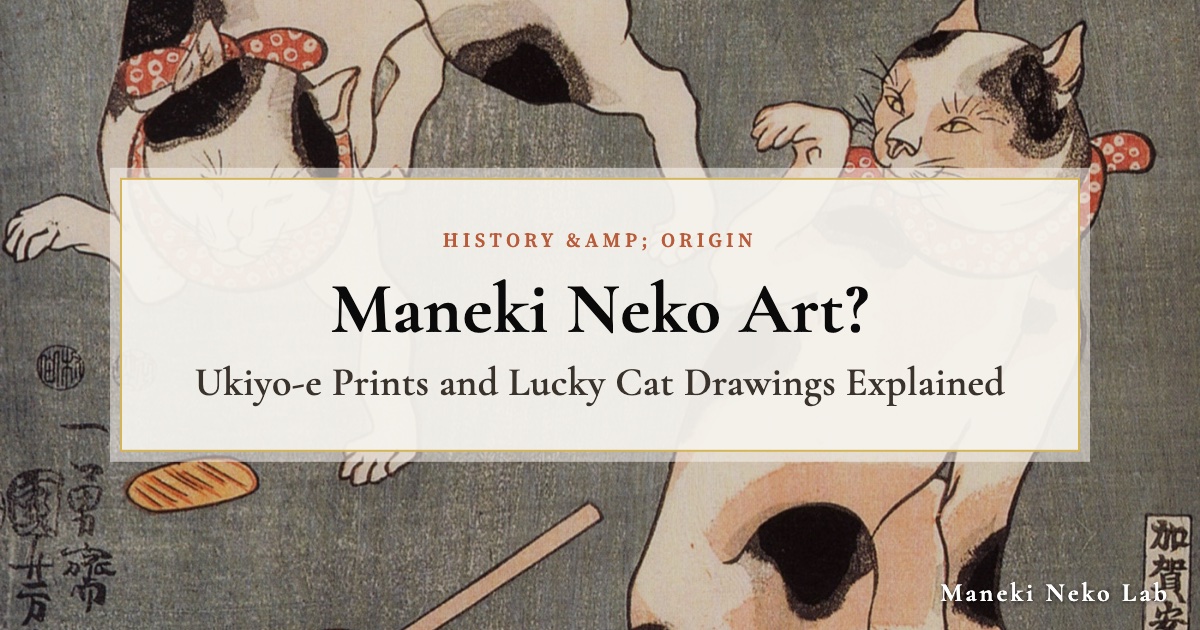
Old prints show how artists drew the cat in the Edo period (1603–1868). They give you poses, collars and coins to borrow.
Edo models for your drawing
- Hiroshige’s 1852 print shows a stall of small white cats
- Kuniyoshi’s cats wear bells, and one of his guests holds a koban
- Our art guide lists museum pages you can view online
Hiroshige, Kuniyoshi and the Edo Cat
The earliest known picture of maneki neko for sale is Utagawa Hiroshige’s print of 1852. The Edo-Tokyo Museum holds the set of seven sheets, and one stall in it shows rows of small white cat figures.
Utagawa Kuniyoshi, famous for his cat prints, supplies the details. His rat-chasing cat wears a bell, and in “Cats Cooling Off” a guest cat holds a koban.
Those details match steps 5 and 6, so a modern drawing repeats choices Edo artists made. Our guide to maneki neko art covers each work and where to view it online.
Frequently Asked Questions
Q. How do I draw a maneki neko with both paws up?
A. Repeat step 3 on both sides of the head, keeping the paws at a similar height. Move the koban to the front of the body or leave it out, since both paws are busy. In Maneki Neko Lab’s definition, a cat with both paws raised invites both money and people, and we do not read it as giving up.
Q. Can I use a lucky cat drawing as a tattoo design?
A. Yes. The same choices of paw, color and items apply, and a tattoo keeps that wish for years, so decide the wish first. A simple line drawing with the beckoning paw, bell and koban stays readable at small sizes. Ask your tattoo artist to keep the palm-down beckon so it does not look like a wave.
Q. Is it bad luck to draw a black lucky cat?
A. No. Maneki Neko Lab defines black as the color of protection from misfortune. In Japan the black cat also has a record as a healer: the Nihon Kokugo Daijiten records an Edo-period belief that keeping one cured tuberculosis. A black cat with a raised left paw, for example, pairs protection with inviting people.
Q. Can I give a lucky cat drawing as a gift?
A. Yes. A drawing suits a new shop, a new home or a friend starting a new job. Choose a left paw for a shop that wants customers, or white or calico for a wish that fits any occasion. A short note on the meaning helps a recipient outside Japan read it as a charm.
Luxen Maneki, Made by Maneki Neko Lab
Drawing a lucky cat shows how much one line of the eye changes the face. On porcelain there is no eraser, so every brushstroke is final.
Luxen Maneki is a brand of Japan ManekiNeko Research Institute, Inc., the company that runs Maneki Neko Lab. Its white Hanaikada (花筏), gold Nishikigoi (錦鯉) and black Ukiyo (浮世) are all Seto ware, one of Japan’s Six Ancient Kilns.
Unlike mass-produced figures, each piece is made to order over about four to six weeks, with gold hand-painted by artisans. It arrives in a paulownia wood box, and we ship worldwide.
Summary
A lucky cat drawing comes together in seven steps, from the head to the face. Start with the head, ears, raised paw and body, add the bib, bell and koban, and draw the face last. The two-heads-tall Tokoname shape is the easiest to begin with.
Choose the paw and colors by the wish. In Maneki Neko Lab’s definitions, a right paw invites money and a left paw invites people, while white and calico suit any wish.
To use the drawing as a charm, put it on a New Year card or near an entrance. For 2027 cards within Japan, post by December 27, 2026, for January 1 delivery (Japan Post, as of November 3, 2026).

