What You’ll Learn
- A red maneki neko stands for protection from illness
- Red charms against smallpox date back to the Edo period
- Red suits get-well wishes, children and older relatives
- Place it where the person you wish health for sees it daily
A red maneki neko (招き猫, “beckoning cat”) is chosen to keep illness away. Maneki Neko Lab defines red as the color of protection from illness, and a Tokoname kiln translates it as “Health.”
Of all the colors a lucky cat comes in, red has the longest history behind its meaning. In Edo Japan, red prints, red toys and red daruma dolls were all used as charms against smallpox.
This guide traces that history through Japanese dictionaries, museum records and Maneki Neko Lab’s interview with an ukiyo-e scholar. It also covers who chooses red, where to place a red cat and how to pair it with other colors.
What Does a Red Maneki Neko Mean?
In Japan, a red maneki neko is a charm against illness. It belongs with black among the colors that protect, while gold and pink invite good things in from outside.
Red maneki neko meaning
- Maneki Neko Lab defines red as protection from illness
- A Tokoname kiln and a collectors’ club both give red to health
- Feng shui ideas about red come from a separate, Chinese system
Maneki Neko Lab’s Definition of Color Meanings
Maneki Neko Lab sets one meaning for each color, and red is the color that guards the body. The full definition below shows where red sits among the others.
Maneki Neko Lab’s definition of color meanings
| Color | Maneki Neko Lab’s definition | How we see the color |
|---|---|---|
| White / Calico | Good fortune of every kind (the basic color for any wish) | White can take on any color, and calico is the most Japanese of cat coats; both invite good fortune without choosing a wish |
| Gold | Wealth and success at work | Gold, like a koban coin or bullion, invites money and the rewards of work and business |
| Black | Protection from misfortune | Black, which melts into the night, keeps misfortune away and protects you and your home |
| Red | Protection from illness | Red, long held to keep illness away, protects your body from sickness |
| Green | Health and long life | Green, the color of grass and young leaves, stands for vitality and a long, healthy life |
| Pink | Love and a good match | Soft pink, like cherry blossoms, invites love and good encounters |
| Yellow | Popularity (being liked and having people gather around you) | Bright yellow catches the eye and invites the luck of being liked by others |
| Blue | Learning (focus and good judgment) | Blue, like a clear sky or water, calms the mind and supports the focus and judgment needed to learn |
In our definition, red stands for protection from illness. Red has long been held to keep sickness away, and we keep that old meaning for the color.
Red is one of two protecting colors, along with black. Black keeps misfortune away from the home, whereas red keeps illness away from the body.
A wish for health also splits in two. Red holds the wish to be spared from illness, while green holds the wish to grow older in good health.
The wish we place in red reads, “May illness stay away, and may you live in good health.”
The definition is a guide for choosing a color, not a promise of good health.
How each color was defined, and how the nine colors compare, is covered in our color guide.

How Japanese Makers Describe Red
Japanese makers give red the same role of guarding health. Baigetsu Tomimoto Ningyoen, a kiln in Tokoname, a pottery town in Aichi Prefecture, lists red as kenko shofuku (健康招福), inviting good health.
Its English line is shorter. It reads “Red = Health,” next to “White = Happiness” and “Gold = Money.”
Source: Baigetsu Tomimoto Ningyoen, “About Maneki Neko”(招き猫について)
The Japan Maneki Neko Club, a collectors’ association, gives red to kenko choju (健康長寿), health and long life. Its Q&A lists this among the main color meanings, with white for overall good fortune.
Source: Japan Maneki Neko Club, “Maneki Neko Q&A”(招き猫Q&A)
The habit of giving each color one wish is newer than the red itself. Folklorist Yoshiyuki Iikura of Kokugakuin University told Maneki Neko Lab that giving each color a meaning is a recent practice, done the same way as for daruma dolls.
Folklorist Takanori Shimamura of Kwansei Gakuin University added that color meanings differ by region and era. So the lists vary, but red is the one color where old belief and modern lists point the same way.
Red in Feng Shui Is a Separate System
Advice such as placing a red lucky cat in the south comes from Chinese thought, not from Japanese maneki neko tradition. Many English shops mix the two without saying so.
In the Chinese Five Phases (wuxing), red belongs to fire, summer and the south. Japanese dictionaries on Kotobank record this link, and the classic Chinese character dictionary Shuowen Jiezi calls red “the color of the south.”
Japanese kilns and collectors’ lists give red a wish, not a direction. Maneki Neko Lab’s definition also holds that no direction is lucky or unlucky for a maneki neko, so we do not recommend one for a red cat.
The gold cat with a moving arm sold in Chinese shops is a related but separate figure, the zhaocai mao. Our comparison guide explains how the two differ.
Why Red Protects Against Illness in Japan
Red’s link with health grew out of Japan’s long fear of smallpox. People believed the god who spread the disease disliked red, so red became the color of charms for sick children.
Red against smallpox
- Smallpox was blamed on a god who was believed to dislike red
- Red prints, red toys and red daruma were used as charms
- The red collar on a maneki neko has a separate history in painting
Smallpox and the God Who Disliked Red
Smallpox, hoso (疱瘡) in Japanese, was among the most feared diseases before vaccination spread. Encyclopedia Nipponica says it was blamed on hosogami (疱瘡神), a god of smallpox.
Families tried to keep that god pleased or drive it out. The Heibonsha World Encyclopedia describes red paper wands set on a straw lid, treated as the god and left at the village edge with red rice.
Ukiyo-e scholar Noriko Okubo of Okayama University told Maneki Neko Lab why red mattered. In Edo-period folk belief, the smallpox god was thought to dislike the color red.
For that reason, she said, many toys and charms for children from the Edo period are red. Encyclopedia Nipponica gives the same belief under its daruma entry, so red worked as a shield for the child.
Source: Kotobank, “Hosogami”(疱瘡神): Heibonsha World Encyclopedia
Our guide to why cats are lucky in Japan covers other beliefs that shaped the maneki neko.
Red Prints and Red Toys Against Smallpox
Edo households used red prints and red toys as smallpox charms. Each one carried the same idea, a red figure standing between the child and the disease.
Hosoe (疱瘡絵) were woodblock prints made in red alone and pasted up to ward off smallpox. Two Japanese dictionaries say they showed strong figures such as Shoki the demon queller, the archer Minamoto no Tametomo and Momotaro the peach boy.
Akamono (赤物, “red things”) are dolls and toys painted red all over. The Saitama Prefectural Museum of History and Folklore explains that they were bought to wish for children to grow up free of illness.
Saitama Prefecture lists the craft in Konosu, a city in Saitama, as a nationally designated intangible folk cultural property. Its red lions and dolls spread widely as smallpox charms for children.
Source: Saitama Prefecture, “Important Intangible Folk Cultural Properties”(重要無形民俗文化財)
Red charms against smallpox in Japan
| Charm | What it is | How it was used |
|---|---|---|
| Hosoe (疱瘡絵) | Woodblock print in red alone | Pasted up as a charm, showing strong heroes |
| Akamono (赤物) | Red-painted toy of sawdust paste | Bought for children to grow up free of illness |
| Akabeko (赤べこ) | Red papier-mache cow from Aizu, Fukushima | Given as a smallpox charm and for child-raising |
| Red horned owl | Red figure with large ears | A charm for keeping good hearing after smallpox |
| Red daruma | Red-robed tumbling doll | Set by a sick child’s pillow |
Okubo keeps a red horned owl on hand. She explained that smallpox often left people hard of hearing, so the owl’s ears were made large in the hope of keeping good hearing.
Red Daruma and the Red Maneki Neko
The red daruma shows how a lucky charm took on red for health. Takasaki City in Gunma Prefecture explains that Edo people bought red daruma during smallpox outbreaks, since red was believed to drive evil away.
The city adds that the dolls are said to have been set by children’s pillows. Encyclopedia Nipponica gives the same account, calling it a folk belief that smallpox disliked the color red.
The two charms differ in their base color. Red is the standard color of a daruma, while the Japan Tourism Agency describes the classic maneki neko as a white, black and orange calico.
So for a maneki neko, red is a color chosen on purpose for one wish. Our daruma guide compares the two charms in full.
The Red Collar on a Maneki Neko
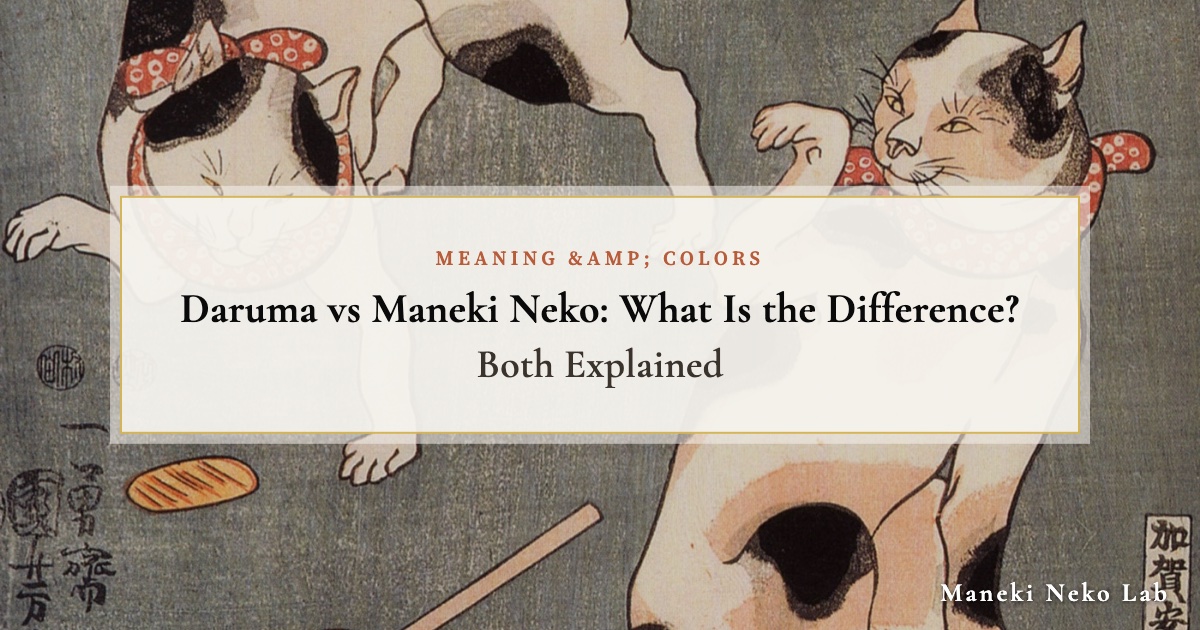
Most maneki neko wear a red collar, and it has its own history. Okubo traces it to the karaneko, cats brought from China that Heian nobles kept on cords.
The Tale of Genji gives the cord no color. Okubo noted that in paintings of its cat scene from the Kamakura period on, the cord is almost always red.
Paintings of court life became popular again in the Edo period. Okubo sees that habit of the red cord behind the red collar on the maneki neko, adding that cats in Chinese paintings wear no cord.
In Maneki Neko Lab’s definition, a collar stands for a lasting bond between the cat and the home that welcomes it. Its red follows our color definition, so a red collar joins that bond with protection from illness.
Who Chooses a Red Maneki Neko?
A red cat suits anyone whose main wish is someone’s health. The paw then adds a second wish, such as money or people.
Who red is for
- A get-well gift, or a home with small children or older relatives
- Not a substitute for medical care or prevention
- A right paw adds money, a left paw adds people
Wishes That Fit a Red Cat
Red fits a wish to keep illness away from someone close. In Maneki Neko Lab’s view, it suits these cases:
- A get-well gift for a family member or friend
- A home with small children or older relatives
- A season or year when you tend to fall ill
The smallpox charms were bought for children, and today the same wish often reaches the whole family. A red maneki neko is a way of keeping that wish in sight, never a substitute for medical care or prevention.
Red also appears at a 60th birthday in Japan, called kanreki (還暦). The Heibonsha World Encyclopedia explains that relatives give red clothing because the person is thought to be born again.
That red carries a meaning of rebirth, not protection from illness. A red cat can still join a kanreki gift, with a note that its red is a wish for good health. Our gift guide covers occasions, paws and messages.
Pick the Paw for Your Wish
In Maneki Neko Lab’s definition, the paw carries a wish of its own, apart from the color. A red cat with a raised right paw pairs health with money, and a left paw pairs it with people.
Maneki Neko Lab’s definition of paws
| Paw | Maneki Neko Lab’s definition |
|---|---|
| Right paw | Money luck (invites money) |
| Left paw | Inviting people (customers and connections) |
| Both paws | Invites both money and people |
For a home, a left-pawed red cat fits a wish for health and for visitors and friends to keep coming. For a shop owner, a right paw adds the wish for business to stay healthy as well.
A cat with both paws raised holds both wishes at once. The Lab reads it as inviting money and people together, not as a gesture of giving up.

Where to Put a Red Maneki Neko
Put a red cat where the person you wish health for will see it every day. No compass direction is needed in our definition.
Placing a red cat
- The Lab’s basic spot is an entrance you pass every day
- Red charms once sat by a sick child’s pillow
- Pair red with a second color for a second wish
Maneki Neko Lab’s Placement View
Maneki Neko Lab’s placement definition starts from an entrance where people and fortune come in. Face the beckoning paw toward the people coming through the door.
The definition also asks for a place you see every day. For a red cat, that can be a shelf in the room where a family member spends the day, since the wish is about that person.
History offers a precedent. Red daruma for smallpox were set by a child’s pillow, close to the person they were meant to guard.
The Japan Maneki Neko Club notes that there is no fixed rule for display. In its account, people once set a cat in a slightly raised spot and offered water, so a clean, raised shelf keeps to that older habit.
Rooms, shops, facing and spots to avoid are covered in our placement guide.

Pair Red With Other Colors
A second cat in another color lets one display hold two wishes. Red pairs well with colors whose wishes sit next to health.
Pairing red with other colors (Maneki Neko Lab’s suggestions)
| Occasion | Combination | Idea |
|---|---|---|
| Exams | Blue + Red | Support focus in study and protect health before the big day |
| Milestone birthday | Green + Red | Grow older in good health and keep illness away |
| New home | Black + Red | Keep misfortune from the home and illness from the family |
| Any new start | White or Calico + Red | Invite good fortune of every kind and guard health |
In Maneki Neko Lab’s definition, two cats can also split their wishes by paw. No number of cats is lucky or unlucky, so you can welcome as many as you have wishes.
Too many cats in one spot can blur what each one is for. Our size and number guide explains how to combine number, paw and height.
Once you know where the cat will sit, you may wonder what size suits a shelf by someone’s bed or desk. Luxen Maneki, a brand of Japan ManekiNeko Research Institute, Inc., the company that runs Maneki Neko Lab, makes cats about 9 cm tall in Seto ware, in white, gold and black.
Red also protects against illness in Aizu’s famous red cow toy.
Red is also the color of kanreki, Japan’s 60th birthday. See the custom here:
Wishing someone a quick recovery? See Japanese get well gifts and what to avoid:
Frequently Asked Questions
Q. Does a red lucky cat mean love?
A. Not in Japan. Some English guides give red to love or passion, but the Japanese kiln and collectors’ lists in this guide give red to health. In Maneki Neko Lab’s definition, red stands for protection from illness, and the color for love and a good match is pink.
Q. Is a red lucky cat Japanese or Chinese?
A. The red maneki neko and its meaning come from Japan, where red is linked to charms against smallpox and to health. The waving zhaocai mao of Chinese shops is a related but separate figure. Readings tied to the Five Phases or feng shui come from Chinese thought, so Maneki Neko Lab keeps them separate from its Japanese definition.
Q. Is a red maneki neko a good get-well gift?
A. Yes. Red carries the wish for illness to stay away, which fits a get-well gift for family or friends. A short note on the Japanese meaning helps the recipient read it as a wish, not a cure. A small cat suits a bedside table or shelf.
Q. What should I do when a red maneki neko is no longer needed?
A. You can keep it as thanks once the illness has passed, or let it go with gratitude. In Maneki Neko Lab’s view, the meaning lies in the wish, not in the figure itself. For a cat from a temple, follow the guidance of that temple.
Luxen Maneki, Made by Maneki Neko Lab
A red cat is often chosen for someone else, so it helps to know where and by whom a gift was made. Many cats sold in shops say little about their maker.
Luxen Maneki is a brand of Japan ManekiNeko Research Institute, Inc., the company that runs Maneki Neko Lab. It makes the white Hanaikada (花筏), the gold Nishikigoi (錦鯉) and the black Ukiyo (浮世) in Seto ware, one of Japan’s Six Ancient Kilns.
Unlike mass-produced figures, each piece is made to order over about four to six weeks, with gold hand-painted by artisans at a traditional kiln. It arrives in a paulownia wood box, and we ship worldwide.
Summary
A red maneki neko is a charm to keep illness away, and Maneki Neko Lab defines red as the color of protection from illness. A Tokoname kiln and a collectors’ club also give red to health.
The meaning rests on real history. Edo Japan used red prints, red toys and red daruma against smallpox, because the smallpox god was believed to dislike red.
To choose your own, pick the paw for your second wish, then place the cat where the person you wish health for sees it every day.

