Why does the maneki neko (招き猫, beckoning cat) look the way it does? Why does it raise a paw, why is it so round, and why is it smiling?
This interview was conducted in Japanese and translated by Maneki Neko Lab. Read the original Japanese interview.
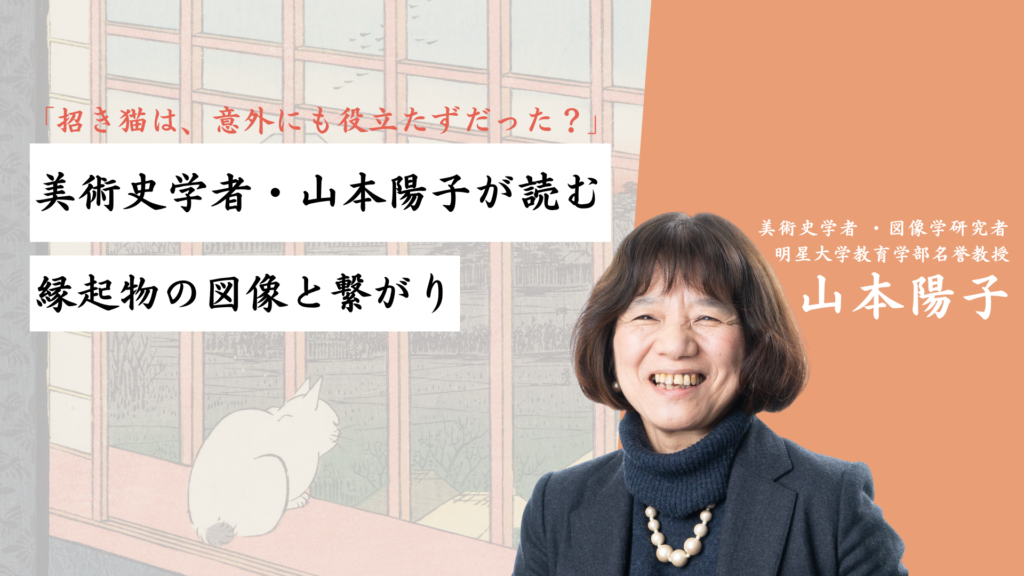
Yoko Yamamoto, who has studied engimono (縁起物, Japanese good-luck objects) from the perspective of art history and iconography, puts it this way: “The cuteness of the maneki neko and its function as a good-luck object may actually be two separate stories.”
Starting from her research on the iconography of Daikokuten and Ebisu, Yamamoto has traveled across the world of good-luck objects. We asked her about the “system of meaning” that spreads out around the maneki neko. Tracing the roles these objects have played, and the human nature that has kept needing them, the journey deepens in unexpected directions.
Chapter 1: Good-Luck Objects as a “Window” — What It Means to Connect with the Otherworld

From Daikokuten Research to the World of Good-Luck Objects
Yamamoto’s research did not begin with the maneki neko.
Her original specialty is the iconography of Daikokuten and Ebisu. As she dug deeper into Daikokuten (大黒天, a god of wealth and plenty), her view naturally widened to the good-luck objects around him: Fukusuke (福助, a big-headed figure of good fortune), the Seven Lucky Gods such as Ebisu and Daikoku, and the maneki neko.
As her words “There was nothing for it, so I swept them all up and researched them” suggest, once you chase one thing for your research, it always leads to something else. That is the nature of the world of good-luck objects.
When I was working on this (Daikokuten), I had no intention of doing cats. To be honest, while I was looking into Daikokuten, I found I needed to look into all the good-luck objects around him too, and that is where the maneki neko got caught in my net.
Yoko Yamamoto
In the world of good-luck objects, pull one thread and another comes out. Follow Daikokuten and you see Ebisu. Follow Ebisu and you see Fukusuke, and eventually it all connects to the maneki neko. Within that chain, though, Yamamoto has found a shared structure: a “grammar of images.”
A “Small Body” Is Not About Height — Iconographic Signs of the Otherworld
To read good-luck objects correctly, you need to know the “codes of meaning” in their forms.
Take Daikokuten’s short, stocky build. Many people may take it simply as “a somehow charming shape.” From the viewpoint of art history, however, its meaning changes a great deal.
Daikokuten’s small body is not about physical height. That shape is actually an iconographic sign that he is “a being who came from the otherworld”
Yoko Yamamoto
Beings from the otherworld have often been depicted with bodies unlike those of humans. An oversized head, short arms and legs, a strange expression: these are agreed-upon codes that tell us the figure “came from a place not of this world.”
The intuition that a good-luck object looks “somehow out of the ordinary” is not so far off the mark. Meaning has been built into its form.
When a Useless Being Becomes a Good-Luck Object
Seen through the same “aesthetics of the unusual form,” Fukusuke is an easy example to understand.
Fukusuke has an abnormally large head and a strange appearance. Ordinarily you would think of him as an odd being, right? But that very shape became the talk of the town, and he ended up becoming a popular figure
Yoko Yamamoto
The same goes for Issun-boshi (一寸法師, the “one-inch boy” of Japanese folktale). His smallness, “only one sun (about 3 centimeters) tall,” is of no practical use at all (he would presumably have a hard time doing any work), yet it gives him reality as “a being who came from the world over there (the otherworld).”
Come to think of it, this is strange. Fukusuke, Daikokuten, Issun-boshi: they all sit a little apart from “usefulness” in the everyday sense. Even so, or perhaps precisely because of that, people have cherished them as good-luck objects.
It is “useless things” that have been enshrined as “things that bring good luck,” and loved. Yamamoto says this paradox may reveal the essential structure of good-luck objects.
When we look at the maneki neko again from that angle, the meaning of the question “Was the maneki neko surprisingly useless?” gradually comes into view.
Chapter 2: Where Did the Maneki Neko’s “Cuteness” Come From?

The Bond Between the Japanese and Cats, Dating Back to the Heian Period
One of the texts showing that cats lived in Japan and were loved by emperors and aristocrats is The Pillow Book (枕草子, Makura no Soshi) by Sei Shonagon.
In Section 9 there is a passage that begins, “The cat that serves in the imperial palace…” Emperor Ichijo had a cat he treasured, and that cat was chased by a dog and became frightened. So the dog was driven away, and then the dog came back all bedraggled, and everyone felt sorry for it… That is the story
Yoko Yamamoto
This was about a thousand years ago. It shows how dearly the aristocrats of the time cherished cats. This cat was called “Myobu no Otodo,” and was treated with great courtesy at court.
Back then, however, cats were not easy-to-get pets like today’s Japanese cats. They were “karaneko” (唐猫, “Tang cats”) imported from China: expensive cats brought over from Tang China, much like Persian or Siamese cats today. That is exactly why they were so precious.
They were not left to roam free. They were kept on leashes and treasured
Yoko Yamamoto
Karaneko were doted on in aristocrats’ rooms, given names, and had their doings recorded. They were treated, in effect, as “living treasures.” Even counting only what is on record, the relationship between the Japanese and cats goes back more than a thousand years.
From Tang Cats to Commoners’ Cats — How Cats Came Down Among Ordinary People
As the centuries passed, cats went from being the exclusive property of aristocrats to entering the lives of ordinary people.
Cats stopped being kept on leashes after the “Cat Release Order” of Keicho 7 (1602). With the prosperity of Kyoto after the Sengoku (Warring States) period ended, mice and rats increased too, and as a countermeasure the Kyoto Shoshidai (the shogunate’s governor of Kyoto) ordered that cats be allowed to roam free.
Yoko Yamamoto
By the Edo period, cats were already living all over the cities. They wandered the alleys of the nagaya (row houses), gathered in front of fish shops, and blended deeply into people’s daily lives.
Cat pictures also became fashionable in the Edo period. Utagawa Kuniyoshi and other artists left many ukiyo-e prints starring cats. The sheer number of surviving pictures tells us how much people of the time loved cats.
Out of this accumulated “cat culture” came the form of the “beckoning cat”: a cat sitting with a raised paw, round and lovable. When, and by whom, that form was first made is still debated, and its origin has not been settled.
What is certain, though, is that this form was nurtured within the popular culture of Edo.
Cats spread through Japan beginning with the imported karaneko, and the affection for cats that took root in Japanese culture over many years crossed paths with the good-luck culture of the Edo period, giving birth to a uniquely Japanese good-luck object.
“Cuteness” and Good Luck — Actually Two Separate Stories
Here, however, Yamamoto quietly raises a question. Perhaps the affection for cats and the emergence of the maneki neko as a good-luck object are not necessarily directly linked.
You often hear the explanation that the maneki neko was born because cats are cute. But I think that cuteness and the function of a good-luck object are separate stories.
Yoko Yamamoto
Indeed, cats being cute and cats bringing good luck are, logically, separate matters. Cute things do not always become good-luck objects, and good-luck objects do not always have cute forms.
Then why was the cat chosen as a good-luck object?
One way of seeing it is the structure touched on in Chapter 1: “useless things” become good-luck objects. Cats are certainly cute. At the same time, a cat does not guard the house like a dog, nor carry loads like a horse.
Cats do catch the mice that gnaw on rice and books, but that meant little to Edo townspeople, who lived by the motto “never keep money overnight” and had few savings or stores to protect. In terms of practical “usefulness,” the cat is in a sense a “useless” being too.
Perhaps that very attribute of “uselessness” was what made people sense a connection to the otherworld. This is the viewpoint behind Yamamoto’s question.
Cuteness and good luck seem to overlap, but they are actually made of different threads. How those two threads crossed to become the form we call the maneki neko remains one of the unsolved mysteries.
What Makes Japanese “Kawaii” Unique
The uniquely Japanese concept of “kawaii” also raises an interesting question in this context. It is a sensibility clearly different from the English word “cute”: something a little round, a little out of proportion, with a presence that is somehow out of the ordinary.
I think the reason Japanese “kawaii” came to exist as an English word is that people over there felt, “This is something different from cute.” It is a uniquely Japanese sensibility, isn’t it?
Yoko Yamamoto
If “cute” is a word that simply describes how lovable something is, “kawaii” includes a certain “otherness” or “unordinariness” carried by the form.
Large eyes, a body only a few heads tall, a rounded outline far removed from reality: seen through art history, these overlap with the iconographic codes that signal “beings of the otherworld.” The form of the maneki neko and the context of kawaii may in fact be connected at a deep level.
What is interesting is that the kawaii sensibility spread around the world only in the last few decades, while the history of that sensibility growing in Japan is far longer.
Just as the image of bushido and the samurai has been received abroad as “Japanese cool,” kawaii too is a concept that cannot be separated from its “Japanese” context.
That something people abroad sense as “different from cute”: Yamamoto’s words quietly point to what that “difference” really is.
Karako — A Distant Source of Japanese Kawaii
Trace kawaii back to its source and you arrive at a Chinese mode of expression called “karako” (唐子, “Chinese children”).
Karako are pictures of big-headed children painted in China. A big head, round eyes, a plump body: it is an image of a top-heavy, lovable child, somewhat like a Kewpie doll (said to be modeled on Cupid, the god of love).
China also has a mode of expression depicting children, called karako. But when it comes to cuteness, I feel that Japanese kawaii ended up spreading around the world first
Yoko Yamamoto
Japan has received a great deal of cultural influence from China. Writing, painting techniques, the images of gods and buddhas: much of it came from China.
When it comes to the sense of “kawaii,” however, Japan developed it in its own direction, until it became powerful enough to be exported back to the world.
If karako stayed at “depicting the cuteness of children,” Japanese kawaii went further, transforming into an odd beauty within everyday life, a lovableness out of the ordinary.
The maneki neko’s round eyes and round body could be called one of the forms born at the end of that transformation.
Yamamoto repeats, though: “That is purely a matter of cuteness. Its function as a good-luck object probably lies somewhere else.”
That question has not yet been answered. And perhaps that is exactly why the maneki neko keeps drawing in so many people.
Chapter 3: National Seclusion Was the “Vessel” That Raised the Maneki Neko

Why Edo Culture Blossomed
Why did good-luck culture, the maneki neko included, grow so richly in the Edo period?
One part of the background is the system of national seclusion (sakoku, 鎖国). With outside influence limited, culture from China came in little by little through the Nagasaki route. Japan was not completely isolated, but it was not constantly exposed to outside cultures either. In that environment, a uniquely Japanese culture quietly grew.
In countries that share land borders, culture is easily forced on you by your neighbors. But Japan is an island nation, and it was also secluded. So even when told “that’s wrong,” it was hard to shake
Yoko Yamamoto
Countries connected by land to a continent are constantly exposed to their neighbors’ cultures and keep facing pressure to be measured against them. That the culture of the Korean Peninsula was more strongly influenced by China is not unrelated to the geopolitical condition of sharing a land border.
An island nation separated by the sea is different. Even when someone outside says, “That is wrong,” it rarely gets through.
A Unique Culture Born of Being an Island Nation
“Much of the culture that reached Japan started in China. Writing, pictures, ways of painting. But precisely because Japan is an island nation, all of that matured in its own way.”
The writing, painting techniques and forms of the gods that came from China all went through repeated, independent maturing within the island nation of Japan.
The cat, which arrived in Japan as a precious import called karaneko, eventually blended into the lives of ordinary people and transformed into the maneki neko as a good-luck object. That, too, is part of this maturing process.
The maneki neko is an original Japanese good-luck object, born when cats took root in Japan, met Japan’s good-luck culture, and grew out of the soil of the Edo period.
In Edo, where merchants and townspeople carried the culture, demand for good-luck objects grew, tied in with the world of the pleasure quarters and geisha.
Within the “vessel” of national seclusion, Japan’s good-luck culture, though it faced outside pressure, was never swallowed up by it and grew to a depth all its own.
Chapter 4: Clinging to Good Luck — It Is Human Instinct

“I Want Something to Cling To” — A Feeling Shared Around the World
Wishes placed in good-luck objects are not unique to Japan.
Praying at a shrine the day before an exam. Buying an omamori (お守り, protective charm) before a trip. Wearing something lucky on an important day. These are not things only especially devout people do.
People reach for good-luck objects “just in case” or “for no particular reason.” Even knowing there is no scientific basis for it, somehow it calms the mind.
All over the world, people look for something that makes them feel positive, something that reassures them. That has not changed, then or now
Yoko Yamamoto
Good-luck objects give a shape to that “clinging.” They turn invisible anxiety into a visible form, into something you can carry, something you can display. And by doing so, they settle the heart a little.
The Japanese maneki neko, Western lucky charms, Chinese good-luck objects: their cultures and forms differ, but the human psychology at their root is the same. You could say the feeling of “wanting something to cling to” has endured as a human instinct, across eras and borders.
Between This World and the Next, Values Are Reversed
Here emerges one of the most interesting viewpoints Yamamoto offers.
As mentioned earlier, good-luck objects are “windows connecting to the otherworld.” Daikokuten’s unusual body and Fukusuke’s big head both point to a connection with “the world over there,” such as Ryugu (竜宮, the undersea Dragon Palace of Japanese folklore). So what kind of place is “the world over there”?
The idea that values are reversed between the next world and this one comes up again and again in folktales. That is what I find most interesting right now
Yoko Yamamoto
First, we heard one story. A variant of Hanasaka Jiisan (花咲爺さん, “The Old Man Who Made the Trees Blossom”) tells of a dog an old man received from Ryugu. When he brings it home, his wife says to the dog, “What a useless dog.”
Then one day the dog poops, and the poop is a lump of gold. The thing thought to be the dirtiest turns into the thing of greatest value.
This is the typical structure of “the reversal of values between the next world and this one.”
“In the next world, the common sense of this world does not apply. The dirtiest thing becomes the most precious gold. Between the next world and this one, values are reversed.”
Then another story. A woman who married a man from another world brought gold koban (小判, oval gold coins) as her dowry. But her husband threw the coins at birds. When the startled woman demanded an explanation, he answered:
“He said, ‘If you go out back behind our house, there are piles of these things.’ In the next world, gold, the most valuable thing in our world, is treated the same as the pebbles used to hunt birds.”
Putting the structure these two stories share in order: what is useless in “this world” (the dog’s poop) is the most valuable thing in “the world over there.” Conversely, what is most valuable in “this world” (gold koban) is no different from pebbles in “the world over there.”
The value system itself is completely reversed depending on which world you are in.
Good-luck objects are beings that connect the next world and this one. Seen that way, there is a kind of inevitability in “useless things” being enshrined as good-luck objects. Placed at the border with the otherworld, good-luck objects carry something that cannot be measured by this world’s logic of “usefulness” alone.
Perhaps it is only within this context that the question “Was the maneki neko surprisingly useless?” can be read in depth.
Chapter 5: Toward the Question an Art Historian Finds Most Interesting Now

The Question “What Is the Value of Things?”
The theme of “the reversal of values between the next world and this one” eventually leads to the fundamental question “What is the value of things?”
When you really think about it, gold is useless. It is soft for a metal, and all it does is sparkle. But it has value because everyone says it is important
Yoko Yamamoto
It is true: you cannot eat gold. It is too soft to make weapons or tools. Apart from being rare, it has little practical use as a material. Even so, for thousands of years humankind has treated gold as the most valuable thing of all.
Pearls are the same. Once extremely precious, they changed in rarity with the development of pearl farming. In China, it is said, pearls were special treasures precisely because there was little sea, and even ones that were not very beautiful were carefully set into crowns.
Among Heian-period depictions of the Pure Land paradise (the world over there), there is a poem in which the ground is made of jewels and celestial beings throw jewels to catch birds. In the next world, jewels are no different from pebbles. People long ago were thinking the same thing: what is value, really?
If there were an enormous amount of it, even gold would become a useless substance that just gets in the way. Maybe the same goes for jewels. What is the value of things, anyway? It is a mystery, isn’t it?
Yoko Yamamoto
Continuing to Pursue “the Border Between This World and the Next”
When we asked Yamamoto which theme interests her most right now, this was her answer.
What I find most interesting right now is the idea, probably held in the old days, that the positions of things and living creatures are reversed between the next world and this one. I am still thinking about how to investigate it from here
Yoko Yamamoto
Strangely enough, the study of good-luck objects reaches out to all sorts of questions: the essence of the value of things, the structure of the human mind, the formation of culture. Chasing a small figurine called the maneki neko eventually leads to the question “Why do humans believe in things?”
“At first, the maneki neko was simply something that got caught in my net as one of many good-luck objects. But as I chased it, it kept getting deeper along with my thinking.”
Yamamoto, who has long studied good-luck objects from the standpoint of art history and iconography, will keep exploring this theme. What lies ahead? Within the work of studying good-luck objects, discoveries no one has noticed yet may be waiting.
“What I thought was just a cute, lucky figurine has a solid system of meaning.” By the time you finish reading this article, the maneki neko in your room may look a little different to you.